Countries by Internet Price, 2026
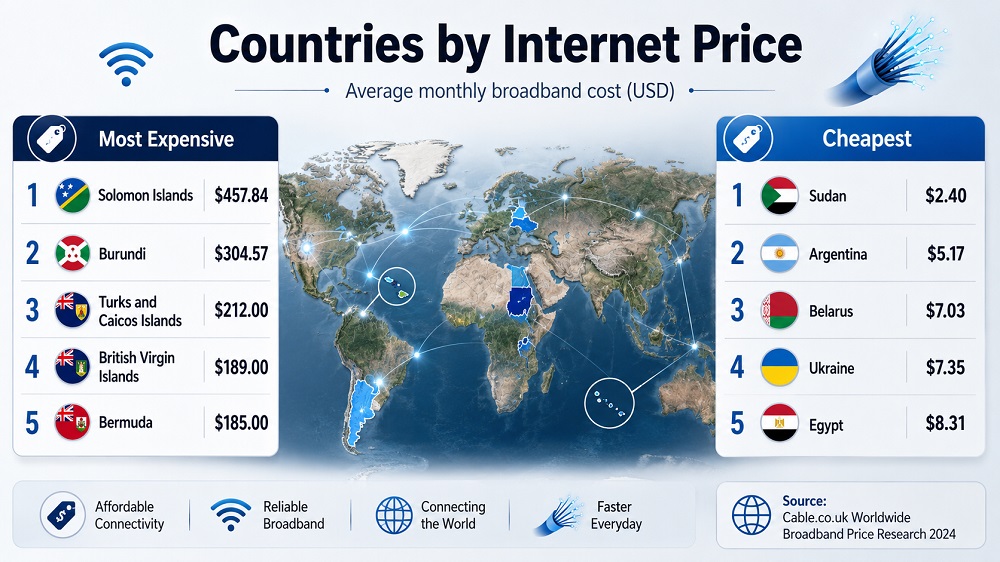
50 lowest fixed broadband internet prices by country
This ranking compares countries and economies by the monthly price of an entry-level fixed-broadband internet basket. The measure standardizes a basic fixed-broadband offer across markets, which makes it more comparable than individual retail plans, temporary discounts or premium fiber packages.
The numeric table is a 2024 data snapshot prepared for the 2026 publication cycle. Values are current US dollars per month and come from a country-level Statbase table based on ITU-series fixed-broadband basket observations. Under the ITU basket definition used from 2018 onward, the entry-level fixed-broadband basket is the cheapest plan from the largest fixed-broadband operator that provides at least 5GB of monthly high-speed data at 256 kbit/s or higher.
Price is not the same as affordability. A low dollar price can still be expensive relative to local income. The interpretation below therefore separates nominal monthly cost from affordability, which is usually assessed as the basket price divided by monthly GNI per capita.
Syrian Arab Republic has the lowest monthly fixed-broadband basket price in this 50-market ranking.
Montenegro closes the list, showing that the lower end of the global dollar-price distribution is tightly grouped.
The source-table global average is well above all entries in this low-price group.
Entry-level fixed-broadband basket, current US dollars per month; 2024 observations used as the 2026 snapshot baseline.
What the internet price ranking measures
The indicator measures the monthly price of a standardized entry-level fixed-broadband service. It is not an average household bill, not a mobile-data price, not a speed-quality ranking and not a measure of unlimited fiber availability. Its purpose is to make basic fixed-broadband prices more comparable across countries.
The ranking is most useful for identifying where basic fixed broadband is priced low in dollar terms. It should be read together with affordability indicators, service quality, coverage, competition and household income. A $6 plan in a lower-income country and a $60 plan in a high-income country can represent very different burdens for households.
Top 10 countries by lowest fixed broadband basket price
The upper part of the ranking is concentrated in Asia and Africa. Several South Asian, East Asian, Western Asian and African markets appear among the lowest nominal prices. These values show low dollar-denominated basket prices, not universal broadband affordability or equal service quality.
| Rank | Country / economy | Region | USD/month |
|---|---|---|---|
| 1 | Syrian Arab Republic | Asia | $0.59 |
| 2 | Yemen | Asia | $0.98 |
| 3 | Sri Lanka | Asia | $2.43 |
| 4 | Bangladesh | Asia | $2.51 |
| 5 | Belarus | Europe | $3.38 |
| 6 | Egypt | Africa | $3.84 |
| 7 | Zambia | Africa | $3.85 |
| 8 | Tanzania | Africa | $3.87 |
| 9 | Libya | Africa | $4.12 |
| 10 | China | Asia | $4.14 |
Values are fixed-broadband basket prices in current US dollars per month. They do not measure mobile-data prices, speed, reliability or coverage.
Chart: lowest fixed broadband basket prices in the Top 20
The lowest twenty entries range from $0.59 to $6.97 per month. The first two entries sit below $1, while most of the remaining Top 20 forms a wider low-price band between roughly $2.40 and $7.00. The chart compares nominal basket prices only; affordability still depends on income, coverage and service quality.
Methodology
The ranking uses the entry-level fixed-broadband basket expressed in current US dollars per month. Countries and economies are sorted from the lowest monthly basket price to the highest among the 50 lowest-price entries available in the source table.
Ranking logic
Rank 1 is the lowest monthly fixed-broadband basket price in USD. Equal values would be left as separate rows rather than merged.
Data year
The table uses 2024 country observations as the practical baseline for a 2026 publication-cycle snapshot.
Unit and rounding
Values are current US dollars per month and are shown to two decimal places where decimals are available.
Affordability formula
Affordability burden = monthly basket price / monthly GNI per capita × 100. This page ranks dollar prices, not affordability burden.
The basket is a standardized price indicator rather than a full market audit. It does not show every provider plan, promotional price, router fee, installation charge, regional price, actual speed, service reliability or rural availability. Dollar-price comparisons are also affected by exchange rates. For household access analysis, the same basket should be compared with income-based affordability measures and broadband coverage data.
The source hierarchy is separated deliberately: ITU documentation is used for basket methodology and institutional context; World Bank Data360 is used to verify the indicator definition and available units; the country-level USD/month values in this table come from the Statbase ITU-source table used for this snapshot. Fixed broadband and mobile broadband are different services and are not merged in this ranking.
Full ranking: 50 lowest fixed broadband basket prices
The table lists the 50 countries and economies with the lowest fixed-broadband basket prices in the source snapshot. The controls search, filter or reorder existing rows; all country rows remain written directly in the HTML table.
| Rank | Country / economy | Region | USD/month |
|---|---|---|---|
| 1 | Syrian Arab Republic | Asia | $0.59 |
| 2 | Yemen | Asia | $0.98 |
| 3 | Sri Lanka | Asia | $2.43 |
| 4 | Bangladesh | Asia | $2.51 |
| 5 | Belarus | Europe | $3.38 |
| 6 | Egypt | Africa | $3.84 |
| 7 | Zambia | Africa | $3.85 |
| 8 | Tanzania | Africa | $3.87 |
| 9 | Libya | Africa | $4.12 |
| 10 | China | Asia | $4.14 |
| 11 | Eswatini | Africa | $5.12 |
| 12 | Lebanese Republic | Asia | $5.21 |
| 13 | Lesotho | Africa | $5.33 |
| 14 | India | Asia | $5.64 |
| 15 | Bhutan | Asia | $5.98 |
| 16 | Russian Federation | Europe | $6.07 |
| 17 | Myanmar | Asia | $6.19 |
| 18 | Romania | Europe | $6.49 |
| 19 | Vietnam | Asia | $6.82 |
| 20 | Fiji | Oceania | $6.97 |
| 21 | Afghanistan | Asia | $7.08 |
| 22 | Moldova | Europe | $7.09 |
| 23 | Ghana | Africa | $7.28 |
| 24 | Tajikistan | Asia | $7.38 |
| 25 | Azerbaijan | Asia | $7.65 |
| 26 | Uzbekistan | Asia | $7.82 |
| 27 | Papua New Guinea | Oceania | $7.86 |
| 28 | Nepal | Asia | $7.87 |
| 29 | Venezuela | Americas | $7.94 |
| 30 | Saudi Arabia | Asia | $8.00 |
| 31 | Lao PDR | Asia | $8.23 |
| 32 | Sudan | Africa | $8.32 |
| 33 | Kyrgyz Republic | Asia | $8.51 |
| 34 | Iran | Asia | $8.77 |
| 35 | Cape Verde | Africa | $8.78 |
| 36 | Pakistan | Asia | $8.88 |
| 37 | Kazakhstan | Asia | $8.93 |
| 38 | Taiwan Province of China | Asia | $8.96 |
| 39 | Croatia | Europe | $9.05 |
| 40 | Hungary | Europe | $9.07 |
| 41 | Guinea | Africa | $9.40 |
| 42 | Mongolia | Asia | $9.47 |
| 43 | Ukraine | Europe | $9.79 |
| 44 | Morocco | Africa | $9.89 |
| 45 | Nigeria | Africa | $10.57 |
| 46 | Ethiopia | Africa | $10.62 |
| 47 | Mauritius | Africa | $10.69 |
| 48 | Kosovo | Europe | $10.76 |
| 49 | Algeria | Africa | $11.90 |
| 50 | Montenegro | Europe | $12.55 |
No matching rows found.
Source snapshot: ITU-series fixed-broadband basket values for 2024, compiled for the 2026 article cycle on May 30, 2026. Values are current US dollars per month.
Key insights from the internet price ranking
Low dollar prices cluster in emerging markets
The upper part of the low-price ranking contains many Asian and African markets. Low headline prices can reflect lower local operating costs, competitive entry-level plans, regulated tariffs or exchange-rate effects. They do not automatically prove that broadband is affordable for every household.
Europe appears in the middle of the low-price group
Belarus, Romania, Moldova, Croatia, Hungary, Ukraine, Kosovo and Montenegro show that some European markets sit far below the source-table global average in dollar terms. Dense urban networks and strong fixed-line competition can help keep entry-level tariffs low.
The Top 10 has two values below $1, followed by a broader cluster between roughly $2.40 and $4.20. That gap matters: ultra-low nominal prices are unusual, while prices between $4 and $10 are more common among the 50 lowest listed markets.
The lower part of the ranking, from Nigeria through Montenegro, remains well below the $30.14 global average shown in the source table. Those countries are not expensive in nominal global comparison, but the practical burden depends on income, installation costs, household budgets and whether the entry-level fixed-broadband plan is widely available outside major cities.
What internet prices mean for readers
For households, a low fixed-broadband basket price can make home connectivity more reachable, especially where several providers compete for basic plans. The real consumer question is broader: whether the plan is available in the user’s area, whether speed is stable, whether installation is affordable and whether the monthly price fits local income.
For businesses, low entry-level broadband prices can support remote work, small online services, cloud tools and digital payments. Business-grade connectivity may still cost much more than the consumer basket when service-level guarantees, static IPs, higher upload speeds or backup links are required.
For analysts and policymakers, the ranking is a starting point for digital inclusion analysis. The same country should be checked against broadband coverage, competition rules, infrastructure investment, household income and the Broadband Commission affordability benchmark of entry-level broadband services priced below 2% of monthly GNI per capita in low- and middle-income countries.
FAQ
Which country has the cheapest fixed broadband internet in this snapshot?
Syrian Arab Republic ranks first in the 50-market table, with a fixed-broadband basket price of $0.59 per month. Yemen follows at $0.98.
Why does the article use 2024 values for a 2026 snapshot?
The page is prepared for the 2026 publication cycle, but the numeric ranking is based on 2024 country observations available in the ITU-series source table used for this compilation. The label should therefore be read as a 2026 snapshot built from 2024 data, not as a final 2026 measured dataset.
Does this ranking compare mobile data prices?
No. The ranking is based on fixed broadband, not data-only mobile broadband. Mobile data and fixed broadband have different basket definitions, market structures and usage patterns, so they should not be merged without a separate methodology.
Is cheap internet always affordable?
No. Affordability depends on income. A low dollar price can still be difficult for households if monthly income is low or if installation, equipment, taxes and contract terms add meaningful costs.
Does the basket reflect every broadband plan in a country?
No. The basket is a standardized entry-level measure. It is useful for international comparison, but it does not replace a full market study of every provider, speed tier, contract type, regional offer or service-quality level.
Why do some high-income countries not appear in the low-price list?
High-income markets can have higher dollar-denominated broadband prices while still being affordable relative to income. This is why price in USD and affordability as a share of income should be interpreted separately.
Sources
-
International Telecommunication Union — ICT prices
Official institutional context for ICT price baskets, fixed and mobile broadband affordability indicators and ITU price-data collection. -
ITU — ICT Price Basket Statistics Manual 2025
Used for basket definitions, data-collection logic and interpretation limits for standardized ICT price baskets. -
World Bank Data360 — Price of a fixed broadband basket 5GB
Used to verify the indicator definition: entry-level fixed broadband basket, 5GB from 2018 onward, expressed in percentage of GNI per capita, US dollars and PPP dollars. -
Statbase — Fixed-broadband Internet basket, ITU-source table
Used as the country-level USD/month table for the 50 ranking values shown in this article. -
Broadband Commission — Affordability target
Used for the affordability benchmark that compares entry-level broadband prices with monthly GNI per capita.
Related rankings
Closely related StatRanker ranking and data pages selected by topic, entity scope and category. Fewer links are shown when strong matches are limited.