Top AI Services by Real Consumer Usage, 2026
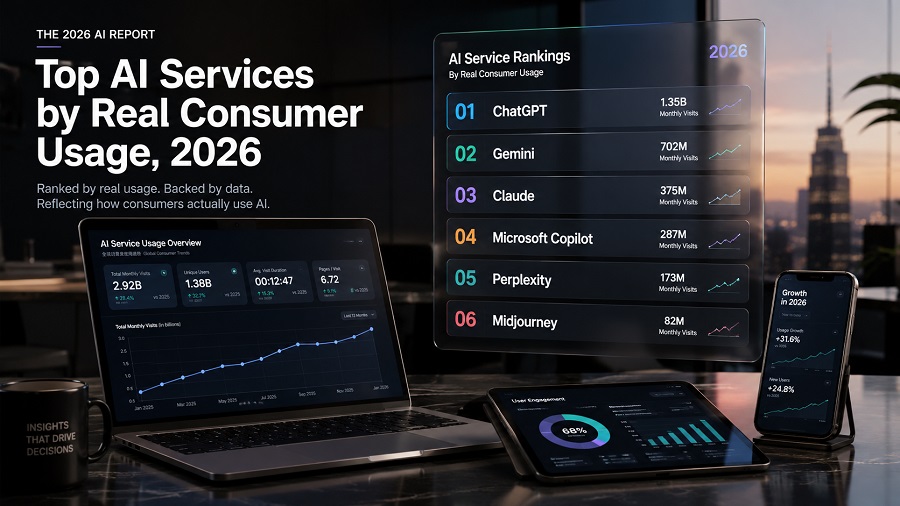
Consumer AI Web Products Ranked by Public a16z/Similarweb Traffic Order
This ranking lists 50 consumer AI web products in the order published by Andreessen Horowitz in its 6th Edition consumer AI report. The web list is based on Similarweb unique monthly visits for January 2026.
The public a16z report discloses the rank order, the web measurement basis and several comparison points, including ChatGPT being 2.7 times larger than Gemini on web traffic. It does not publish a product-by-product table of exact monthly visit counts. For that reason, the table below is an ordinal traffic ranking, not a numeric visits table.
Mobile apps are excluded from the ranking table because a16z measures them separately by Sensor Tower monthly active users. Web visits and mobile active users are different indicators and should not be merged into one numeric list.
Continue exploring
More StatRanker pages connected by topic, category or ranking theme.
Top 100 Countries by Fixed Broadband Subscriptions per 100 People
Open rankingTop 100 Countries by Global Cybersecurity Index: 2026 Snapshot Based on Latest Official 2024 Data
Open rankingCountries by Mobile Data Price, 2026
Open rankingData disclosure: exact unique monthly web visits for each of the 50 products are not shown because they are not publicly provided in the source report. The rank order is the usable public dataset.
Fifty web products are listed. The separate mobile Top 50 is not mixed into this table.
Unique monthly visits, Similarweb, January 2026, as reported by a16z.
The source publishes the ordered ranking, not exact visit totals for every row.
a16z reports ChatGPT web traffic at 2.7 times Gemini’s level in the snapshot.
What the upper part of the ranking shows
The top of the web list is led by general AI assistants. ChatGPT ranks first, Gemini second, and DeepSeek, Grok and Claude also appear in the top six. This indicates that browser-based AI demand remains concentrated around broad assistants used for writing, research, coding and everyday task support.
The upper tier is no longer limited to chatbot destinations. Canva ranks third, Notion ninth and Google AI Studio tenth, showing that consumer AI usage has moved into design, productivity and developer workflows. These entries reflect a broader definition of AI products: software where generative AI has become central to the user experience.
The middle and lower parts of the Top 50 add more specialized use cases: writing tools, background removal, companion chat, coding agents, image communities, video generation and regional assistants.
Top 10 AI web products in the public traffic ranking
The Top 10 combines broad AI assistants with platforms where AI is embedded in existing work, creative or development behavior. The positions are based on the public a16z web rank order, not on a reproduced table of exact visit counts.
| Rank | AI web product | Primary category | Public numeric value |
|---|---|---|---|
| 1 | ChatGPT | AI assistant | Exact visits not published |
| 2 | Gemini | AI assistant | Exact visits not published |
| 3 | Canva | Creative / design | Exact visits not published |
| 4 | DeepSeek | AI assistant | Exact visits not published |
| 5 | Grok | AI assistant | Exact visits not published |
| 6 | Claude | AI assistant | Exact visits not published |
| 7 | Character.AI | Companion | Exact visits not published |
| 8 | Perplexity | Search / research | Exact visits not published |
| 9 | Notion | Writing / productivity | Exact visits not published |
| 10 | Google AI Studio | Coding / agents | Exact visits not published |
Source basis: public a16z web ranking from Similarweb unique monthly visits, January 2026. Product-level visit counts are not disclosed in the public list.
Category mix in the Top 50 AI web products
The chart groups the 50 ranked web entries by primary consumer use case. It counts products, not visits. Because exact visit totals are not public for every row, the chart must not be read as traffic share.
Methodology
The rank order follows Andreessen Horowitz’s 6th Edition consumer AI report. The web ranking is based on unique monthly visits measured by Similarweb as of January 2026. The public source provides the ordered Top 50 web list and states the measurement basis, but it does not provide exact monthly visit counts for each product.
How is the rank determined?
Products are ordered by the public a16z web ranking, which is based on Similarweb unique monthly web visits for January 2026.
Why are there no visit totals?
The public source does not disclose a row-by-row numeric table of exact visits. Adding invented figures would make the ranking unreliable.
Why only web products?
Mobile apps are measured separately by monthly active users from Sensor Tower. Web visits and mobile MAU are not the same unit.
What does the ranking exclude?
It excludes model quality, privacy, safety, enterprise usage, API usage, revenue, retention, paid conversion and user satisfaction.
Category labels are StatRanker analytical groupings based on the primary consumer use case of each product: AI assistant, creative/design, coding/agents, companion, writing/productivity, photo editing, video or search/research. These labels help interpret the list but do not affect the source rank order.
Similarweb traffic data is a third-party measurement estimate, not an official user count from each company. It is useful for comparing public web demand, but it can understate activity that happens through mobile apps, desktop apps, APIs, browser extensions, enterprise deployments or embedded AI features inside other platforms.
Full Top 50 AI web products ranking
The table lists the full public Top 50 web order. The “Public numeric value” column is included to avoid a false impression that exact visit counts are available for each row.
Showing 50 ranked products.
| Rank | AI web product | Primary category | Public numeric value |
|---|---|---|---|
| 1 | ChatGPT | AI assistant | Exact visits not published |
| 2 | Gemini | AI assistant | Exact visits not published |
| 3 | Canva | Creative / design | Exact visits not published |
| 4 | DeepSeek | AI assistant | Exact visits not published |
| 5 | Grok | AI assistant | Exact visits not published |
| 6 | Claude | AI assistant | Exact visits not published |
| 7 | Character.AI | Companion | Exact visits not published |
| 8 | Perplexity | Search / research | Exact visits not published |
| 9 | Notion | Writing / productivity | Exact visits not published |
| 10 | Google AI Studio | Coding / agents | Exact visits not published |
| 11 | Freepik | Creative / design | Exact visits not published |
| 12 | Doubao | AI assistant | Exact visits not published |
| 13 | JanitorAI | Companion | Exact visits not published |
| 14 | Quark | AI assistant | Exact visits not published |
| 15 | Suno | Creative / design | Exact visits not published |
| 16 | remove.bg | Photo editing | Exact visits not published |
| 17 | CapCut | Video | Exact visits not published |
| 18 | Grammarly | Writing / productivity | Exact visits not published |
| 19 | SpicyChat.AI | Companion | Exact visits not published |
| 20 | QuillBot | Writing / productivity | Exact visits not published |
| 21 | Lovable | Coding / agents | Exact visits not published |
| 22 | PolyBuzz | Companion | Exact visits not published |
| 23 | OurDream.ai | Companion | Exact visits not published |
| 24 | Kimi | AI assistant | Exact visits not published |
| 25 | Google Labs | Creative / design | Exact visits not published |
| 26 | Qwen | AI assistant | Exact visits not published |
| 27 | TurboScribe | Writing / productivity | Exact visits not published |
| 28 | Gamma | Writing / productivity | Exact visits not published |
| 29 | ElevenLabs | Creative / design | Exact visits not published |
| 30 | NotebookLM | Writing / productivity | Exact visits not published |
| 31 | LMArena | Coding / agents | Exact visits not published |
| 32 | SeaArt.AI | Creative / design | Exact visits not published |
| 33 | Hugging Face | Coding / agents | Exact visits not published |
| 34 | Crushon AI | Companion | Exact visits not published |
| 35 | Meta AI | AI assistant | Exact visits not published |
| 36 | Candy.AI | Companion | Exact visits not published |
| 37 | Photoroom | Photo editing | Exact visits not published |
| 38 | Pixelcut | Photo editing | Exact visits not published |
| 39 | Adot | Search / research | Exact visits not published |
| 40 | Higgsfield | Creative / design | Exact visits not published |
| 41 | Cursor | Coding / agents | Exact visits not published |
| 42 | CivitAI | Creative / design | Exact visits not published |
| 43 | Midjourney | Creative / design | Exact visits not published |
| 44 | Manus | Coding / agents | Exact visits not published |
| 45 | Kling AI | Video | Exact visits not published |
| 46 | VEED | Video | Exact visits not published |
| 47 | Genspark | Coding / agents | Exact visits not published |
| 48 | GigaChat | AI assistant | Exact visits not published |
| 49 | Poe | AI assistant | Exact visits not published |
| 50 | Cutout.pro | Photo editing | Exact visits not published |
Table basis: public Top 50 Gen AI web products ranking from a16z, based on Similarweb unique monthly visits for January 2026. Exact visit totals are not published for each product.
Insights from the Top 50 AI web ranking
General assistants still define the top of the web market
AI assistants hold the largest category count in the Top 50 and dominate the first positions. The web interface remains the place where users ask long questions, compare answers, write, code, research and switch between tasks.
AI is moving into established software
Canva, Notion, Grammarly and CapCut show that consumer AI adoption is not limited to new AI-native destinations. Large existing products can capture AI demand when generative features become part of a familiar workflow.
Specialized web tools are still visible
Suno, ElevenLabs, remove.bg, Photoroom, Pixelcut, Midjourney, Kling AI, VEED and Cutout.pro show that specialized creative and editing tasks still generate enough web demand to appear in the ranking.
The lower half is fragmented
Ranks 26–50 include assistants, coding tools, creative communities, photo editors, video generators and companion platforms. This part of the table looks less like one AI market and more like several separate consumer use-case markets.
What this ranking means for readers
For users, the ranking helps separate repeated public web demand from launch hype. A product in the Top 50 has enough browser-based activity to stand out, but quality, privacy, safety and fit for a specific task still require separate evaluation.
For product teams, the table shows where web-based AI demand concentrates: general assistants, design tools, writing aids, coding agents, companion platforms and creative production tools. Web usage tends to favor products that support deeper sessions and multi-step work.
For analysts, the ranking is a distribution signal rather than a complete market-size dataset. It should be read alongside retention, paid conversion, revenue, geography, device mix and dependence on platform defaults. Traffic rank alone does not show whether a product is profitable, safe or durable.
FAQ
Does rank 1 mean ChatGPT had the exact number of users shown here?
No. The table shows the public rank order. It does not show exact product-level visit counts because the public source does not publish those counts for every row.
What is the difference between visits and users?
Web visits measure traffic activity to websites. Users or monthly active users measure people or accounts, depending on the source definition. The a16z web list uses Similarweb unique monthly visits, while the separate mobile list uses Sensor Tower monthly active users.
Why are Canva, Notion and Grammarly included if they are not pure chatbot products?
The 6th Edition report broadened the consumer AI lens to include products where generative AI has become central to the user experience. That is why established products with major AI features appear next to AI-native assistants.
Can this ranking prove which AI product is best?
No. It measures public web traffic rank, not model quality, accuracy, safety, privacy, pricing, customer satisfaction, revenue or professional suitability.
Why not estimate the missing visit numbers?
Estimated numbers from separate tools would use different collection dates, definitions and sampling methods. Mixing them into the public a16z order would make the table look more precise than the source supports.
How often can this type of ranking change?
Consumer AI traffic can move quickly after model launches, product integrations, viral features, app restrictions, regional policy changes and platform defaults. The January 2026 snapshot should be read as a point-in-time view.
Sources
-
Andreessen Horowitz — The Top Gen AI Consumer Apps, 6th Edition
Primary source for the public Top 50 web order, January 2026 snapshot basis, and the statement that the web ranking is based on Similarweb unique monthly visits. -
Similarweb
Measurement provider cited by a16z for unique monthly web visits in the web product ranking. -
Sensor Tower
Measurement provider cited by a16z for the separate mobile monthly active user ranking, used here only to explain why mobile rows are excluded from the web table.
Related rankings
More StatRanker pages connected by topic, category or ranking theme.
Countries by Internet Price, 2026
Open rankingTop 100 Companies by R&D Spending, 2026
Open rankingTop 100 Countries by Global Innovation Index, 2025
Open rankingTop 100 Countries by E-Government Development Index, 2025
Open ranking
StatRanker (Website)
administrator