Top 100 Countries by Bird Species Richness, 2026
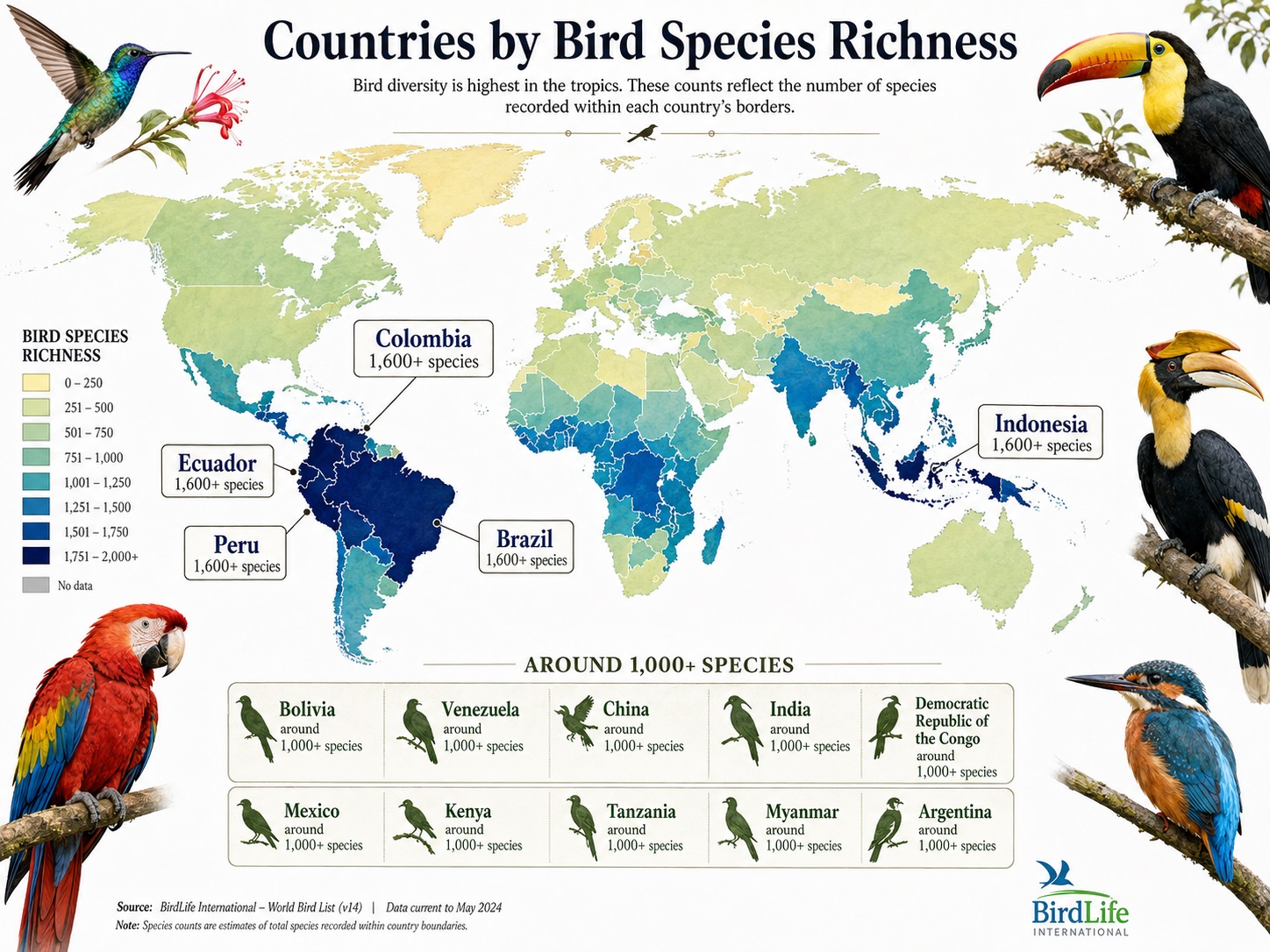
Countries with the highest recorded bird species richness
Bird species richness measures how many distinct bird species are recorded for a country or territory under a selected checklist. It is a species count, not a count of individual birds, population size, habitat quality or conservation performance.
This 2026 publication snapshot uses country-level species counts from BioDB’s Birds Per Country table, with the source table dated April 2024 and described as compiled from BirdLife data. BirdLife DataZone, IUCN Red List and Avibase are used as checklist and conservation references, not as separate sources for every row in the ranking.
Colombia leads with 1,871 recorded bird species, followed closely by Peru and Brazil. The upper part of the list is concentrated in tropical South America, Southeast Asia, equatorial Africa and countries with strong elevation gradients, wetlands, forests, islands or major migration corridors. The 2026 label refers to the publication snapshot, not to an annual global bird census.
1,871 recorded bird species in the compiled country-level table.
The table preserves source ranks and tie positions where species counts are equal.
Number of accepted bird species recorded for the selected country or territory checklist.
April 2024 source table, compiled for a 2026 publication snapshot on May 30, 2026.
What the upper part of the list shows
The leading group reflects clear ecological patterns. Colombia, Peru, Brazil, Ecuador, Bolivia and Venezuela combine Amazonian lowlands, Andean slopes, cloud forests, wetlands, dry valleys and coastlines. This creates rapid turnover between habitats and elevation bands, allowing many bird species to occur inside the same national boundary.
Indonesia reaches the top tier through a different mechanism. Island biogeography, tropical forests and deep-water barriers create strong species turnover and high endemism across the archipelago. Large Asian countries such as China and India rank high because they combine tropical lowlands, mountain systems, wetlands, coasts and major migratory flyways.
A high national species total is not evidence of strong conservation outcomes. Species richness describes recorded diversity; conservation risk depends on habitat loss, population trends, hunting pressure, invasive species, climate exposure and whether endemic species have viable ranges.
Top 10 countries by bird species richness
The Top 10 is led by the tropical Andes and Amazon basin. Colombia, Peru, Brazil, Ecuador, Bolivia and Venezuela form the strongest regional cluster, while Indonesia represents the island-archipelago route to extreme bird diversity. China, India and the Democratic Republic of the Congo add large-area, multi-biome examples from Asia and Africa.
| Rank | Country | Bird species | Region |
|---|---|---|---|
| 1 | Colombia | 1,871 | Americas |
| 2 | Peru | 1,861 | Americas |
| 3 | Brazil | 1,816 | Americas |
| 4 | Indonesia | 1,746 | Asia |
| 5 | Ecuador | 1,624 | Americas |
| 6 | Bolivia | 1,437 | Americas |
| 7 | Venezuela | 1,387 | Americas |
| 8 | China | 1,288 | Asia |
| 9 | India | 1,211 | Asia |
| 10 | Democratic Republic of the Congo | 1,110 | Africa |
Primary table source: BioDB “Birds Per Country”, source table dated April 2024 and described as compiled from BirdLife data. Checklist and taxonomy limits are explained in the methodology.
Chart: highest bird species counts among the leading entries
The leading entries show a strong tropical concentration. Colombia, Peru and Brazil sit above 1,800 recorded species; Indonesia and Ecuador remain above 1,600; Cameroon and Panama share rank 20 with the same count.
Bar length is scaled to Colombia’s count of 1,871 species. Cameroon and Panama are combined in one bar because both have 889 recorded species and share rank 20.
Methodology
Bird species richness is calculated as the number of accepted bird species recorded for a country or territory in the selected source table. The ranking orders entries from highest to lowest species count and keeps the source tie positions where values are equal.
How the indicator is calculated
Bird species richness = count of accepted bird species recorded within the country or territory checklist. It does not measure individual abundance, population health or protected-area quality.
Data year and snapshot logic
The numerical table uses BioDB’s April 2024 country dataset, described by BioDB as compiled from BirdLife data. It is used here as a 2026 publication snapshot because global bird checklists are revised periodically, not counted as annual censuses.
Taxonomy and checklist treatment
Species counts can change when checklist authorities split, lump or reclassify species. Avibase, BirdLife, IOC, eBird/Clements and national committees may therefore show different totals for the same country.
Residents, migrants and vagrants
Country checklists can include residents, seasonal migrants and accepted records under the source rules. Rare vagrants, introduced birds and disputed records are major comparability limits.
The values are whole-species counts and require no rounding beyond the source table. Region labels are added for navigation and interpretation. Cross-country comparison is strongest when the reader treats the ranking as a structured biodiversity snapshot, not as a final taxonomic verdict. Country area, survey intensity, field access, island isolation, elevation range and migration routes all affect totals.
Full ranking: 100 countries and territories by bird species richness
The table lists 100 entries by recorded bird species count. Search and filters change the visible subset, while the rank column preserves the original source order and tie positions.
| Rank | Country / territory | Bird species | Region |
|---|---|---|---|
| 1 | Colombia | 1,871 | Americas |
| 2 | Peru | 1,861 | Americas |
| 3 | Brazil | 1,816 | Americas |
| 4 | Indonesia | 1,746 | Asia |
| 5 | Ecuador | 1,624 | Americas |
| 6 | Bolivia | 1,437 | Americas |
| 7 | Venezuela | 1,387 | Americas |
| 8 | China | 1,288 | Asia |
| 9 | India | 1,211 | Asia |
| 10 | Democratic Republic of the Congo | 1,110 | Africa |
| 11 | Mexico | 1,094 | Americas |
| 12 | Tanzania | 1,075 | Africa |
| 13 | Kenya | 1,058 | Africa |
| 14 | Myanmar | 1,038 | Asia |
| 15 | Argentina | 1,002 | Americas |
| 16 | Uganda | 1,000 | Africa |
| 17 | Thailand | 939 | Asia |
| 18 | Angola | 921 | Africa |
| 19 | Sudan | 912 | Africa |
| 20 | Cameroon | 889 | Africa |
| 20 | Panama | 889 | Americas |
| 22 | Nigeria | 866 | Africa |
| 23 | Costa Rica | 843 | Americas |
| 24 | Vietnam | 831 | Asia |
| 25 | Ethiopia | 821 | Africa |
| 26 | Nepal | 820 | Asia |
| 26 | United States | 820 | Americas |
| 28 | South Sudan | 806 | Africa |
| 29 | Guyana | 792 | Americas |
| 30 | South Africa | 762 | Africa |
| 31 | Papua New Guinea | 741 | Oceania |
| 32 | Zambia | 734 | Africa |
| 33 | Australia | 726 | Oceania |
| 33 | Malaysia | 726 | Asia |
| 35 | Central African Republic | 721 | Africa |
| 36 | Honduras | 708 | Americas |
| 37 | Guatemala | 699 | Americas |
| 38 | Laos | 697 | Asia |
| 39 | Suriname | 695 | Americas |
| 40 | Paraguay | 689 | Americas |
| 41 | Nicaragua | 685 | Americas |
| 42 | Ghana | 681 | Africa |
| 43 | Mozambique | 676 | Africa |
| 44 | Côte d’Ivoire | 672 | Africa |
| 45 | Russia | 663 | Europe |
| 46 | Rwanda | 636 | Africa |
| 47 | Guinea | 635 | Africa |
| 48 | Malawi | 633 | Africa |
| 49 | Zimbabwe | 629 | Africa |
| 50 | Bhutan | 620 | Asia |
| 51 | Republic of the Congo | 614 | Africa |
| 52 | Pakistan | 611 | Asia |
| 53 | Gabon | 604 | Africa |
| 54 | Bangladesh | 603 | Asia |
| 55 | Namibia | 599 | Africa |
| 56 | Burundi | 596 | Africa |
| 57 | Philippines | 595 | Asia |
| 58 | Sierra Leone | 583 | Africa |
| 59 | Togo | 572 | Africa |
| 60 | Somalia | 570 | Africa |
| 61 | Mali | 567 | Africa |
| 62 | Senegal | 560 | Africa |
| 63 | Benin | 551 | Africa |
| 64 | Eritrea | 544 | Africa |
| 65 | Botswana | 537 | Africa |
| 66 | Liberia | 536 | Africa |
| 67 | Belize | 530 | Americas |
| 68 | Chad | 526 | Africa |
| 69 | Cambodia | 516 | Asia |
| 70 | Canada | 495 | Americas |
| 71 | El Salvador | 489 | Americas |
| 72 | Eswatini | 486 | Africa |
| 73 | Iran | 473 | Asia |
| 74 | Mauritania | 472 | Africa |
| 75 | Gambia | 462 | Africa |
| 76 | Burkina Faso | 453 | Africa |
| 76 | Guinea-Bissau | 453 | Africa |
| 78 | Japan | 441 | Asia |
| 79 | Niger | 439 | Africa |
| 80 | Kazakhstan | 438 | Asia |
| 81 | Equatorial Guinea | 434 | Africa |
| 82 | Chile | 429 | Americas |
| 83 | Brunei | 415 | Asia |
| 84 | Uruguay | 408 | Americas |
| 85 | Trinidad and Tobago | 395 | Americas |
| 86 | Afghanistan | 393 | Asia |
| 86 | Turkey | 393 | Asia |
| 88 | Saudi Arabia | 392 | Asia |
| 89 | Israel | 385 | Asia |
| 90 | Spain | 379 | Europe |
| 91 | Egypt | 377 | Africa |
| 92 | Sri Lanka | 376 | Asia |
| 93 | Taiwan | 375 | Asia |
| 94 | Iraq | 374 | Asia |
| 95 | Singapore | 369 | Asia |
| 96 | Turkmenistan | 366 | Asia |
| 97 | Mongolia | 363 | Asia |
| 98 | France | 359 | Europe |
| 99 | South Korea | 357 | Asia |
| 100 | Uzbekistan | 354 | Asia |
Primary table source: BioDB “Birds Per Country”, source table dated April 2024 and described as compiled from BirdLife data. Compiled for this 2026 publication snapshot on May 30, 2026.
What the bird-richness ranking shows
Upper tier: tropical complexity
The very top is dominated by countries where tropical climate, mountain gradients and forest systems overlap. Colombia and Peru are especially strong because the Andes create many elevation zones next to Amazonian, Pacific, Caribbean and wetland habitats.
Island systems: turnover and endemism
Indonesia, Papua New Guinea, the Philippines, Sri Lanka, Taiwan and Australia show a different pattern: total richness is shaped by isolation, island turnover and endemic species, not only by continental area.
The middle of the Top 100 is dense with African countries because savannahs, river basins, forests, wetlands and drylands often meet within relatively short distances. Kenya, Tanzania, Uganda, Angola, Sudan, Cameroon and Nigeria all benefit from this habitat mosaic.
The lower part of the Top 100 still contains globally important bird countries. Spain, Egypt, Sri Lanka, Singapore, South Korea and Uzbekistan do not match the Amazon or tropical Andes in total species count, but they matter for migration, endemism, island ecology, wetland networks or regional flyways.
Species richness should not be confused with conservation success. A country may have many species because it is large and tropical while also facing severe habitat loss. Another country may have fewer total species but a high share of endemic birds, making each extinction risk more globally significant.
Why bird species richness matters
For readers, bird species richness is a compact way to see where avian biodiversity is concentrated. It explains why the tropical Andes, Amazon basin, Southeast Asian archipelagos and equatorial African landscapes are central to global nature protection.
For travellers and birdwatchers, a high national count signals opportunity, but trip quality depends on access, season, habitat concentration, safety, local guides and protected-area infrastructure. Ecuador or Costa Rica can offer exceptional birding density in compact areas, while Brazil or Indonesia require more targeted regional planning.
For policymakers and conservation analysts, the indicator is useful as a first screen for responsibility. High-richness countries often carry disproportionate importance for forests, wetlands, flyways and mountain ecosystems. Stronger decisions come from combining richness with threatened species, endemism, habitat loss, protected-area coverage and population trends.
FAQ
Which country has the most bird species in the 2026 snapshot?
Colombia ranks first in the compiled table with 1,871 recorded bird species. Its leading position reflects the combination of Amazonian forests, Andean mountain systems, Pacific and Caribbean coasts, wetlands and dry valleys.
Does bird species richness mean there are more individual birds?
No. Species richness counts how many species are recorded, not how many individual birds live there. A country can have many species but declining populations if habitats are being lost or degraded.
Why does Colombia rank so high?
Colombia sits where several major ecological systems meet. The Andes create steep elevation changes, the Amazon and Chocó regions add tropical forest diversity, and the country also has Caribbean, Pacific, wetland and dry-valley habitats.
Why can bird species counts differ between sources?
Counts differ because checklists use different taxonomies and rules for accepted records. A species split can raise a national total, while a rejected vagrant record or a taxonomic lump can reduce it. Avibase, BirdLife, IOC, eBird/Clements and national committees may therefore report different values.
Are migrant and vagrant birds included?
Country checklists usually include resident and migrant species that meet the source’s acceptance rules. Rare vagrants, introduced species and uncertain records are handled differently by different checklist systems, which is why methodology matters.
Does a high species count mean a country protects birds well?
No. High richness describes biological potential and recorded diversity. Protection quality requires separate evidence: threatened-species trends, habitat loss, protected areas, enforcement, restoration, hunting pressure and climate risk.
Why do tropical countries dominate the list?
Tropical regions often have more stable year-round productivity, complex forests, many ecological niches and long evolutionary histories. When tropical climate is combined with mountains, rivers, wetlands or islands, bird turnover rises sharply.
How often can this ranking change?
Major positions are relatively stable, but exact counts can change whenever checklists are updated, new records are accepted, vagrant rules change or taxonomic revisions split and lump species.
Sources and checklist references
-
BioDB — Birds Per Country
Primary table source for the country-level bird species counts used in the ranking. The table is dated April 2024 and described as compiled from BirdLife data. -
BirdLife DataZone
Reference environment for bird distribution, country profiles, species conservation context and BirdLife’s global data framework. -
BirdLife DataZone — Dataset information
Used for background on range maps, distribution datasets, taxonomy context and the interpretation of global bird data. -
IUCN Red List
Conservation-status reference for interpreting threatened species and why richness alone is not a measure of population security. -
Avibase — The World Bird Database
Checklist and taxonomy reference for understanding why country species totals may vary between global and national checklist systems.
Related rankings
Closely related StatRanker ranking and data pages selected by topic, entity scope and category. Fewer links are shown when strong matches are limited.