

Top 100 Countries by Internet Users Share, 2026
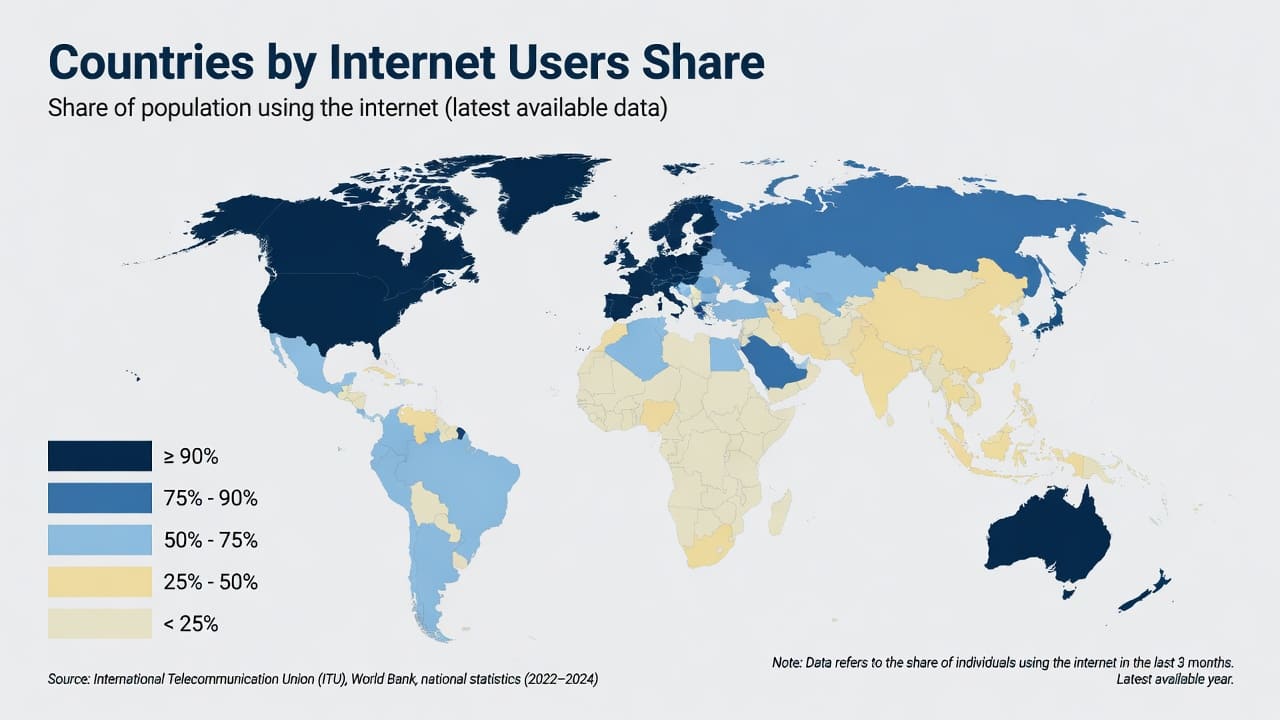
Internet Penetration by Country: 2026 Snapshot Using 2024 Data
Bahrain, Saudi Arabia and the United Arab Emirates share first place at 100%. The ranking compares the percentage of people who used the Internet during the previous three months. All countries are compared using the same 2024 reference year.
The figures come from World Bank indicator IT.NET.USER.ZS, sourced from the International Telecommunication Union. The series combines information reported through national statistical systems with ITU estimates where country data are incomplete.
Bahrain, Saudi Arabia and the United Arab Emirates share first place.
South Africa is the final country included in the table.
Half of the listed countries are above this rate and half are below it.
The unit is percentage of the national population.
What the Internet Penetration Rate Measures
The indicator measures the proportion of individuals who used the Internet from any location during the previous three months. People may connect through fixed or mobile networks and may use personal, shared, public, school or workplace connections.
Internet use is not broadband subscriptions
This percentage measures people who went online. Broadband statistics usually count subscriptions or connections. One person may hold several subscriptions, while another may use a shared connection without owning one.
Why rates differ between countries
Important factors include household income, device ownership, mobile coverage, fixed-network availability, service prices, urbanization, education, digital skills, geography, public investment and political or security conditions.
Small gaps need cautious interpretation
Countries near the top are often separated by fractions of a percentage point. A difference of several positions may therefore reflect only a small statistical gap.
What this percentage cannot show
The indicator does not compare download speed, latency, reliability, service prices, online safety, digital skills, frequency of use or the quality of rural connections.
Top 10 Countries by Share of Population Online
Every country in the Top 10 exceeds 98%. The first three entries share the same value, while the difference between Denmark in fourth place and Iceland in tenth place is about 1.6 percentage points.
Top 10 countries by individuals using the Internet
| Rank | Country | Internet use | Region |
|---|---|---|---|
| 1 | Bahrain | 100.0% | Asia |
| 2 | Saudi Arabia | 100.0% | Asia |
| 3 | United Arab Emirates | 100.0% | Asia |
| 4 | Denmark | 99.8% | Europe |
| 5 | Kuwait | 99.7% | Asia |
| 6 | Monaco | 99.0% | Europe |
| 7 | Norway | 99.0% | Europe |
| 8 | Luxembourg | 98.8% | Europe |
| 9 | Liechtenstein | 98.3% | Europe |
| 10 | Iceland | 98.2% | Europe |
Ranks use unrounded percentages. Countries with identical values are listed alphabetically and should be read as tied.
How Close the Top 20 Countries Are
The chart begins at 95% so that the narrow differences between the leading countries remain visible.
How the Ranking Was Compiled
The ranking uses World Bank indicator IT.NET.USER.ZS, sourced from the ITU World Telecommunication/ICT Indicators Database. Countries are ordered from the highest percentage to the lowest.
Countries included
The eligible group consists of the 193 United Nations member states, the Holy See and the State of Palestine. Territories, dependencies and regional aggregates are excluded. Only states with a 2024 value can enter the ranking.
Regional classification
Regions follow the United Nations M49 classification. Under this system Cyprus is included in Asia. The Top 100 contains 42 European, 30 Asian, 19 American, 5 Oceanian and 4 African countries.
Reported data and ITU estimates
ITU harmonizes information received through national statistical systems and may estimate missing values. The public World Bank table does not consistently identify the origin of every country value.
Differences between surveys
Results can be affected by survey timing, age coverage, sample design, interview method and questionnaire wording. Closely ranked countries should therefore be treated as having broadly similar levels of use.
Revisions
Historical percentages can change when countries submit newer survey results or when ITU updates its estimates. The access date identifies the version used for this table.
Rounding and ties
Ranking uses the full percentage available in the source. Values are displayed to one decimal place. Equal full values are treated as ties, with alphabetical order used for presentation.
Missing countries
A country without a 2024 value is not filled with an older figure. This keeps the reference period consistent across the table.
Scope of the measure
The percentage describes whether people used the Internet. Separate statistics are needed to assess affordability, network coverage, speed, reliability and digital skills.
Top 100 Countries by Internet Penetration
Search for a country, select a region, change the order or choose how many results to display.
100 countries
Share of the population using the Internet
| Rank | Country | Internet use | Region |
|---|---|---|---|
| 1 | Bahrain | 100.0% | Asia |
| 2 | Saudi Arabia | 100.0% | Asia |
| 3 | United Arab Emirates | 100.0% | Asia |
| 4 | Denmark | 99.8% | Europe |
| 5 | Kuwait | 99.7% | Asia |
| 6 | Monaco | 99.0% | Europe |
| 7 | Norway | 99.0% | Europe |
| 8 | Luxembourg | 98.8% | Europe |
| 9 | Liechtenstein | 98.3% | Europe |
| 10 | Iceland | 98.2% | Europe |
| 11 | Qatar | 98.1% | Asia |
| 12 | Malaysia | 98.0% | Asia |
| 13 | South Korea | 97.9% | Asia |
| 14 | San Marino | 97.4% | Europe |
| 15 | Switzerland | 97.3% | Europe |
| 16 | Ireland | 97.2% | Europe |
| 17 | Netherlands | 97.0% | Europe |
| 18 | Brunei Darussalam | 96.3% | Asia |
| 19 | Australia | 96.1% | Oceania |
| 20 | Belgium | 95.8% | Europe |
| 21 | Spain | 95.8% | Europe |
| 22 | Jordan | 95.6% | Asia |
| 23 | Chile | 95.6% | Americas |
| 24 | Sweden | 95.5% | Europe |
| 25 | United Kingdom | 95.5% | Europe |
| 26 | Oman | 95.3% | Asia |
| 27 | Austria | 94.9% | Europe |
| 28 | United States | 94.7% | Americas |
| 29 | Andorra | 94.4% | Europe |
| 30 | Singapore | 94.4% | Asia |
| 31 | Russia | 94.4% | Europe |
| 32 | Canada | 94.4% | Americas |
| 33 | Belarus | 94.3% | Europe |
| 34 | Malta | 93.9% | Europe |
| 35 | Hungary | 93.8% | Europe |
| 36 | Finland | 93.7% | Europe |
| 37 | North Macedonia | 93.6% | Europe |
| 38 | New Zealand | 93.5% | Oceania |
| 39 | Germany | 93.5% | Europe |
| 40 | Kazakhstan | 93.4% | Asia |
| 41 | Latvia | 92.7% | Europe |
| 42 | Bahamas | 92.5% | Americas |
| 43 | Estonia | 92.2% | Europe |
| 44 | Kyrgyzstan | 92.0% | Asia |
| 45 | China | 92.0% | Asia |
| 46 | Uruguay | 92.0% | Americas |
| 47 | Romania | 91.3% | Europe |
| 48 | Bhutan | 91.3% | Asia |
| 49 | Morocco | 91.2% | Africa |
| 50 | Dominican Republic | 91.0% | Americas |
| 51 | Thailand | 90.9% | Asia |
| 52 | Slovenia | 90.8% | Europe |
| 53 | Azerbaijan | 90.4% | Asia |
| 54 | Jamaica | 90.1% | Americas |
| 55 | Slovakia | 89.8% | Europe |
| 56 | Argentina | 89.7% | Americas |
| 57 | Cyprus | 89.6% | Asia |
| 58 | Uzbekistan | 89.5% | Asia |
| 59 | Kiribati | 89.4% | Oceania |
| 60 | Italy | 89.2% | Europe |
| 61 | Lithuania | 89.2% | Europe |
| 62 | Montenegro | 88.9% | Europe |
| 63 | France | 88.7% | Europe |
| 64 | Poland | 88.6% | Europe |
| 65 | Portugal | 88.5% | Europe |
| 66 | Israel | 88.2% | Asia |
| 67 | Seychelles | 87.8% | Africa |
| 68 | Serbia | 87.7% | Europe |
| 69 | Czechia | 87.7% | Europe |
| 70 | Türkiye | 87.3% | Asia |
| 71 | Costa Rica | 87.2% | Americas |
| 72 | Greece | 86.3% | Europe |
| 73 | Bosnia and Herzegovina | 86.1% | Europe |
| 74 | Albania | 85.9% | Europe |
| 75 | Japan | 85.5% | Asia |
| 76 | Iran | 85.3% | Asia |
| 77 | Maldives | 85.2% | Asia |
| 78 | Mongolia | 85.1% | Asia |
| 79 | Brazil | 84.5% | Americas |
| 80 | Vietnam | 84.2% | Asia |
| 81 | Palau | 83.9% | Oceania |
| 82 | Georgia | 83.8% | Asia |
| 83 | Croatia | 83.6% | Europe |
| 84 | Mexico | 83.1% | Americas |
| 85 | Nauru | 83.0% | Oceania |
| 86 | Guyana | 83.0% | Americas |
| 87 | Ukraine | 82.5% | Europe |
| 88 | Bulgaria | 82.4% | Europe |
| 89 | Trinidad and Tobago | 82.2% | Americas |
| 90 | Dominica | 82.0% | Americas |
| 91 | Peru | 82.0% | Americas |
| 92 | Libya | 82.0% | Africa |
| 93 | Paraguay | 81.6% | Americas |
| 94 | Iraq | 81.5% | Asia |
| 95 | Armenia | 81.3% | Asia |
| 96 | Lebanon | 80.6% | Asia |
| 97 | Belize | 80.0% | Americas |
| 98 | Bolivia | 79.7% | Americas |
| 99 | Colombia | 79.3% | Americas |
| 100 | South Africa | 78.4% | Africa |
No countries match the selected filters.
World Bank WDI indicator IT.NET.USER.ZS, sourced from ITU. Data accessed July 11, 2026.
Patterns in the Top 100
Three countries share 100%
Bahrain, Saudi Arabia and the United Arab Emirates have the highest value. A rate of 100% should be understood as effectively universal use rather than proof that every resident was online.
More than half exceed 90%
Fifty-four countries reach at least 90%, while the median for the full Top 100 is 90.9%.
Europe and Asia provide 72 entries
Europe accounts for 42 countries and Asia for 30 under the UN M49 classification. The Americas contribute 19, Oceania 5 and Africa 4.
Several ranks are separated by tiny margins
The United States ranks 28th and Canada 32nd, yet their values differ by only about 0.34 percentage points.
How to Use This Ranking
Compare broad adoption
The table is most useful for comparing how widely Internet use has spread through national populations. It does not show whether connections are fast, affordable or reliable.
Treat close values as similar
Small differences can reflect rounding, survey timing or later revisions. Countries separated by only a few tenths of a percentage point should be viewed as having broadly comparable rates.
Check the year before comparing
This table keeps all entries in 2024. Comparisons with another ranking should use the same reference year and the same definition of Internet use.
Use additional indicators for policy analysis
A fuller digital-access assessment should also consider prices, mobile and fixed coverage, connection speeds, rural access, device ownership and digital skills.
Download the Top 100 Countries by Internet Users Share, 2026 dataset
Top 100 Countries by Internet Users Share, 2026
100 ranked entries · Excel + CSV + methodology + sources + chart · Snapshot: 2024 World Bank WDI / ITU internet-users share · Version 1.0
The archive includes machine-readable data, methodology and source documentation. Quick human verification is required before the ZIP is delivered. Full Data Pack downloads require a free account. Free accounts can download 1 different Data Pack every 30 days; re-downloading the same pack does not use another slot. Annual Data Access provides unlimited manual downloads while annual access is active.
Download Excel + CSV Data PackFrequently Asked Questions
Which countries have the highest Internet penetration rate?
Bahrain, Saudi Arabia and the United Arab Emirates share first place at 100%.
Are these 2026 Internet-use figures?
No. This is a 2026 publication using 2024 values, which were the latest broadly available common-year data when the table was prepared.
Is Internet penetration the same as broadband penetration?
No. This table measures the percentage of people who used the Internet. Broadband statistics usually count subscriptions or connections.
Are all country values taken directly from national surveys?
Not necessarily. The international series includes information supplied through national statistical systems and may also include ITU estimates where data are incomplete.
Why can a country show 100%?
Percentages may be rounded and can be based on survey estimates. A value of 100% means Internet use is effectively universal in the source series.
Why is Cyprus included in Asia?
The table follows the United Nations M49 statistical classification, which places Cyprus in Western Asia.
Why are territories excluded?
The ranking is limited to UN member states and the two UN observer states. Territories, dependencies and regional aggregates are not included.
Why can older values change?
Historical figures can be revised when countries publish newer survey results or when ITU updates its estimates.
What does this ranking not measure?
It does not compare Internet speed, prices, reliability, digital skills, cybersecurity or the quality of rural access.
Sources
World Bank — Individuals using the Internet
Country percentages, reference year and indicator information.
World Bank Data360 CSV
Download used for the unrounded country values and ranking order.
ITU Facts and Figures 2025
Global context on Internet use, affordability and remaining connectivity gaps.
ITU estimation methods
Explanation of how missing ICT indicator values may be estimated.
United Nations M49 classification
Regional classification used throughout the table.
United Nations member states
Basis for determining which states are eligible for the ranking.
Related rankings
Closely related StatRanker ranking and data pages selected by topic, entity scope and category. Fewer links are shown when strong matches are limited.
