Tax Burden by State 2026: Income Tax Burden Ranking
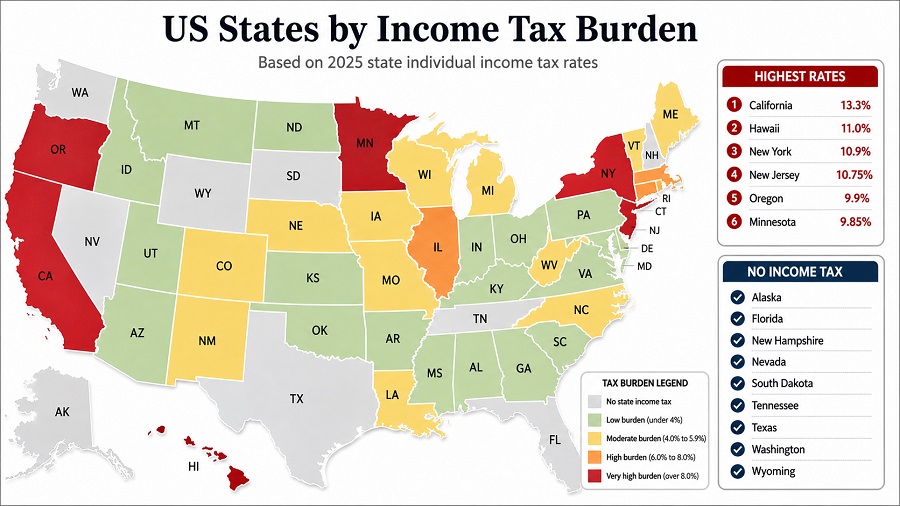
Tax Burden by State 2026: Income Tax Collections as a Share of Resident Income
Tax burden by state 2026 can mean several different things. This page focuses on the income-tax component: FY2025 state-government individual income tax collections divided by an estimated 2025 resident personal-income base. On this measure, Oregon ranks first at 4.17%, followed by Delaware at 3.79%, California at 3.59%, Massachusetts at 3.47% and New York at 3.34%.
The table is a compiled research dataset built from three official data families: U.S. Census state tax collections, BEA/FRED personal income, and Census population estimates. Row-level source and method notes are shown in the ranking table. The final percentages are calculated from official observed inputs, not a forecast or projection.
Metric: state-government Census T40 individual income tax collections ÷ estimated resident personal income. Unit: percent. Direction: higher ratio ranks higher. Coverage: 50 states. Status: 50 calculated values. District of Columbia is excluded.
FY2025 Census T40 collections relative to the 2025 resident-income estimate.
Census T40 is X/not applicable; zero is used only as a disclosed ranking assumption.
50 calculated values; no forecast or modeled-projection rows.
Median 1.89%; average 1.86% across the 50 raw ranking values.
Tax burden by state 2026: income-tax burden vs overall tax burden
Broad tax-burden comparisons usually combine several tax categories. This ranking deliberately isolates state-government individual income-tax collections so the 50 states can be compared on a narrower, reproducible metric using official observed data.
The numerator is U.S. Census Bureau item T40, Individual Income Taxes, from FY2025 State Government Tax Collections. The denominator estimates resident personal income from BEA 2025 per-capita personal income, published through FRED, multiplied by the Census Bureau July 1, 2025 population estimate.
The result is best read as a state-government collections-to-resident-income ratio. It compares collection scale with each state's resident income base; it does not show the effective tax rate of a typical household, statutory brackets or combined state-and-local tax burden.
The populations are not perfectly matched: BEA personal income is residence-based, while state tax collections can include liabilities paid by nonresidents. That limitation is material for interpretation.
Tax burden by state 2026: highest income-tax collection ratios
Oregon ranks first at 4.17%. Delaware, California, Massachusetts and New York complete the Top 5. Rank uses unrounded values.
Top 10 · FY2025 state T40 collections relative to estimated 2025 resident personal income
| Rank | State | Collection ratio | Source / method note |
|---|---|---|---|
| 1 | Oregon | 4.17% | Calculated; Census T40 FY2025 $13.07B; BEA/FRED PCPI 2025 $73,283; Census pop. 2025 4,273,586; 2026 snapshot; formula T40×1,000/(PCPI×pop.)×100. |
| 2 | Delaware | 3.79% | Calculated; Census T40 FY2025 $2.75B; BEA/FRED PCPI 2025 $68,630; Census pop. 2025 1,059,952; 2026 snapshot; formula T40×1,000/(PCPI×pop.)×100. |
| 3 | California | 3.59% | Calculated; Census T40 FY2025 $128.69B; BEA/FRED PCPI 2025 $90,957; Census pop. 2025 39,355,309; 2026 snapshot; formula T40×1,000/(PCPI×pop.)×100. |
| 4 | Massachusetts | 3.47% | Calculated; Census T40 FY2025 $24.48B; BEA/FRED PCPI 2025 $98,700; Census pop. 2025 7,154,084; 2026 snapshot; formula T40×1,000/(PCPI×pop.)×100. |
| 5 | New York | 3.34% | Calculated; Census T40 FY2025 $61.20B; BEA/FRED PCPI 2025 $91,504; Census pop. 2025 20,002,427; 2026 snapshot; formula T40×1,000/(PCPI×pop.)×100. |
| 6 | Minnesota | 3.06% | Calculated; Census T40 FY2025 $13.96B; BEA/FRED PCPI 2025 $78,197; Census pop. 2025 5,830,405; 2026 snapshot; formula T40×1,000/(PCPI×pop.)×100. |
| 7 | Hawaii | 2.98% | Calculated; Census T40 FY2025 $3.29B; BEA/FRED PCPI 2025 $76,966; Census pop. 2025 1,432,820; 2026 snapshot; formula T40×1,000/(PCPI×pop.)×100. |
| 8 | Connecticut | 2.97% | Calculated; Census T40 FY2025 $11.22B; BEA/FRED PCPI 2025 $102,307; Census pop. 2025 3,688,496; 2026 snapshot; formula T40×1,000/(PCPI×pop.)×100. |
| 9 | Vermont | 2.87% | Calculated; Census T40 FY2025 $1.40B; BEA/FRED PCPI 2025 $75,723; Census pop. 2025 644,663; 2026 snapshot; formula T40×1,000/(PCPI×pop.)×100. |
| 10 | Montana | 2.80% | Calculated; Census T40 FY2025 $2.31B; BEA/FRED PCPI 2025 $72,066; Census pop. 2025 1,144,694; 2026 snapshot; formula T40×1,000/(PCPI×pop.)×100. |
This ratio is a fiscal comparison proxy, not a resident effective tax rate. Local income taxes are excluded.
Chart: Top 20 state income-tax collection ratios
The chart uses the same raw values as the ranking table; bar length is scaled to Oregon.
Methodology and limitations
The final ratio is not published directly by Census, BEA or FRED. StatRanker calculates it from official observed inputs, so it is a calculated value rather than an official burden rate or forecast.
Numerator
Census FY2025 State Government Tax Collections, item T40, Individual Income Taxes. Flat-file amounts are reported in thousands of dollars.
Income input
BEA 2025 per-capita personal income, an annual residence-based measure, accessed through the FRED Personal Income by State release table.
Population input
Census Vintage 2025 resident population estimate for July 1, 2025. District of Columbia is excluded.
Ranking rule
Higher raw ratios rank higher. Equal raw values are ordered alphabetically. Display rounding never determines rank.
Formula: collection-to-income ratio % = (FY2025 T40 × 1,000) ÷ (2025 PCPI × July 1, 2025 population) × 100.
Population mismatch: the denominator is resident income, while T40 is a state-government collection measure and may include payments by nonresidents. Do not interpret the result as the share of income paid by an average resident.
Timing: the numerator is fiscal-year 2025; income is calendar-year 2025 and population is July 1, 2025. These periods are close but not identical.
Census X values: Census distinguishes X, “not applicable,” from Z, “zero or rounds to zero.” For Alaska, Florida, Nevada, South Dakota, Texas and Wyoming, FY2025 T40 is X. This page assigns zero only to sort those rows in a complete 50-state table; it does not convert X into an official zero-dollar observation.
Current-data note: this snapshot uses BEA's revised 2025 annual per-capita personal-income values from the September 30, 2026 annual regional update. The ranking was refreshed on October 1, 2026 using the updated 2025 income inputs.
Exclusions: local and federal income taxes, property and sales taxes, statutory brackets, filing status, deductions, credits, tax progressivity and cost of living are outside the metric.
Rounding: unrounded calculated ratios determine rank. Most values are displayed to two decimals. Tennessee is shown to four decimals because two-decimal rounding would hide its small positive FY2025 T40 amount.
All 50 states: income-tax collections relative to resident income
Search by state, filter by Census region or status, change sort order, or show the Top 10, Top 20 or all 50 rows.
50-state ranking · FY2025 Census T40 / estimated 2025 resident personal income
| Rank | State | Collection ratio | Source / method note |
|---|---|---|---|
| 1 | Oregon | 4.17% | Calculated; Census T40 FY2025 $13.07B; BEA/FRED PCPI 2025 $73,283; Census pop. 2025 4,273,586; 2026 snapshot; formula T40×1,000/(PCPI×pop.)×100. |
| 2 | Delaware | 3.79% | Calculated; Census T40 FY2025 $2.75B; BEA/FRED PCPI 2025 $68,630; Census pop. 2025 1,059,952; 2026 snapshot; formula T40×1,000/(PCPI×pop.)×100. |
| 3 | California | 3.59% | Calculated; Census T40 FY2025 $128.69B; BEA/FRED PCPI 2025 $90,957; Census pop. 2025 39,355,309; 2026 snapshot; formula T40×1,000/(PCPI×pop.)×100. |
| 4 | Massachusetts | 3.47% | Calculated; Census T40 FY2025 $24.48B; BEA/FRED PCPI 2025 $98,700; Census pop. 2025 7,154,084; 2026 snapshot; formula T40×1,000/(PCPI×pop.)×100. |
| 5 | New York | 3.34% | Calculated; Census T40 FY2025 $61.20B; BEA/FRED PCPI 2025 $91,504; Census pop. 2025 20,002,427; 2026 snapshot; formula T40×1,000/(PCPI×pop.)×100. |
| 6 | Minnesota | 3.06% | Calculated; Census T40 FY2025 $13.96B; BEA/FRED PCPI 2025 $78,197; Census pop. 2025 5,830,405; 2026 snapshot; formula T40×1,000/(PCPI×pop.)×100. |
| 7 | Hawaii | 2.98% | Calculated; Census T40 FY2025 $3.29B; BEA/FRED PCPI 2025 $76,966; Census pop. 2025 1,432,820; 2026 snapshot; formula T40×1,000/(PCPI×pop.)×100. |
| 8 | Connecticut | 2.97% | Calculated; Census T40 FY2025 $11.22B; BEA/FRED PCPI 2025 $102,307; Census pop. 2025 3,688,496; 2026 snapshot; formula T40×1,000/(PCPI×pop.)×100. |
| 9 | Vermont | 2.87% | Calculated; Census T40 FY2025 $1.40B; BEA/FRED PCPI 2025 $75,723; Census pop. 2025 644,663; 2026 snapshot; formula T40×1,000/(PCPI×pop.)×100. |
| 10 | Montana | 2.80% | Calculated; Census T40 FY2025 $2.31B; BEA/FRED PCPI 2025 $72,066; Census pop. 2025 1,144,694; 2026 snapshot; formula T40×1,000/(PCPI×pop.)×100. |
| 11 | Maine | 2.69% | Calculated; Census T40 FY2025 $2.73B; BEA/FRED PCPI 2025 $71,742; Census pop. 2025 1,414,874; 2026 snapshot; formula T40×1,000/(PCPI×pop.)×100. |
| 12 | Virginia | 2.65% | Calculated; Census T40 FY2025 $19.03B; BEA/FRED PCPI 2025 $80,903; Census pop. 2025 8,880,107; 2026 snapshot; formula T40×1,000/(PCPI×pop.)×100. |
| 13 | Illinois | 2.53% | Calculated; Census T40 FY2025 $25.41B; BEA/FRED PCPI 2025 $78,987; Census pop. 2025 12,719,141; 2026 snapshot; formula T40×1,000/(PCPI×pop.)×100. |
| 14 | New Jersey | 2.45% | Calculated; Census T40 FY2025 $21.01B; BEA/FRED PCPI 2025 $89,720; Census pop. 2025 9,548,215; 2026 snapshot; formula T40×1,000/(PCPI×pop.)×100. |
| 15 | Utah | 2.43% | Calculated; Census T40 FY2025 $6.05B; BEA/FRED PCPI 2025 $70,323; Census pop. 2025 3,538,904; 2026 snapshot; formula T40×1,000/(PCPI×pop.)×100. |
| 16 | Wisconsin | 2.40% | Calculated; Census T40 FY2025 $10.22B; BEA/FRED PCPI 2025 $71,219; Census pop. 2025 5,972,787; 2026 snapshot; formula T40×1,000/(PCPI×pop.)×100. |
| 17 | Idaho | 2.38% | Calculated; Census T40 FY2025 $3.10B; BEA/FRED PCPI 2025 $64,200; Census pop. 2025 2,029,733; 2026 snapshot; formula T40×1,000/(PCPI×pop.)×100. |
| 18 | Kansas | 2.27% | Calculated; Census T40 FY2025 $4.68B; BEA/FRED PCPI 2025 $69,149; Census pop. 2025 2,977,220; 2026 snapshot; formula T40×1,000/(PCPI×pop.)×100. |
| 19 | Maryland | 2.27% | Calculated; Census T40 FY2025 $11.70B; BEA/FRED PCPI 2025 $82,387; Census pop. 2025 6,265,347; 2026 snapshot; formula T40×1,000/(PCPI×pop.)×100. |
| 20 | North Carolina | 2.24% | Calculated; Census T40 FY2025 $17.09B; BEA/FRED PCPI 2025 $68,274; Census pop. 2025 11,197,968; 2026 snapshot; formula T40×1,000/(PCPI×pop.)×100. |
| 21 | Georgia | 2.21% | Calculated; Census T40 FY2025 $16.24B; BEA/FRED PCPI 2025 $65,111; Census pop. 2025 11,302,748; 2026 snapshot; formula T40×1,000/(PCPI×pop.)×100. |
| 22 | Rhode Island | 2.18% | Calculated; Census T40 FY2025 $1.83B; BEA/FRED PCPI 2025 $75,233; Census pop. 2025 1,114,521; 2026 snapshot; formula T40×1,000/(PCPI×pop.)×100. |
| 23 | West Virginia | 2.10% | Calculated; Census T40 FY2025 $2.16B; BEA/FRED PCPI 2025 $58,217; Census pop. 2025 1,766,147; 2026 snapshot; formula T40×1,000/(PCPI×pop.)×100. |
| 24 | South Carolina | 1.91% | Calculated; Census T40 FY2025 $6.75B; BEA/FRED PCPI 2025 $63,435; Census pop. 2025 5,570,274; 2026 snapshot; formula T40×1,000/(PCPI×pop.)×100. |
| 25 | New Mexico | 1.91% | Calculated; Census T40 FY2025 $2.52B; BEA/FRED PCPI 2025 $62,089; Census pop. 2025 2,125,498; 2026 snapshot; formula T40×1,000/(PCPI×pop.)×100. |
| 26 | Indiana | 1.87% | Calculated; Census T40 FY2025 $8.69B; BEA/FRED PCPI 2025 $66,455; Census pop. 2025 6,973,333; 2026 snapshot; formula T40×1,000/(PCPI×pop.)×100. |
| 27 | Alabama | 1.87% | Calculated; Census T40 FY2025 $5.80B; BEA/FRED PCPI 2025 $59,754; Census pop. 2025 5,193,088; 2026 snapshot; formula T40×1,000/(PCPI×pop.)×100. |
| 28 | Michigan | 1.84% | Calculated; Census T40 FY2025 $12.52B; BEA/FRED PCPI 2025 $67,245; Census pop. 2025 10,127,884; 2026 snapshot; formula T40×1,000/(PCPI×pop.)×100. |
| 29 | Pennsylvania | 1.82% | Calculated; Census T40 FY2025 $17.87B; BEA/FRED PCPI 2025 $75,370; Census pop. 2025 13,059,432; 2026 snapshot; formula T40×1,000/(PCPI×pop.)×100. |
| 30 | Oklahoma | 1.79% | Calculated; Census T40 FY2025 $4.89B; BEA/FRED PCPI 2025 $66,055; Census pop. 2025 4,123,288; 2026 snapshot; formula T40×1,000/(PCPI×pop.)×100. |
| 31 | Missouri | 1.78% | Calculated; Census T40 FY2025 $7.78B; BEA/FRED PCPI 2025 $69,836; Census pop. 2025 6,270,541; 2026 snapshot; formula T40×1,000/(PCPI×pop.)×100. |
| 32 | Iowa | 1.75% | Calculated; Census T40 FY2025 $3.81B; BEA/FRED PCPI 2025 $67,321; Census pop. 2025 3,238,387; 2026 snapshot; formula T40×1,000/(PCPI×pop.)×100. |
| 33 | Kentucky | 1.72% | Calculated; Census T40 FY2025 $4.81B; BEA/FRED PCPI 2025 $60,835; Census pop. 2025 4,606,864; 2026 snapshot; formula T40×1,000/(PCPI×pop.)×100. |
| 34 | Colorado | 1.70% | Calculated; Census T40 FY2025 $8.82B; BEA/FRED PCPI 2025 $86,342; Census pop. 2025 6,012,561; 2026 snapshot; formula T40×1,000/(PCPI×pop.)×100. |
| 35 | Louisiana | 1.61% | Calculated; Census T40 FY2025 $4.76B; BEA/FRED PCPI 2025 $64,103; Census pop. 2025 4,618,189; 2026 snapshot; formula T40×1,000/(PCPI×pop.)×100. |
| 36 | Mississippi | 1.47% | Calculated; Census T40 FY2025 $2.37B; BEA/FRED PCPI 2025 $54,433; Census pop. 2025 2,954,160; 2026 snapshot; formula T40×1,000/(PCPI×pop.)×100. |
| 37 | Arkansas | 1.42% | Calculated; Census T40 FY2025 $2.74B; BEA/FRED PCPI 2025 $61,697; Census pop. 2025 3,114,791; 2026 snapshot; formula T40×1,000/(PCPI×pop.)×100. |
| 38 | Nebraska | 1.42% | Calculated; Census T40 FY2025 $2.18B; BEA/FRED PCPI 2025 $76,055; Census pop. 2025 2,018,006; 2026 snapshot; formula T40×1,000/(PCPI×pop.)×100. |
| 39 | Ohio | 1.37% | Calculated; Census T40 FY2025 $10.98B; BEA/FRED PCPI 2025 $67,584; Census pop. 2025 11,900,510; 2026 snapshot; formula T40×1,000/(PCPI×pop.)×100. |
| 40 | Arizona | 1.05% | Calculated; Census T40 FY2025 $5.49B; BEA/FRED PCPI 2025 $68,373; Census pop. 2025 7,623,818; 2026 snapshot; formula T40×1,000/(PCPI×pop.)×100. |
| 41 | North Dakota | 0.69% | Calculated; Census T40 FY2025 $425.441M; BEA/FRED PCPI 2025 $77,438; Census pop. 2025 799,358; 2026 snapshot; formula T40×1,000/(PCPI×pop.)×100. |
| 42 | Washington | 0.08% | Calculated; Census T40 FY2025 $545.712M; BEA/FRED PCPI 2025 $88,944; Census pop. 2025 8,001,020; 2026 snapshot; formula T40×1,000/(PCPI×pop.)×100. Positive T40 does not by itself mean a broad wage-income tax. |
| 43 | New Hampshire | 0.07% | Calculated; Census T40 FY2025 $91.186M; BEA/FRED PCPI 2025 $88,145; Census pop. 2025 1,415,342; 2026 snapshot; formula T40×1,000/(PCPI×pop.)×100. Positive T40 does not by itself mean a broad wage-income tax. |
| 44 | Tennessee | 0.0004% | Calculated; Census T40 FY2025 $2.088M; BEA/FRED PCPI 2025 $69,274; Census pop. 2025 7,315,076; 2026 snapshot; formula T40×1,000/(PCPI×pop.)×100. Positive T40 does not by itself mean a broad wage-income tax. |
| 45 | Alaska | 0.00%* | Calculated under disclosed assumption; Census T40 FY2025 X/not applicable, mapped to 0 only for ranking; BEA/FRED PCPI 2025 $80,510; Census pop. 2025 737,270. |
| 46 | Florida | 0.00%* | Calculated under disclosed assumption; Census T40 FY2025 X/not applicable, mapped to 0 only for ranking; BEA/FRED PCPI 2025 $78,345; Census pop. 2025 23,462,518. |
| 47 | Nevada | 0.00%* | Calculated under disclosed assumption; Census T40 FY2025 X/not applicable, mapped to 0 only for ranking; BEA/FRED PCPI 2025 $73,767; Census pop. 2025 3,282,188. |
| 48 | South Dakota | 0.00%* | Calculated under disclosed assumption; Census T40 FY2025 X/not applicable, mapped to 0 only for ranking; BEA/FRED PCPI 2025 $78,999; Census pop. 2025 935,094. |
| 49 | Texas | 0.00%* | Calculated under disclosed assumption; Census T40 FY2025 X/not applicable, mapped to 0 only for ranking; BEA/FRED PCPI 2025 $73,156; Census pop. 2025 31,709,821. |
| 50 | Wyoming | 0.00%* | Calculated under disclosed assumption; Census T40 FY2025 X/not applicable, mapped to 0 only for ranking; BEA/FRED PCPI 2025 $91,109; Census pop. 2025 588,753. |
* Census T40 is X/not applicable; 0 is used only under the disclosed ranking assumption and is not a Census-published numeric zero.
What stands out in the 50-state data
Key insight
Oregon's 4.17% ratio is highest. Delaware, California, Massachusetts and New York form the next group at 3.34%–3.79%.
Notable pattern
The Top 10 includes four Western states, four Northeastern states, one Midwestern state and one Southern state.
Middle of the ranking
The median is 1.89% and the 50-state average is 1.86%.
Lower-end caveat
Six bottom rows are Census X/not-applicable observations; their placement follows the disclosed zero-for-ranking assumption.
How to interpret tax burden by state comparisons
Use the table to compare state-government individual income tax collections with a state's resident income base. A higher ratio means collections are larger relative to that base; it does not mean every resident faces a higher statutory or effective rate.
For household decisions, filing status, taxable income, deductions, credits, treatment of retirement or investment income, local taxes and source-state rules can materially change liability. A low value here also does not imply a low overall tax burden because other taxes are outside the metric.
Download the US States by Income Tax Burden, 2026 Snapshot dataset
US States by Income Tax Burden, 2026 Snapshot
50 ranked entries · Excel + CSV + methodology + sources + chart · Snapshot: FY2025 tax collections + 2025 income and population / 2026 snapshot · Version 1.0
No signup required. The archive includes machine-readable data, methodology and source documentation. Quick human verification is required before the ZIP is delivered.
Download Excel + CSV Data PackFAQ
What does “tax burden by state 2026” mean on this page?
This page uses a narrow income-tax burden proxy: FY2025 state-government individual income tax collections divided by estimated 2025 resident personal income. It does not combine property, sales, excise, local income or federal taxes into an overall tax-burden figure.
Which state ranks highest on this income-tax burden proxy?
Oregon ranks first at 4.17% under the disclosed FY2025/2025 formula.
Is 4.17% Oregon's effective tax rate for the average resident?
No. State collections can include tax paid by nonresidents, while the denominator is residence-based income. The ratio is a fiscal comparison proxy, not an individual effective rate.
Are the percentages officially published?
No. Census, BEA/FRED and Census population data are official observed inputs; StatRanker calculates the final ratios.
Does this ranking include local income taxes?
No. The numerator is the Census state-government T40 series. City, county and other local income taxes are outside the metric.
Why do six states show 0.00%*?
Census marks T40 as X/not applicable for Alaska, Florida, Nevada, South Dakota, Texas and Wyoming. Zero is assigned only for ranking; Census did not publish numeric zeroes for those cells.
Why can New Hampshire, Tennessee or Washington have positive T40 amounts?
T40 is a collections classification, not a list of states with a broad wage-income tax. Positive collections can reflect classification, timing or prior-period liabilities; they do not by themselves prove a current broad wage tax.
Why can this differ from a tax-rate or total-tax-burden ranking?
Those measures answer different questions. Rate tables compare legal schedules, while broader burden studies may combine state and local income, property, sales and other taxes. This page isolates state-government T40 collections relative to resident income.
Are these 2026 tax figures?
No. This is a 2026 snapshot using FY2025 collections and 2025 income/population inputs. It is not a 2026 forecast.
Sources
U.S. Census Bureau — 2025 State Government Tax Dataset
Primary numerator source for FY2025 state-government tax collections.
https://www.census.gov/data/datasets/2025/econ/stc/2025-annual.html
U.S. Census Bureau — FY2025 State Tax Flat File
Direct row-level source for T40 amounts and X/not-applicable cells.
https://www2.census.gov/programs-surveys/stc/datasets/2025/FY2025-Flat-File.txt
U.S. Census Bureau — FY2025 STC Methodology
Survey scope, timing and collection methodology.
https://www.census.gov/programs-surveys/stc/technical-documentation/methodology/2025.html
U.S. Census Bureau — Tax Classification Manual
Definition and classification reference for T40 Individual Income Taxes.
https://www2.census.gov/govs/pubs/classification/tax-revenue-classification-manual.pdf
BEA / FRED — Per Capita Personal Income by State, Annual
2025 annual per-capita personal-income input sourced from the U.S. Bureau of Economic Analysis.
https://fred.stlouisfed.org/release/tables?eid=257197&rid=110
U.S. Bureau of Economic Analysis — Personal Income by State
Primary conceptual source for state personal income and its residence-based interpretation.
https://www.bea.gov/data/income-saving/personal-income-by-state
U.S. Census Bureau — Vintage 2025 State Population Estimates
July 1, 2025 resident population input used in the denominator.
https://www.census.gov/data/tables/time-series/demo/popest/2020s-state-total.html
BEA — 2026 Annual Regional Update
Documents the September 30, 2026 annual regional update that revised state personal-income statistics.
https://apps.bea.gov/scb/issues/2026/08-august/0826-regional-annual-revision-preview.htm
Related rankings
Closely related StatRanker pages selected by topic. If no strong match exists, fewer links are shown instead of unrelated recommendations.