Top Countries by Tungsten Production in the World
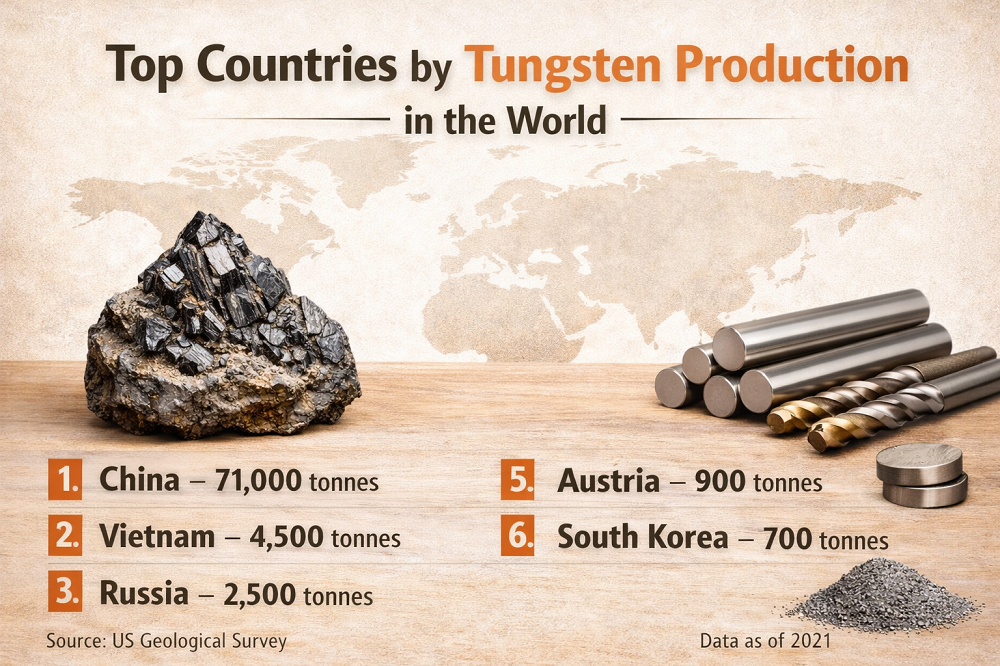
World tungsten production by country: 2025 ranking
Tungsten is one of the most strategically important industrial metals because it is hard, heat-resistant, dense, and difficult to replace in many high-performance applications. The latest comparable global mine-production snapshot currently available is the 2025 estimate published by the U.S. Geological Survey in its 2026 Mineral Commodity Summaries. That dataset measures mine output in metric tons of tungsten content, which is the right basis for cross-country comparison.
Thank you for reading this post, don't forget to subscribe!The core result is clear: the global tungsten market is still dominated by one country. China alone is estimated to have produced 67,000 metric tons in 2025 out of a world total of 85,000. Vietnam remained a distant second, and the rest of the market was split among a small group of mid-sized producers such as Kazakhstan, Russia, North Korea, Bolivia, Rwanda, Australia, Austria, and Spain.
This ranking is about mine production. It is not the same as refined tungsten output, exports, or reserves. That distinction matters because a country can be influential in processing and trade even if its mine output is smaller.
Top 10 countries by tungsten mine production in 2025
Latest available year: 2025 estimate. Unit: metric tons of tungsten content. Share is calculated against the USGS world total of 85,000 metric tons. Portugal, at 700 t, sits just outside the top ten.
| Rank | Country | Production (t W content) | Share of world |
|---|---|---|---|
| 1 | China | 67,000 | 78.82% |
| 2 | Vietnam | 3,000 | 3.53% |
| 3 | Kazakhstan | 2,400 | 2.82% |
| 4 | Russia | 2,000 | 2.35% |
| 5 | North Korea | 2,000 | 2.35% |
| 6 | Bolivia | 1,700 | 2.00% |
| 7 | Rwanda | 1,300 | 1.53% |
| 8 | Australia | 1,000 | 1.18% |
| 9 | Austria | 840 | 0.99% |
| 10 | Spain | 800 | 0.94% |
Source basis: USGS Mineral Commodity Summaries 2026, tungsten chapter, using 2025 estimated mine production. Smaller producing countries are not all listed individually by USGS for 2025; part of the remaining output is grouped under “Other countries.”
Chart: tungsten production leaders in 2025
The chart shows just how concentrated the market remains. China is not merely first; its output is several times larger than the rest of the ranked field combined. That kind of concentration is why tungsten keeps appearing in discussions about critical minerals, strategic autonomy, and industrial resilience.
Fallback ranked list:
- China — 67,000 t
- Vietnam — 3,000 t
- Kazakhstan — 2,400 t
- Russia — 2,000 t
- North Korea — 2,000 t
- Bolivia — 1,700 t
- Rwanda — 1,300 t
- Australia — 1,000 t
- Austria — 840 t
- Spain — 800 t
USGS also reported that world mine production rose from 82,000 t in 2024 to 85,000 t in 2025, with additional supply helped by the start of production at the Boguty deposit in Kazakhstan.
Methodology
This article uses the latest available official global mine-production snapshot for tungsten, which is the 2025 estimate published by the U.S. Geological Survey in Mineral Commodity Summaries 2026. The USGS table reports output in metric tons of tungsten content, which makes country values comparable even when ore grades and concentrate forms differ. That is the right unit for a mine-production ranking.
The ranking is sorted from highest to lowest using those 2025 estimates. World share percentages are calculated here as country production divided by the reported world total of 85,000 metric tons. Shares are rounded to two decimals. Because the USGS world total is itself rounded, the sum of country-level rows and the world total may not match perfectly down to the last ton.
One limitation needs to be stated clearly. The latest USGS table does not list every small producer separately for 2025. Instead, some production is grouped under “Other countries.” That means a complete long-tail ranking for the latest year is not always possible from the official top-line table alone. To interpret concentration and the shape of the smaller-producer tail, this article also draws context from World Mining Data 2025, an official publication based on 2023 mining output data from the Austrian Federal Ministry of Finance system.
Another limitation is that mine production tells only one part of the story. Tungsten supply chains also depend on refining, processing, recycling, inventory management, export controls, and logistics. A country with modest mine output can still matter greatly if it has strong downstream processing capacity. That is why production rankings should be read as a starting point, not the whole market.
Key insights and interpretation
The clearest takeaway is the scale of Chinese dominance. With almost four-fifths of world mine production in the latest USGS estimate, China remains the anchor of the entire tungsten raw-material chain. That does not mean every tonne of tungsten outside China is irrelevant. It means the rest of the world still operates in a market where one producer overwhelmingly influences supply balance, pricing power, and policy risk.
Below China, the market has a real but fragmented second tier. Vietnam is clearly the largest producer after China, yet it is still far behind in absolute tonnage. After that, the market quickly becomes a mosaic of mid-sized and smaller producers. Kazakhstan’s jump into the upper tier is especially important because it shows that new or restarted projects can matter in a tight market even when they do not fundamentally alter China’s leadership.
The broader pattern is concentration risk. World Mining Data’s detailed 2023 ranking already showed a highly concentrated structure, with China far ahead and only a small number of countries above 1,000 metric tons. The latest 2025 USGS estimate points in the same direction. In practice, this means manufacturers, defense suppliers, mining equipment producers, tooling firms, and specialty-alloy users should care about country concentration as much as they care about the headline world total.
Policy risk now matters more than before. The USGS noted that China implemented new export controls on selected tungsten items in February 2025, while prices rose sharply through the year. That does not automatically translate into a permanent shortage, but it does mean procurement strategy, stock planning, and diversification of feedstock sources are becoming more important for industrial buyers.
What this means for readers
For general readers, this ranking is a good reminder that some metals are strategically important far beyond their visibility in everyday life. Tungsten sits deep inside the industrial economy: cutting tools, drilling, wear-resistant parts, electrical applications, welding, high-density alloys, and defense hardware all rely on its unusual physical properties.
For investors and commodity watchers, the main point is not simply “China is number one.” The more useful takeaway is that a market with this degree of mine-supply concentration can react quickly to policy shifts, operational disruptions, or transport bottlenecks. Smaller producers can benefit from such moments, but they usually do not replace the dominant supplier overnight.
For manufacturers and procurement teams, the ranking argues for supplier diversification, realistic lead-time planning, and closer attention to recycled tungsten streams. In a market this concentrated, resilience comes from sourcing strategy as much as from the nominal size of the world total.
FAQ
Why is China so far ahead in tungsten production?
China combines a very large resource base, a deep mining and processing ecosystem, and decades of industrial specialization in tungsten. That combination is difficult for other countries to replicate quickly.
Is this ranking based on ore tonnage or pure tungsten?
It is based on tungsten content, not crude ore tonnage. That is the correct way to compare mine production across countries with different ore grades and concentrate types.
Why is Vietnam second but still so far behind China?
Vietnam is a meaningful producer in global terms, but the absolute scale gap is enormous. China’s 2025 estimate is more than twenty times Vietnam’s output, which shows how concentrated the market remains even beyond the top two.
Why did Kazakhstan move into the top tier?
According to the USGS, world mine production increased in 2025 partly because of the start of production at the Boguty deposit in Kazakhstan. In a tight and concentrated market, one new project can materially change the country ranking.
Does mine production tell me who controls the whole tungsten market?
Not fully. Mine production is the upstream part of the chain. Processing, refining, recycling, exports, and product manufacturing also matter. A country can be strategically important even with lower mine output if it has strong downstream capacity.
Why are some smaller countries missing from the latest-year list?
The latest USGS table groups part of 2025 output into “Other countries,” so not every small producer is published separately in that summary table. That is why this article is precise about what can and cannot be ranked for the latest year.
What industries care most about tungsten supply?
Tungsten matters most in cemented carbides and hard metals used in metalworking, mining, and construction, but it also matters in electronics, heating and welding applications, high-density alloys, aerospace-related uses, and defense systems.
Sources
-
U.S. Geological Survey — Mineral Commodity Summaries 2026, Tungsten.
Latest official summary with 2024 and 2025 mine-production estimates, world total, reserves, and 2025 market developments.
https://pubs.usgs.gov/periodicals/mcs2026/mcs2026-tungsten.pdf -
U.S. Geological Survey — Tungsten Statistics and Information.
Official overview of tungsten uses and data resources from the National Minerals Information Center.
https://www.usgs.gov/centers/national-minerals-information-center/tungsten-statistics-and-information -
World Mining Data 2025.
Official international mining publication used here for concentration context and the longer producer tail based on 2023 data.
https://www.world-mining-data.info/wmd/downloads/PDF/WMD%202025.pdf -
European Commission — European Critical Raw Materials Act.
Official policy page showing why tungsten matters for strategic industrial supply chains, including space and defense uses.
https://commission.europa.eu/topics/competitiveness/green-deal-industrial-plan/european-critical-raw-materials-act_en
Updated for publication using the latest official global mine-production estimates available as of April 2026.

StatRanker (Website)
administrator