Top 100 Cities by Walkability, 2026
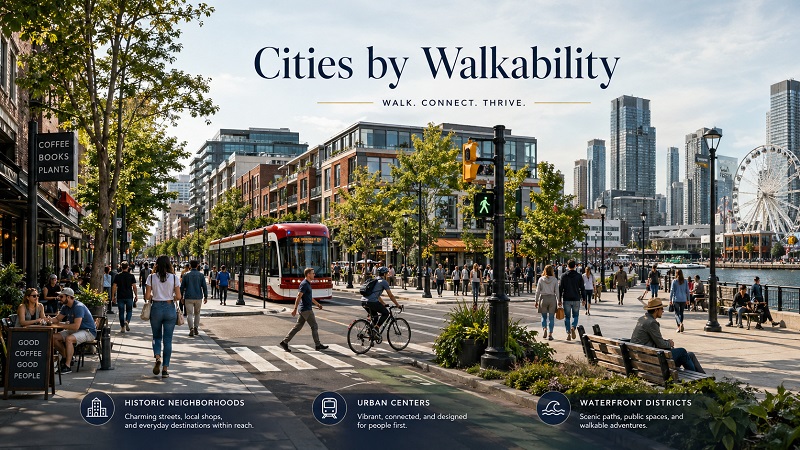
Where walking-based city experiences are strongest in 2026
Walkability is the ability to experience a city comfortably on foot: short distances between sights, active street life, safe and readable public space, memorable urban form and enough pedestrian-friendly routes to make walking the natural choice. This 2026 ranking uses the GuruWalk Best 100 Walking Cities list as a walking-tourism snapshot, so it reflects where travelers actually walked with local guides and how strongly they rated the experience.
Overview: what the 2026 traveler ranking shows
Rome keeps the first position, followed by Madrid, Budapest, Prague and Lisbon. The top of the ranking is heavily European because compact historic centers, mixed-use streets, dense public spaces and strong tourism ecosystems make many European cities easy to explore on foot. Spain is especially prominent, with Madrid, Barcelona, Seville, Toledo, Santiago de Compostela, Málaga, Granada, Valencia and several smaller northern cities all appearing in the list.
The ranking also shows a broader global shift. Tokyo reaches the top 20, New York climbs to 23rd as the only United States city in the list, and Latin American cities such as Santiago, Medellín, Mexico City, Buenos Aires, Cartagena, Cusco, Bogotá and Lima confirm that walkable visitor districts are not limited to Europe. The result is best read as a traveler-oriented walkability ranking, not as a city-hall audit of sidewalks, crossings or accessibility standards.
Continue exploring
More StatRanker rankings on health systems, outcomes and medical capacity.
Largest Cities in the World by Population: 2026 Snapshot Based on UN 2025 Estimates
Open rankingLargest U.S. Cities by Population: 2026 Snapshot Based on 2025 Census Estimates
Open rankingUS Cities by Job Growth, 2026
Open rankingChart: Top 20 walking cities, 2026
The visual below keeps the source ranking order. The bar length is a simple position index where rank #1 equals 100 and rank #20 equals 81. It is not an additional official score; it helps readers compare the top cluster at a glance.
Full Top 100 walking cities table
Use the controls to search by city or country, filter by region and switch between the first 10, first 20 or the full 100-city list.
| Rank | City | Country | Region |
|---|---|---|---|
| 1 | Rome | Italy | Europe |
| 2 | Madrid | Spain | Europe |
| 3 | Budapest | Hungary | Europe |
| 4 | Prague | Czech Republic | Europe |
| 5 | Lisbon | Portugal | Europe |
| 6 | Amsterdam | Netherlands | Europe |
| 7 | Porto | Portugal | Europe |
| 8 | Barcelona | Spain | Europe |
| 9 | London | United Kingdom | Europe |
| 10 | Berlin | Germany | Europe |
| 11 | Paris | France | Europe |
| 12 | Seville | Spain | Europe |
| 13 | Istanbul | Turkey | Europe |
| 14 | Krakow | Poland | Europe |
| 15 | Florence | Italy | Europe |
| 16 | Vienna | Austria | Europe |
| 17 | Toledo | Spain | Europe |
| 18 | Dublin | Ireland | Europe |
| 19 | Dubrovnik | Croatia | Europe |
| 20 | Tokyo | Japan | Asia |
| 21 | Split | Croatia | Europe |
| 22 | Santiago de Compostela | Spain | Europe |
| 23 | New York | United States | Americas |
| 24 | Bucharest | Romania | Europe |
| 25 | Santiago | Chile | Americas |
| 26 | Málaga | Spain | Europe |
| 27 | Granada | Spain | Europe |
| 28 | Brussels | Belgium | Europe |
| 29 | Bruges | Belgium | Europe |
| 30 | Ljubljana | Slovenia | Europe |
| 31 | Valencia | Spain | Europe |
| 32 | Medellín | Colombia | Americas |
| 33 | Mexico City | Mexico | Americas |
| 34 | Buenos Aires | Argentina | Americas |
| 35 | Kyoto | Japan | Asia |
| 36 | Marseille | France | Europe |
| 37 | Hanoi | Vietnam | Asia |
| 38 | Ho Chi Minh City | Vietnam | Asia |
| 39 | Zagreb | Croatia | Europe |
| 40 | Naples | Italy | Europe |
| 41 | Copenhagen | Denmark | Europe |
| 42 | Helsinki | Finland | Europe |
| 43 | Sarajevo | Bosnia and Herzegovina | Europe |
| 44 | Tirana | Albania | Europe |
| 45 | Edinburgh | United Kingdom | Europe |
| 46 | A Coruña | Spain | Europe |
| 47 | Valletta | Malta | Europe |
| 48 | Cartagena | Colombia | Americas |
| 49 | Cusco | Peru | Americas |
| 50 | Sofia | Bulgaria | Europe |
| 51 | Milan | Italy | Europe |
| 52 | Kuala Lumpur | Malaysia | Asia |
| 53 | Kotor | Montenegro | Europe |
| 54 | Warsaw | Poland | Europe |
| 55 | Cairo | Egypt | Africa |
| 56 | Marrakech | Morocco | Africa |
| 57 | Bratislava | Slovakia | Europe |
| 58 | Oviedo | Spain | Europe |
| 59 | Cádiz | Spain | Europe |
| 60 | Fez | Morocco | Africa |
| 61 | Toulouse | France | Europe |
| 62 | Shanghai | China | Asia |
| 63 | Munich | Germany | Europe |
| 64 | Hoi An | Vietnam | Asia |
| 65 | Hamburg | Germany | Europe |
| 66 | Zaragoza | Spain | Europe |
| 67 | Tbilisi | Georgia | Asia |
| 68 | Lyon | France | Europe |
| 69 | Stockholm | Sweden | Europe |
| 70 | Singapore | Singapore | Asia |
| 71 | Valladolid | Spain | Europe |
| 72 | Strasbourg | France | Europe |
| 73 | Riga | Latvia | Europe |
| 74 | Donostia-San Sebastián | Spain | Europe |
| 75 | Nuremberg | Germany | Europe |
| 76 | Gdańsk | Poland | Europe |
| 77 | Ghent | Belgium | Europe |
| 78 | Mérida | Mexico | Americas |
| 79 | Pamplona | Spain | Europe |
| 80 | Bordeaux | France | Europe |
| 81 | Hiroshima | Japan | Asia |
| 82 | Zurich | Switzerland | Europe |
| 83 | Bilbao | Spain | Europe |
| 84 | Panama City | Panama | Americas |
| 85 | Bogotá | Colombia | Americas |
| 86 | Lima | Peru | Americas |
| 87 | Gijón | Spain | Europe |
| 88 | Tallinn | Estonia | Europe |
| 89 | Salamanca | Spain | Europe |
| 90 | Athens | Greece | Europe |
| 91 | Venice | Italy | Europe |
| 92 | Zadar | Croatia | Europe |
| 93 | Salvador de Bahía | Brazil | Americas |
| 94 | Rio de Janeiro | Brazil | Americas |
| 95 | Santander | Spain | Europe |
| 96 | Belfast | United Kingdom | Europe |
| 97 | Oaxaca | Mexico | Americas |
| 98 | Liverpool | United Kingdom | Europe |
| 99 | Nice | France | Europe |
| 100 | Antigua Guatemala | Guatemala | Americas |
Source: GuruWalk Best 100 Walking Cities 2026, published April 21, 2026. The ranking uses verified traveler activity from April 2025 to April 2026. Page updated: April 25, 2026.
Methodology
This page uses the GuruWalk Best 100 Walking Cities 2026 list as its primary ranking source. The underlying ranking is based on real walking-tour activity over the previous twelve months, from April 2025 to April 2026. GuruWalk states that the dataset includes more than 467,000 verified reviews, 3,600 tours and more than 800 cities. The final score combines traveler volume with satisfaction: 65% of the weighting comes from volume and 35% from traveler ratings.
The word “walkability” can mean different things depending on context. In urban planning, it normally includes density, land-use mix, street connectivity, sidewalk quality, safe crossings, access to transit, shade, traffic speed and pedestrian priority. In this article, the ranking is narrower: it measures walkability as experienced by travelers on guided walking routes and historic or cultural city walks. That makes it especially useful for lifestyle, tourism and city-experience comparisons, but less suitable as a full engineering audit of pedestrian infrastructure.
Rows were normalized into city, country and broad region fields so readers can search and compare the published list more easily. The chart uses the published rank order only. Because GuruWalk does not publish a public numeric score for every city in this source article, this page does not invent one.
Important interpretation: a high position means that a city performs strongly as a place visitors choose and enjoy exploring on foot. It does not automatically mean that every neighborhood is safe, accessible, step-free, shaded or equally pleasant for residents with different mobility needs.
Insights from the ranking
Historic density wins
Rome, Madrid, Budapest, Prague, Lisbon, Amsterdam and Porto show the advantage of compact historic centers. Visitors can move between major landmarks, public squares, cafés, museums and viewpoints without needing a car.
Europe dominates, but not alone
Europe has the deepest representation, but Asia and the Americas are clearly visible. Tokyo, Kyoto, Hanoi, Ho Chi Minh City, Shanghai, Singapore, Santiago, Medellín, Mexico City and Buenos Aires broaden the map.
Small cities can compete with capitals
Toledo, Dubrovnik, Santiago de Compostela, Bruges, Ljubljana, Kotor, Oviedo, Cádiz, Hoi An and Antigua Guatemala show that compactness and identity can matter as much as metropolitan scale.
Tourist walkability is not resident equity
A city can be excellent for visitor routes while still having gaps in accessibility, heat protection, traffic safety or everyday walkability in outer districts. The ranking is strongest when used alongside transport and public-space indicators.
What this means for readers
For travelers, the ranking is a practical shortlist of cities where walking is likely to be part of the main experience rather than a secondary activity. High-ranking cities tend to reward slow exploration: historic streets, layered architecture, accessible public squares, local food districts and enough route density to fill several days without constant transfers.
For people comparing places to live, study or work remotely, the table is a starting signal rather than a final decision tool. Strong walking-tour performance often overlaps with cultural depth and central-area livability, but daily life also depends on housing costs, transit reliability, air quality, climate, safety after dark and accessibility for people with disabilities.
For city planners and local businesses, the ranking highlights the economic value of streets that invite people to stay outdoors. Walkable districts support cafés, museums, small retailers, guided tours and public life. They also reduce the need for short car trips, making tourism less dependent on congestion-heavy movement.
FAQ
Is this a ranking of pedestrian infrastructure?
Not exactly. It is a ranking of cities that perform strongly for walking-based travel experiences. It reflects traveler volume and satisfaction on guided walking tours, not a full audit of sidewalks, crossings, curb ramps, traffic speeds or accessibility.
Why is Rome ranked first?
Rome combines dense historic fabric, global landmarks, layered street life and a very strong walking-tour ecosystem. Its attractions are spread across walkable districts where the journey between sights is part of the experience.
Why do European cities dominate the top positions?
Many European cities have older compact cores, short blocks, mixed uses, public squares and pedestrian-oriented heritage districts. Those features match the way travelers discover cities on foot.
Why is New York only 23rd if it is highly walkable?
New York is highly walkable in many planning and real-estate metrics, but this specific ranking is based on walking-tour activity and satisfaction across the GuruWalk platform. It measures a travel-experience signal, not only street-network walkability.
Can this ranking be used for relocation decisions?
It can help identify cities with strong pedestrian appeal, but relocation requires additional checks: rent, commute, public transport, safety, healthcare, schools, climate, language and visa rules.
What is the biggest limitation of the ranking?
Platform coverage matters. Cities with active walking-tour markets and many reviews are more likely to score well. Less-touristed but genuinely walkable cities may be underrepresented if they have lower platform activity.
Sources
-
GuruWalk — Best 100 Walking Cities 2026.
Primary source for the Top 100 ranking, published April 21, 2026, based on verified reviews, tour activity and satisfaction.
https://blog.guruwalk.com/top-100-walking-cities-2026-en/ -
GuruWalk — methodology note for the 2026 ranking.
Used for the source methodology: April 2025–April 2026 activity, 467,000+ verified reviews, 3,600 tours, 800+ cities, 65% traveler volume and 35% satisfaction weighting.
https://discover.guruwalk.com/en/best-100-walking-cities-2026-guruwalk-reveals-the-worlds-top-cities-to-explore-on-foot/ -
Institute for Transportation and Development Policy — Pedestrians First.
Used for the broader urban-planning interpretation of walkability as a measurable urban environment concept.
https://itdp.org/publication/walkability-tool/ -
Global Observatory of Healthy and Sustainable Cities.
Used for context on evidence-based spatial indicators, healthy cities and comparable urban measurement.
https://www.healthysustainablecities.org/about/ -
Walk Score — Cities and Neighborhoods.
Used as a reference point for the narrower real-estate and neighborhood-access meaning of walkability.
https://www.walkscore.com/cities-and-neighborhoods/
Related rankings
More StatRanker rankings on health systems, outcomes and medical capacity.
Cities by Public Transport Monthly Pass Price, 2026
Open rankingU.S. Metro Areas by Monthly Rent, 2026
Open rankingUS Cities by Air Quality, 2026
Open rankingCalifornia Cities by Air Quality, 2026
Open ranking
StatRanker (Website)
administrator