

Top 100 Cities by Hotel Price, 2026
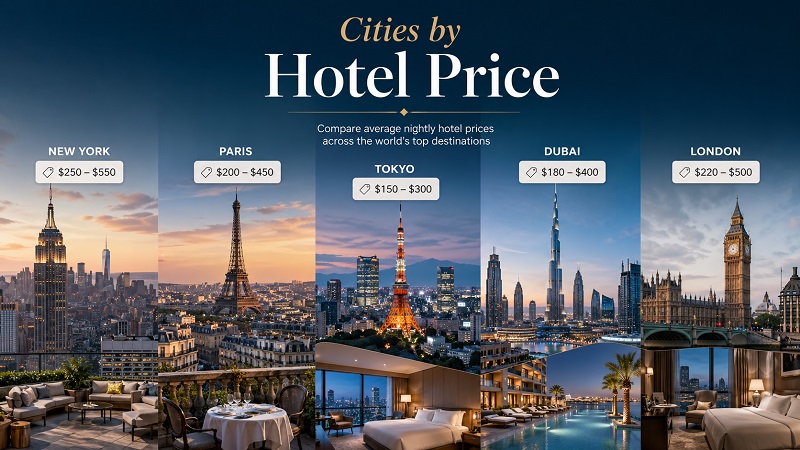
Where hotel stays are most expensive in the 2026 travel-planning edition
Hotel price is one of the clearest signals of travel demand, room supply, business activity and destination pressure. A high average nightly rate does not mean every stay in the city is expensive, but it shows where a well-located standard hotel room is most likely to take a large share of a visitor’s budget.
This ranking estimates average hotel-room prices across major global travel cities. Values are expressed in US dollars per night for a standard double room in a well-located mid-market to upper-mid-market hotel, using normal travel-date conditions rather than peak mega-event dates. The 2026 edition uses recent hotel-rate observations, tourism demand indicators and inflation context from 2025 as the basis for a travel-planning snapshot.
Updated: April 25, 2026. Metric: modeled average nightly hotel price, USD.
Continue exploring
More StatRanker rankings on health systems, outcomes and medical capacity.
Cities by Public Transport Monthly Pass Price, 2026
Open rankingCities by Restaurant Meal Price, 2026
Open rankingCalifornia Cities by Median Home Sale Price, 2026
Open rankingWhat the top of the ranking shows
The most expensive hotel cities are not all the same type of destination. Monaco, Santorini, Venice and Honolulu are driven mainly by high-end leisure demand and limited prime-location inventory. Geneva, Zurich, New York City, Boston, San Francisco and London combine business travel, conventions, premium corporate demand and strong international visitor flows. Paris, Reykjavik and Amsterdam sit between those groups: cultural demand is heavy, but room supply in central districts is constrained.
The price gap is large. A traveler booking a central standard hotel in the most expensive cities may face nightly rates three to eight times higher than in lower-priced Asian, African or Latin American cities that still appear in the Top 100 because of strong tourism or business relevance. That gap matters for families, event visitors, digital nomads and companies managing travel budgets.
Use the ranking to compare hotel-cost differences between cities, not to predict the exact checkout price for a specific booking. Actual prices can move sharply around holidays, conferences, festivals, sports events, school breaks and local peak seasons.
Top 100 cities by estimated average hotel price, 2026
Use the controls to compare cities by region, market type, ranking depth and estimated price trend. All 100 cities are listed below, with the Top 20 shown first for a faster overview.
| Rank | City | Avg hotel price | Estimated price trend |
|---|---|---|---|
| 1 | Monaco / Monte Carlo, Monaco | $390Index 100 | +5.8% |
| 2 | Geneva, Switzerland | $345Index 100 | +4.9% |
| 3 | New York City, United States | $338Index 100 | +5.6% |
| 4 | Zurich, Switzerland | $326Index 100 | +4.5% |
| 5 | Boston, United States | $309Index 100 | +4.7% |
| 6 | San Francisco, United States | $298Index 100 | +3.9% |
| 7 | London, United Kingdom | $292Index 100 | +5.1% |
| 8 | Paris, France | $286Index 100 | +4.8% |
| 9 | Reykjavik, Iceland | $279Index 100 | +5.3% |
| 10 | Santorini, Greece | $274Index 100 | +6.2% |
| 11 | Venice, Italy | $268Index 100 | +4.6% |
| 12 | Copenhagen, Denmark | $262Index 100 | +4.1% |
| 13 | Amsterdam, Netherlands | $258Index 100 | +4.4% |
| 14 | Dubai, United Arab Emirates | $254Index 100 | +4.0% |
| 15 | Singapore, Singapore | $248Index 100 | +3.7% |
| 16 | Hong Kong, China | $241Index 100 | +3.5% |
| 17 | Tokyo, Japan | $236Index 100 | +4.9% |
| 18 | Sydney, Australia | $232Index 100 | +3.8% |
| 19 | Honolulu, United States | $229Index 100 | +4.6% |
| 20 | Miami Beach, United States | $226Index 100 | +4.3% |
| 21 | Los Angeles, United States | $222Index 100 | +3.9% |
| 22 | Washington, D.C., United States | $218Index 100 | +3.6% |
| 23 | Dublin, Ireland | $215Index 100 | +4.7% |
| 24 | Edinburgh, United Kingdom | $211Index 100 | +4.5% |
| 25 | Seattle, United States | $208Index 100 | +3.3% |
| 26 | Doha, Qatar | $205Index 100 | +3.8% |
| 27 | Rome, Italy | $202Index 100 | +4.2% |
| 28 | Florence, Italy | $199Index 100 | +4.6% |
| 29 | Barcelona, Spain | $196Index 100 | +4.3% |
| 30 | Madrid, Spain | $193Index 100 | +3.7% |
| 31 | Vienna, Austria | $190Index 100 | +3.5% |
| 32 | Munich, Germany | $188Index 100 | +3.4% |
| 33 | Las Vegas, United States | $186Index 100 | +3.2% |
| 34 | Aspen, United States | $184Index 100 | +5.0% |
| 35 | Queenstown, New Zealand | $181Index 100 | +4.1% |
| 36 | Oslo, Norway | $179Index 100 | +3.3% |
| 37 | Stockholm, Sweden | $176Index 100 | +3.1% |
| 38 | Milan, Italy | $174Index 100 | +3.7% |
| 39 | Nice, France | $172Index 100 | +4.2% |
| 40 | Vancouver, Canada | $169Index 100 | +3.6% |
| 41 | Toronto, Canada | $167Index 100 | +3.2% |
| 42 | Chicago, United States | $165Index 100 | +2.9% |
| 43 | Seoul, South Korea | $162Index 100 | +3.9% |
| 44 | Kyoto, Japan | $160Index 100 | +4.8% |
| 45 | Melbourne, Australia | $158Index 100 | +3.1% |
| 46 | Hamburg, Germany | $156Index 100 | +2.8% |
| 47 | Berlin, Germany | $154Index 100 | +3.0% |
| 48 | Brussels, Belgium | $152Index 100 | +2.7% |
| 49 | Lisbon, Portugal | $150Index 100 | +4.4% |
| 50 | Porto, Portugal | $148Index 100 | +4.1% |
| 51 | Prague, Czechia | $146Index 100 | +3.8% |
| 52 | Athens, Greece | $144Index 100 | +4.5% |
| 53 | Auckland, New Zealand | $142Index 100 | +2.9% |
| 54 | Tel Aviv, Israel | $140Index 100 | +3.2% |
| 55 | Abu Dhabi, United Arab Emirates | $138Index 100 | +4.4% |
| 56 | Riyadh, Saudi Arabia | $136Index 100 | +4.7% |
| 57 | Bangkok, Thailand | $134Index 100 | +4.2% |
| 58 | Phuket, Thailand | $132Index 100 | +4.8% |
| 59 | Bali / Denpasar, Indonesia | $130Index 100 | +5.1% |
| 60 | Marrakech, Morocco | $128Index 100 | +4.6% |
| 61 | Cape Town, South Africa | $126Index 100 | +3.9% |
| 62 | Istanbul, Turkey | $124Index 100 | +4.3% |
| 63 | Budapest, Hungary | $122Index 100 | +3.5% |
| 64 | Warsaw, Poland | $120Index 100 | +3.1% |
| 65 | Krakow, Poland | $118Index 100 | +3.4% |
| 66 | Tallinn, Estonia | $116Index 100 | +3.2% |
| 67 | Helsinki, Finland | $114Index 100 | +2.7% |
| 68 | Ljubljana, Slovenia | $112Index 100 | +3.0% |
| 69 | Dubrovnik, Croatia | $110Index 100 | +4.7% |
| 70 | Split, Croatia | $108Index 100 | +4.3% |
| 71 | Mexico City, Mexico | $106Index 100 | +3.6% |
| 72 | Cancun, Mexico | $104Index 100 | +4.1% |
| 73 | Buenos Aires, Argentina | $102Index 100 | +4.8% |
| 74 | Santiago, Chile | $100Index 100 | +3.2% |
| 75 | Lima, Peru | $98Index 100 | +3.4% |
| 76 | Bogota, Colombia | $96Index 100 | +3.1% |
| 77 | Rio de Janeiro, Brazil | $94Index 100 | +3.7% |
| 78 | Sao Paulo, Brazil | $92Index 100 | +2.9% |
| 79 | Panama City, Panama | $90Index 100 | +3.2% |
| 80 | San Jose, Costa Rica | $88Index 100 | +3.5% |
| 81 | Kuala Lumpur, Malaysia | $86Index 100 | +3.0% |
| 82 | Ho Chi Minh City, Vietnam | $84Index 100 | +3.9% |
| 83 | Hanoi, Vietnam | $82Index 100 | +3.6% |
| 84 | Taipei, Taiwan | $80Index 100 | +2.8% |
| 85 | Shanghai, China | $78Index 100 | +2.6% |
| 86 | Beijing, China | $76Index 100 | +2.5% |
| 87 | Guangzhou, China | $74Index 100 | +2.3% |
| 88 | Shenzhen, China | $72Index 100 | +2.4% |
| 89 | Manila, Philippines | $70Index 100 | +3.3% |
| 90 | Cebu, Philippines | $68Index 100 | +3.7% |
| 91 | Delhi, India | $66Index 100 | +3.2% |
| 92 | Mumbai, India | $64Index 100 | +3.5% |
| 93 | Bengaluru, India | $62Index 100 | +3.1% |
| 94 | Jaipur, India | $60Index 100 | +3.8% |
| 95 | Cairo, Egypt | $58Index 100 | +4.0% |
| 96 | Nairobi, Kenya | $56Index 100 | +3.6% |
| 97 | Lagos, Nigeria | $54Index 100 | +3.8% |
| 98 | Accra, Ghana | $52Index 100 | +3.5% |
| 99 | Tbilisi, Georgia | $50Index 100 | +3.9% |
| 100 | Yerevan, Armenia | $48Index 100 | +3.7% |
Estimated average nightly hotel price in USD for a standard double room in a well-located mid-market to upper-mid-market hotel. Based on recent hotel-rate observations, tourism demand indicators and 2025 inflation context. Updated: April 25, 2026.
Top 20 hotel price comparison
The chart highlights the sharp premium at the top of the ranking. The most expensive destinations combine limited central inventory with intense leisure, business or event demand.
Price tiers and regional patterns
These are the most supply-constrained or premium-demand cities. Luxury leisure, finance, conventions and scarce central hotel inventory push rates far above the global city average.
This group includes global capitals, major US leisure cities, high-income Asian hubs and destinations where international demand is strong across much of the year.
Large European, North American, Middle Eastern and Oceania cities dominate this range. Prices are still high for travelers, but the premium is less extreme than in the top tier.
Many Asian, African and Latin American cities remain comparatively affordable for hotels, even when they are major business or tourism destinations. Airfare, safety, seasonality and local transport still affect the full trip budget.
Methodology
Hotel price is measured as a modeled average nightly rate in US dollars for a standard double room in a well-located mid-market to upper-mid-market hotel. The benchmark is designed around normal travel dates and excludes short peak distortions from mega-events where possible. Ultra-luxury properties are not used as the sole reference point because they would exaggerate prices in resort and wealth-hub destinations. The lowest visible rooms are also excluded because they often reflect hostels, distant suburbs, low-rated accommodation or promotional inventory that does not represent a typical visitor stay.
Hotel rates change throughout the year, so the 2026 label should be read as a planning edition rather than a fixed annual average. No single official global register ranks cities by comparable hotel-room prices. StatRanker therefore treats this page as an estimated city benchmark built from publicly visible hotel-rate ranges, tourism demand data, hotel-market indicators, inflation conditions and prices converted to US dollars for comparison. Values are rounded to the nearest US dollar. The “estimated price trend” field is a directional reading of recent market movement, not an official annual growth statistic.
Comparability is limited by seasonality, local taxes, resort fees, booking platform coverage, hotel classification differences, cancellation terms and city geography. A central hotel in Paris, New York or Tokyo is not directly comparable with an airport-area or suburban hotel in the same metropolitan region. Major events can also move prices sharply for short periods, so the ranking should be read as a city-level travel-cost benchmark rather than a guaranteed booking quote.
Key insights from the ranking
The top of the list is split between luxury leisure destinations and global business hubs. In leisure markets, prices rise because prime land is scarce, peak seasons are intense and visitors compete for a limited number of central or high-quality rooms. In business hubs, weekday corporate demand, conferences and international connectivity support high average rates even outside holiday periods.
Europe has a strong presence in the upper half because many cities combine historic central districts, strict planning limits and resilient cultural tourism. North American cities rank high where business travel, events and domestic leisure demand overlap. Asian cities show a wider spread: Singapore, Hong Kong and Tokyo are expensive, while many major Southeast Asian and Indian cities remain far more affordable on hotel price alone.
A lower hotel price does not automatically mean a cheaper trip. Airfare, local transport, visa costs, food, safety, exchange rates and attraction prices can change the final budget. Hotel price is most useful when treated as one component of total travel cost.
What this means for travelers
Travelers should use the ranking as an early budget filter. Cities in the top price tiers reward early booking, flexible dates and careful neighborhood choice. A short stay in a high-price city may still be manageable, but longer trips, family travel and event-week visits can become expensive very quickly.
Business travelers can use the ranking to set realistic accommodation caps before approving trips. Vacation travelers can compare hotel costs with airfare and daily spending. Digital nomads should pay special attention to the median and lower half of the Top 100, where accommodation can remain affordable without giving up access to major airports, culture and services.
FAQ
Small cities can be expensive when demand is strong and hotel supply is limited. Monaco, Santorini and some Alpine or island destinations have fewer central rooms than large capitals, so high-income leisure demand pushes nightly rates upward.
No. The ranking measures hotel accommodation, not the full cost of living or the total travel budget. Food, public transport, taxis, museums and airfare can tell a different story.
The estimates are intended to represent comparable nightly room prices in USD. Local taxes, city fees and resort fees vary by destination and booking platform, so travelers should check the final checkout price before booking.
Hotel prices respond to occupancy, seasonality, events, holidays and booking lead time. A city can be affordable in shoulder season and very expensive during a major festival, trade fair or sports event.
No. Business hubs often have high weekday rates, but leisure destinations can be more expensive during peak seasons. The highest prices usually appear when business, leisure and limited room supply overlap.
Use it to estimate the accommodation part of the trip budget, then compare dates and neighborhoods. For high-price cities, booking early and avoiding event weeks can make a large difference.
Platforms may cover different hotels, room types, cancellation rules, taxes, loyalty rates and availability windows. That is why this ranking uses harmonised estimates rather than treating a single displayed price as the city average.
Sources
Provides global tourism momentum, international arrivals context and background on accommodation costs in travel conditions.
https://www.unwto.org/tourism-data/global-and-regional-tourism-performance
Supplies European accommodation demand context, nights spent in tourist accommodation and cross-country tourism statistics.
Adds policy context on tourism recovery, travel economies and price conditions after the post-pandemic rebound.
https://www.oecd.org/en/publications/oecd-tourism-trends-and-policies-2024_80885d8b-en.html
Provides hotel-market indicators such as ADR, RevPAR and market-level performance trends, which help interpret pricing conditions in commercial accommodation markets.
https://www.costar.com/products/str-benchmark/resources/data-insights-blog
Helps explain the inflation and currency environment that can influence hotel prices when converted to USD.
Provide local tourism demand, hotel occupancy context, event calendars and destination-level accommodation signals where city-level public information is available.
Related rankings
More StatRanker rankings on health systems, outcomes and medical capacity.
US Cities by Home Price-to-Income Ratio, 2026
Open rankingTop 100 Cities by Housing Affordability (Price-to-Income Ratio), 2025
Open rankingLargest Cities in the World by Population: 2026 Snapshot Based on UN 2025 Estimates
Open rankingLargest U.S. Cities by Population: 2026 Snapshot Based on 2025 Census Estimates
Open ranking
StatRanker (Website)
administrator
