TOP 10 Countries by Irrigated Farmland Share (2025)
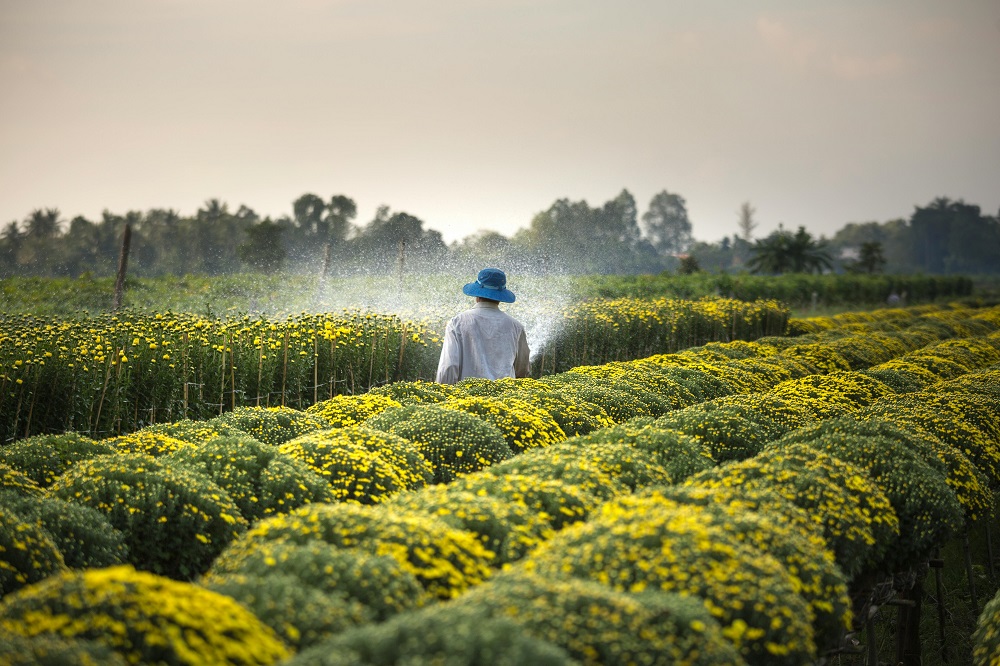
Countries Where Irrigation Covers the Largest Share of Farmland
Irrigated farmland share measures the percentage of a country’s agricultural land that is purposely supplied with water through irrigation. The indicator used here is Agricultural irrigated land (% of total agricultural land), World Bank code AG.LND.IRIG.AG.ZS, sourced from the Food and Agriculture Organization of the United Nations.
This is a 2025 data edition based on the latest available 2023 country observations. It is not a direct measurement of irrigation activity during calendar year 2025. The metric is useful for comparing how dependent agricultural systems are on managed water supply, but it does not measure irrigation efficiency, water stress, crop yields or the total number of irrigated hectares.
Highest share
Bangladesh
89.04%Second place
Suriname
Source
World Bank / FAO
AG.LND.IRIG.AG.ZSUnit
Irrigated agricultural land
% of total agricultural landOverview: what the ranking shows
The top of the ranking is shaped by countries where farming depends heavily on controlled water supply. Bangladesh leads because irrigation is central to rice and other crop systems across a densely cultivated landscape. Suriname ranks second, reflecting a much smaller agricultural land base where irrigated production accounts for a very large share of reported farmland.
South Asia is the strongest regional pattern in the table. Bangladesh, Pakistan, India and Nepal all appear in the Top 10, showing how irrigation supports food production in monsoon-influenced systems where rainfall timing is uneven and dry-season cultivation depends on water management. The list also includes dry or water-constrained economies such as Israel, Malta, Azerbaijan and the United Arab Emirates, where agriculture is more limited but often highly dependent on irrigation infrastructure.
A high irrigation share should not be read as a simple quality score. It can indicate productive water infrastructure, but it can also reveal exposure to groundwater depletion, river-basin stress, salinization, energy costs and climate variability.
Top 10 countries by irrigated farmland share
The countries below have the highest reported share of agricultural land that is irrigated in the latest World Bank / FAO observations available for this 2025 edition.
| Rank | Country | Irrigated farmland share | Region |
|---|---|---|---|
| 1 | Bangladesh | 89.04% | South Asia |
| 2 | Suriname | 74.36% | South America |
| 3 | Pakistan | 54.17% | South Asia |
| 4 | India | 44.41% | South Asia |
| 5 | Israel | 36.11% | Middle East |
| 6 | Malta | 33.87% | Europe |
| 7 | Nepal | 32.29% | South Asia |
| 8 | Azerbaijan | 30.63% | Caucasus / West Asia |
| 9 | United Arab Emirates | 23.99% | Middle East |
| 10 | Greece | 22.26% | Europe |
Data note: values are percentages of total agricultural land, based on World Bank / FAO 2023 observations. Countries without a reported value in the source series are not ranked.
Chart: the gap between the leaders and the rest
Bangladesh and Suriname stand clearly above the rest of the Top 10. Pakistan and India form the next tier, while the remaining countries cluster between roughly 22% and 36%. The distribution shows that irrigation dependence can be high in both densely farmed river systems and smaller dry-climate agricultural economies.
Values show irrigated agricultural land as a percentage of total agricultural land.
Methodology
The ranking uses World Bank indicator AG.LND.IRIG.AG.ZS, which reports agricultural irrigated land as a percentage of total agricultural land. The underlying source is FAO land-use data. Agricultural irrigated land refers to agricultural areas purposely provided with water, including land irrigated by controlled flooding and other artificial water-supply methods.
The 2025 edition uses the latest available country observations in the World Bank / FAO series, currently 2023 for the ranked countries shown here. Countries were sorted from highest to lowest by the reported percentage. Values are displayed to two decimal places in the tables and to one decimal place in the chart.
The indicator compares shares, not absolute irrigated area. India, for example, has a very large irrigated agricultural system, but the ranking position depends on irrigation as a percentage of total agricultural land. Countries with very small agricultural land bases can rank high when most reported farmland is irrigated.
International comparison has limits. FAO works with standard definitions, but reporting practices, land classifications, climate conditions, crop mixes and the treatment of pasture can differ by country. A high value may indicate strong irrigation infrastructure, but it may also point to dependence on scarce water resources.
Formula
Irrigated farmland share = irrigated agricultural land ÷ total agricultural land × 100.
What it does not show
The metric does not show crop productivity, water efficiency, total irrigated hectares, groundwater sustainability or the cost of maintaining irrigation systems.
Data table: irrigated agricultural land share
The table lists the ten countries with the highest reported irrigated agricultural land share in the latest World Bank / FAO data used for this edition.
| Rank | Country | Share of agricultural land irrigated | Data year |
|---|---|---|---|
| 1 | Bangladesh | 89.04% | 2023 |
| 2 | Suriname | 74.36% | 2023 |
| 3 | Pakistan | 54.17% | 2023 |
| 4 | India | 44.41% | 2023 |
| 5 | Israel | 36.11% | 2023 |
| 6 | Malta | 33.87% | 2023 |
| 7 | Nepal | 32.29% | 2023 |
| 8 | Azerbaijan | 30.63% | 2023 |
| 9 | United Arab Emirates | 23.99% | 2023 |
| 10 | Greece | 22.26% | 2023 |
Source: World Bank / FAO, Agricultural irrigated land (% of total agricultural land), indicator AG.LND.IRIG.AG.ZS. The ranking excludes countries and territories without a reported value in the source view.
Insights from the ranking
South Asia is the main cluster
Four of the ten countries are in South Asia. The pattern reflects the importance of irrigation in rice, wheat and other staple systems, especially where seasonal rainfall must be complemented by groundwater, canals or river-basin management.
Small agricultural bases can push shares higher
Malta and the United Arab Emirates do not have large agricultural sectors, but much of the farmland they report depends on irrigation. A percentage-based ranking can therefore highlight intensity rather than total farming scale.
The middle of the Top 10 shows infrastructure dependence
Israel, Nepal and Azerbaijan sit between roughly 30% and 36%. These values are high enough to show that irrigation is not a marginal input; it is a structural part of agricultural production and water planning.
The lower end still represents substantial reliance
The United Arab Emirates and Greece close the Top 10 at about one-quarter and one-fifth of agricultural land irrigated. Even at this level, irrigation can shape crop choice, drought resilience and water-policy priorities.
What irrigated farmland share means for readers
For readers comparing agricultural systems, this ranking shows where food production is most closely tied to water infrastructure. High irrigation shares can support more stable harvests and dry-season production, but they also create direct exposure to water availability, pumping costs, reservoir management and river-basin governance.
For businesses and analysts, the indicator is a starting point for assessing agricultural water risk. Countries with high irrigation dependence may be more sensitive to drought, energy prices, groundwater regulation and investments in canals, pumps, drainage and water-saving technologies.
For policymakers, the ranking underlines the difference between expanding irrigated area and using water efficiently. The long-term challenge is not simply to irrigate more land, but to maintain productivity while reducing losses, protecting aquifers and limiting soil salinization.
FAQ
What does irrigated farmland share mean?
It is the percentage of total agricultural land that is purposely supplied with water through irrigation. This can include controlled flooding, canal systems, pumping, sprinklers and other artificial water-delivery methods.
Is a higher irrigation share always better?
No. A higher share may support stable crop production, but it can also mean stronger dependence on scarce water. The indicator does not show whether irrigation is efficient, affordable or environmentally sustainable.
Why does Bangladesh rank first?
Bangladesh has a very high reported share of agricultural land under irrigation. The result reflects intensive cultivation, strong reliance on managed water and the importance of irrigation for crop production beyond rainfall alone.
Does this ranking show total irrigated hectares?
No. It shows a percentage of agricultural land. A large country may have more irrigated hectares in absolute terms but still rank lower if its total agricultural land base is much larger.
Why is this called a 2025 edition if the data year is 2023?
International land-use statistics are usually published with a lag. This page is a 2025 edition because it uses the latest available World Bank / FAO data available for publication, while the ranked observations are from 2023.
Can this indicator be used to compare water stress?
Only partly. Irrigated farmland share shows dependence on managed water, but water stress requires additional indicators such as freshwater withdrawals, groundwater depletion, renewable water resources, crop mix and climate exposure.
Sources
- World Bank Data — Agricultural irrigated land (% of total agricultural land), AG.LND.IRIG.AG.ZS. Used for the official indicator name, country values, unit and source attribution. https://data.worldbank.org/indicator/AG.LND.IRIG.AG.ZS
- World Bank DataBank / World Development Indicators metadata. Used to verify the indicator definition, source organization, reference period and methodological limitations. https://databank.worldbank.org/source/2?series=AG.LND.IRIG.AG.ZS
- FAOSTAT — Land Use domain. Used as the FAO source context for land-use and irrigation-related agricultural statistics. https://www.fao.org/faostat/en/#data/RL
- Our World in Data — Share of agricultural land which is irrigated. Used to cross-check the 2023 country values, update date, unit and source processing notes. https://ourworldindata.org/grapher/agricultural-land-irrigation