Top 100 Countries by Democracy Index (EIU), 2025 Edition
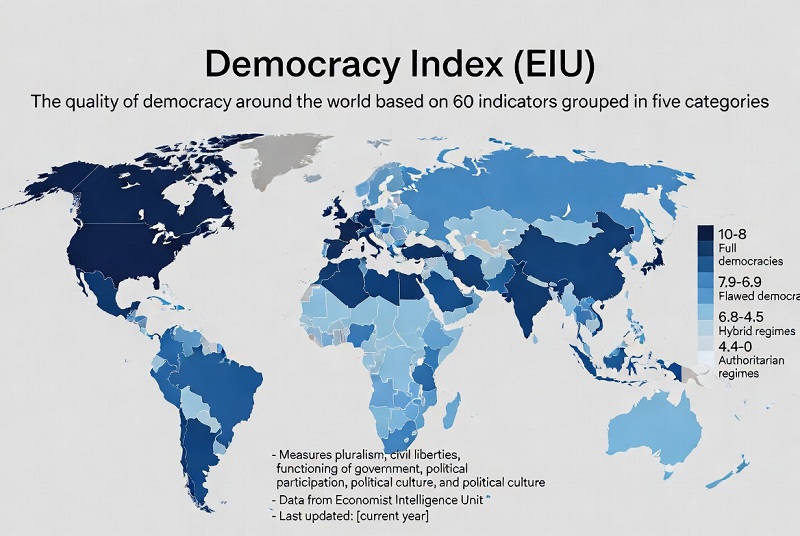
The latest available global ranking comes from EIU’s Democracy Index 2024, published in 2025 and used here as the current cross-country benchmark for governance quality. The index scores 167 countries and territories on a 0–10 scale across electoral process and pluralism, functioning of government, political participation, political culture, and civil liberties.
This matters because the headline score does more than reward elections alone. It captures whether institutions work, whether people trust democratic rules, whether civil liberties are defended in practice, and whether political participation is broad rather than symbolic. In the latest release, the global average slipped again, confirming that democracy remains under pressure even after a record election year.
Global regime distribution in the latest edition: 25 full democracies, 46 flawed democracies, 36 hybrid regimes and 60 authoritarian regimes. In this article, “2025” means the latest available edition in current search terms, but the underlying country scores are the published 2024 EIU values.
Continue exploring
More StatRanker pages connected by topic, category or ranking theme.
Top 100 Movies of All Time (2025 Edition): A Transparent Multi-Source Ranking Method
Open rankingTop 100 Countries by Freshwater Resources per Capita, 2026 Edition
Open rankingTop 100 Countries by Human Capital Index, Latest Edition
Open rankingTop 10 countries by Democracy Index score
Norway
Democracy Index score: 9.81
Europe · Full democracy · Δ rank 0
Broad social trust, strong institutions and consistently high scores across all five EIU dimensions keep Norway at the top.
New Zealand
Democracy Index score: 9.61
Oceania · Full democracy · Δ rank 0
Clean elections, resilient institutions and very strong civil liberties keep New Zealand in the top tier.
Sweden
Democracy Index score: 9.39
Europe · Full democracy · Δ rank +1
Sweden’s rise reflects strong government performance, robust civic culture and entrenched democratic norms.
Iceland
Democracy Index score: 9.38
Europe · Full democracy · Δ rank -1
Iceland remains among the leaders even after a slight slip, with very high civil-liberties and governance scores.
Switzerland
Democracy Index score: 9.32
Europe · Full democracy · Δ rank +3
A major riser in 2024, Switzerland combines federal accountability with strong civic participation.
Finland
Democracy Index score: 9.30
Europe · Full democracy · Δ rank -1
Finland stays in the top group despite softer participation metrics, thanks to very strong institutions and liberties.
Denmark
Democracy Index score: 9.28
Europe · Full democracy · Δ rank -1
Denmark remains a democratic benchmark with balanced performance across electoral integrity, governance and rights.
Ireland
Democracy Index score: 9.19
Europe · Full democracy · Δ rank -1
Ireland’s mix of competitive politics, civil liberties and democratic culture keeps it safely inside the full-democracy tier.
Netherlands
Democracy Index score: 9.00
Europe · Full democracy · Δ rank 0
The Netherlands still scores 9.00, but slower progress in political culture and participation limits further gains.
Luxembourg
Democracy Index score: 8.88
Europe · Full democracy · Δ rank +1
Luxembourg closes the Top 10, helped by strong governance and civil-liberty scores despite a smaller participation base.
Table 1. Top 10 most democratic countries
| Rank | Country | Score | Regime |
|---|---|---|---|
| 1 | Norway | 9.81 | Full democracy |
| 2 | New Zealand | 9.61 | Full democracy |
| 3 | Sweden | 9.39 | Full democracy |
| 4 | Iceland | 9.38 | Full democracy |
| 5 | Switzerland | 9.32 | Full democracy |
| 6 | Finland | 9.30 | Full democracy |
| 7 | Denmark | 9.28 | Full democracy |
| 8 | Ireland | 9.19 | Full democracy |
| 9 | Netherlands | 9.00 | Full democracy |
| 10 | Luxembourg | 8.88 | Full democracy |
Full democracies still dominate the very top of the ranking, with Nordic and wider European institutional models strongly represented. New Zealand remains the leading non-European case in the Top 10.
Chart 1. Top 20 countries by Democracy Index score
Top 20, listed as text
- Norway — 9.81
- New Zealand — 9.61
- Sweden — 9.39
- Iceland — 9.38
- Switzerland — 9.32
- Finland — 9.30
- Denmark — 9.28
- Ireland — 9.19
- Netherlands — 9.00
- Luxembourg — 8.88
- Australia — 8.85
- Taiwan — 8.78
- Germany — 8.73
- Canada — 8.69
- Uruguay — 8.67
- Japan — 8.48
- United Kingdom — 8.34
- Costa Rica — 8.29
- Austria — 8.28
- Mauritius — 8.23
The chart stays tightly clustered between 8.23 and 9.81, which shows how competitive the top tier is. A move of just a few tenths can shift several places in the ranking.
Methodology
The Democracy Index is published by the Economist Intelligence Unit and covers 167 countries and territories. It is built from 60 indicators grouped into five pillars: electoral process and pluralism, functioning of government, political participation, political culture, and civil liberties. Each country receives a 0–10 overall score, calculated as the simple average of the five category scores, and is then assigned to one of four regime types: full democracy, flawed democracy, hybrid regime, or authoritarian regime.
For this page, the latest available edition is the 2024 Democracy Index, released in 2025, so it serves as the operative 2025 snapshot for search and comparison purposes. Country names are standardized for consistency, tied ranks are shown as a clean top-to-bottom sequence for readability in the HTML tables, and values are rounded to two decimals. Where interactive elements are added below, they enhance the user experience only; all core ranking rows remain fully visible in the page source.
The main limitation is that democracy scores are not hard-output measures like trade or GDP. They blend structured indicators with expert judgment and are therefore best used as a comparative governance benchmark rather than as a mechanical “truth score.” Small year-to-year moves can reflect real political change, methodological nuance, or both. A second limitation is timing: the 2024 release captures the state of democracy after events occurring in that year, but not later political shocks in 2025 or 2026.
Insights and takeaways
The first pattern is the continuing strength of small and medium-sized institutional democracies. Norway, New Zealand, the Nordics, Switzerland, Ireland and the Netherlands all combine clean electoral competition with high administrative capacity and durable civil-liberties protections. These are not simply places with good election laws; they are systems in which democratic norms are deeply embedded.
The second pattern is that democratic quality is not distributed evenly across advanced economies. The United States, France, South Korea and Israel remain relatively high-scoring countries, but they sit below the full-democracy frontier because polarization, government effectiveness, civic trust or civil-liberties pressures pull down their overall scores. That tells readers that wealth and state capacity do not automatically guarantee top-tier democratic performance.
A third pattern is the importance of political culture and functioning of government. Some countries perform well in electoral competition but lose ground because institutions deliver unevenly, coalition politics becomes unstable, corruption weakens trust, or citizens become more accepting of non-democratic shortcuts. In other words, democratic resilience depends not only on formal rules but also on how those rules work in practice.
Finally, the upper half of the Top 100 shows that democracy is not a purely Western story. Uruguay, Costa Rica, Mauritius, Taiwan, Japan and several newer European democracies demonstrate that very different constitutional traditions can still produce durable democratic outcomes when accountability, rights and institutional continuity are strong.
What this means for the reader
- For relocation or lifestyle decisions, the index is a useful shortcut for comparing institutional reliability, civil liberties and political stability.
- For investors and businesses, higher-scoring democracies often provide more predictable rules, stronger checks on executive power and lower policy volatility.
- For students, journalists and researchers, the score helps place headline political events in wider institutional context rather than treating elections as isolated moments.
- For ordinary readers, the ranking is most useful when read together with rule-of-law, corruption, safety and economic indicators rather than in isolation.
FAQ
Why is Norway still number one?
Norway combines top-tier results across all five pillars, especially functioning of government, political participation, political culture and civil liberties. It is not carried by one exceptional dimension; it is consistently strong almost everywhere.
Does a high score mean a country has no political problems?
No. A country can rank near the top and still face polarization, coalition instability, culture-war conflicts or institutional strains. The score signals relative strength, not perfection.
What is the difference between a full democracy and a flawed democracy?
Full democracies score above 8.00 and tend to pair fair elections with strong institutions, civil liberties and democratic culture. Flawed democracies still hold meaningful elections, but they fall short on government performance, participation, political culture or rights protection.
Why are some rich countries outside the full-democracy group?
Because the index rewards institutional quality, not income. Rich countries can lose points when polarization grows, trust declines, executive power expands or civil-liberties standards weaken.
Why is Singapore not near the top here even though it ranks highly on many economic tables?
The Democracy Index is not an economic competitiveness score. Singapore performs strongly on state capacity, but its political system scores lower on pluralism and participation than the top-ranked democracies.
Can a country move a lot in one year?
Yes. Sharp political crises, coups, constitutional changes, crackdowns on opposition, election disputes or major governance reforms can move countries noticeably in a single edition.
Is this better than looking only at election quality?
Usually yes, because it is broader. Elections matter, but democracy also depends on civil liberties, functioning institutions, participation and whether democratic norms are accepted by both elites and citizens.
Full Top 100 ranking
The table below keeps all 100 rows directly in the HTML source. By default, the interface starts in Top 20 mode for readability, but every row is already present on the page and becomes visible when you switch the scope filter to All. The score toggle lets readers switch from the raw Democracy Index score to each country’s share of the Top 100 total score.
Top 100 total score: 688.39. This is used only for the score-share toggle inside the table. For global context, the EIU world average across all 167 countries and territories is 5.17.
| Rank | Country | Score | Regime |
|---|---|---|---|
| 1 |
Norway
Europe · Δ rank 0
|
9.81 1.43% | Full democracy |
| 2 |
New Zealand
Oceania · Δ rank 0
|
9.61 1.40% | Full democracy |
| 3 |
Sweden
Europe · Δ rank +1
|
9.39 1.36% | Full democracy |
| 4 |
Iceland
Europe · Δ rank -1
|
9.38 1.36% | Full democracy |
| 5 |
Switzerland
Europe · Δ rank +3
|
9.32 1.35% | Full democracy |
| 6 |
Finland
Europe · Δ rank -1
|
9.30 1.35% | Full democracy |
| 7 |
Denmark
Europe · Δ rank -1
|
9.28 1.35% | Full democracy |
| 8 |
Ireland
Europe · Δ rank -1
|
9.19 1.33% | Full democracy |
| 9 |
Netherlands
Europe · Δ rank 0
|
9.00 1.31% | Full democracy |
| 10 |
Luxembourg
Europe · Δ rank +1
|
8.88 1.29% | Full democracy |
| 11 |
Australia
Oceania · Δ rank +3
|
8.85 1.29% | Full democracy |
| 12 |
Taiwan
Asia · Δ rank -2
|
8.78 1.28% | Full democracy |
| 13 |
Germany
Europe · Δ rank -1
|
8.73 1.27% | Full democracy |
| 14 |
Canada
Americas · Δ rank -1
|
8.69 1.26% | Full democracy |
| 15 |
Uruguay
Americas · Δ rank -1
|
8.67 1.26% | Full democracy |
| 16 |
Japan
Asia · Δ rank 0
|
8.48 1.23% | Full democracy |
| 17 |
United Kingdom
Europe · Δ rank +1
|
8.34 1.21% | Full democracy |
| 18 |
Costa Rica
Americas · Δ rank -1
|
8.29 1.20% | Full democracy |
| 19 |
Austria
Europe · Δ rank -1
|
8.28 1.20% | Full democracy |
| 20 |
Mauritius
Africa · Δ rank 0
|
8.23 1.20% | Full democracy |
| 21 |
Estonia
Europe · Δ rank +6
|
8.13 1.18% | Full democracy |
| 22 |
Spain
Europe · Δ rank +2
|
8.13 1.18% | Full democracy |
| 23 |
Czech Republic
Europe · Δ rank +3
|
8.08 1.17% | Full democracy |
| 24 |
Portugal
Europe · Δ rank +8
|
8.08 1.17% | Full democracy |
| 25 |
Greece
Europe · Δ rank -5
|
8.07 1.17% | Full democracy |
| 26 |
France
Europe · Δ rank -3
|
7.99 1.16% | Flawed democracy |
| 27 |
Malta
Europe · Δ rank +1
|
7.93 1.15% | Flawed democracy |
| 28 |
United States
Americas · Δ rank +1
|
7.85 1.14% | Flawed democracy |
| 29 |
Chile
Americas · Δ rank -4
|
7.83 1.14% | Flawed democracy |
| 30 |
Slovenia
Europe · Δ rank +1
|
7.82 1.14% | Flawed democracy |
| 31 |
Israel
MENA · Δ rank -1
|
7.80 1.13% | Flawed democracy |
| 32 |
South Korea
Asia · Δ rank -10
|
7.75 1.13% | Flawed democracy |
| 33 |
Latvia
Europe · Δ rank +4
|
7.66 1.11% | Flawed democracy |
| 34 |
Belgium
Europe · Δ rank +2
|
7.64 1.11% | Flawed democracy |
| 35 |
Botswana
Africa · Δ rank -2
|
7.63 1.11% | Flawed democracy |
| 36 |
Lithuania
Europe · Δ rank +3
|
7.59 1.10% | Flawed democracy |
| 37 |
Cabo Verde
Africa · Δ rank -2
|
7.58 1.10% | Flawed democracy |
| 38 |
Italy
Europe · Δ rank -3
|
7.58 1.10% | Flawed democracy |
| 39 |
Poland
Europe · Δ rank +2
|
7.40 1.07% | Flawed democracy |
| 40 |
Cyprus
Europe · Δ rank -3
|
7.38 1.07% | Flawed democracy |
| 41 |
India
Asia · Δ rank 0
|
7.29 1.06% | Flawed democracy |
| 42 |
Slovakia
Europe · Δ rank +2
|
7.21 1.05% | Flawed democracy |
| 43 |
South Africa
Africa · Δ rank +4
|
7.16 1.04% | Flawed democracy |
| 44 |
Malaysia
Asia · Δ rank -4
|
7.11 1.03% | Flawed democracy |
| 45 |
Trinidad and Tobago
Americas · Δ rank -2
|
7.09 1.03% | Flawed democracy |
| 46 |
Timor-Leste
Asia · Δ rank -1
|
7.03 1.02% | Flawed democracy |
| 47 |
Panama
Americas · Δ rank +1
|
6.84 0.99% | Flawed democracy |
| 48 |
Suriname
Americas · Δ rank +1
|
6.79 0.99% | Flawed democracy |
| 49 |
Jamaica
Americas · Δ rank -4
|
6.74 0.98% | Flawed democracy |
| 50 |
Montenegro
Europe · Δ rank +2
|
6.73 0.98% | Flawed democracy |
| 51 |
Philippines
Asia · Δ rank +2
|
6.63 0.96% | Flawed democracy |
| 52 |
Dominican Republic
Americas · Δ rank +9
|
6.62 0.96% | Flawed democracy |
| 53 |
Mongolia
Asia · Δ rank +6
|
6.53 0.95% | Flawed democracy |
| 54 |
Argentina
Americas · Δ rank 0
|
6.51 0.95% | Flawed democracy |
| 55 |
Hungary
Europe · Δ rank -4
|
6.51 0.95% | Flawed democracy |
| 56 |
Croatia
Europe · Δ rank +2
|
6.50 0.94% | Flawed democracy |
| 57 |
Brazil
Americas · Δ rank -6
|
6.49 0.94% | Flawed democracy |
| 58 |
Namibia
Africa · Δ rank -1
|
6.48 0.94% | Flawed democracy |
| 59 |
Indonesia
Asia · Δ rank -3
|
6.44 0.94% | Flawed democracy |
| 60 |
Colombia
Americas · Δ rank -5
|
6.35 0.92% | Flawed democracy |
| 61 |
Bulgaria
Europe · Δ rank +1
|
6.34 0.92% | Flawed democracy |
| 62 |
North Macedonia
Europe · Δ rank +10
|
6.28 0.91% | Flawed democracy |
| 63 |
Thailand
Asia · Δ rank 0
|
6.27 0.91% | Flawed democracy |
| 64 |
Serbia
Europe · Δ rank 0
|
6.26 0.91% | Flawed democracy |
| 65 |
Ghana
Africa · Δ rank 0
|
6.24 0.91% | Flawed democracy |
| 66 |
Albania
Europe · Δ rank 0
|
6.20 0.90% | Flawed democracy |
| 67 |
Sri Lanka
Asia · Δ rank +3
|
6.19 0.90% | Flawed democracy |
| 68 |
Singapore
Asia · Δ rank +1
|
6.18 0.90% | Flawed democracy |
| 69 |
Guyana
Americas · Δ rank -2
|
6.11 0.89% | Flawed democracy |
| 70 |
Lesotho
Africa · Δ rank +1
|
6.06 0.88% | Flawed democracy |
| 71 |
Moldova
Europe · Δ rank -3
|
6.04 0.88% | Flawed democracy |
| 72 |
Romania
Europe · Δ rank -12
|
5.99 0.87% | Hybrid regime |
| 73 |
Papua New Guinea
Oceania · Δ rank -1
|
5.97 0.87% | Hybrid regime |
| 74 |
Senegal
Africa · Δ rank +9
|
5.93 0.86% | Hybrid regime |
| 75 |
Paraguay
Americas · Δ rank -1
|
5.92 0.86% | Hybrid regime |
| 76 |
Malawi
Africa · Δ rank 0
|
5.85 0.85% | Hybrid regime |
| 77 |
Zambia
Africa · Δ rank +1
|
5.73 0.83% | Hybrid regime |
| 78 |
Peru
Americas · Δ rank -1
|
5.69 0.83% | Hybrid regime |
| 79 |
Bhutan
Asia · Δ rank +2
|
5.65 0.82% | Hybrid regime |
| 80 |
Liberia
Africa · Δ rank -1
|
5.57 0.81% | Hybrid regime |
| 81 |
Fiji
Oceania · Δ rank -1
|
5.39 0.78% | Hybrid regime |
| 82 |
Armenia
Asia · Δ rank +2
|
5.35 0.78% | Hybrid regime |
| 83 |
Madagascar
Africa · Δ rank +4
|
5.33 0.77% | Hybrid regime |
| 84 |
Mexico
Americas · Δ rank +6
|
5.32 0.77% | Hybrid regime |
| 85 |
Ecuador
Americas · Δ rank 0
|
5.24 0.76% | Hybrid regime |
| 86 |
Tanzania
Africa · Δ rank 0
|
5.20 0.76% | Hybrid regime |
| 87 |
Hong Kong
Asia · Δ rank +1
|
5.09 0.74% | Hybrid regime |
| 88 |
Bosnia and Herzegovina
Europe · Δ rank +6
|
5.06 0.74% | Hybrid regime |
| 89 |
Kenya
Africa · Δ rank +3
|
5.05 0.73% | Hybrid regime |
| 90 |
Honduras
Americas · Δ rank +5
|
4.98 0.72% | Hybrid regime |
| 91 |
Morocco
MENA · Δ rank +2
|
4.97 0.72% | Hybrid regime |
| 92 |
Ukraine
Europe · Δ rank -1
|
4.90 0.71% | Hybrid regime |
| 93 |
Tunisia
MENA · Δ rank -11
|
4.71 0.68% | Hybrid regime |
| 94 |
Georgia
Europe · Δ rank -5
|
4.70 0.68% | Hybrid regime |
| 95 |
El Salvador
Americas · Δ rank +1
|
4.61 0.67% | Hybrid regime |
| 96 |
Nepal
Asia · Δ rank +2
|
4.60 0.67% | Hybrid regime |
| 97 |
Guatemala
Americas · Δ rank +3
|
4.55 0.66% | Hybrid regime |
| 98 |
Uganda
Africa · Δ rank +1
|
4.49 0.65% | Hybrid regime |
| 99 |
Gambia
Africa · Δ rank +1
|
4.47 0.65% | Hybrid regime |
| 100 |
Bangladesh
Asia · Δ rank -25
|
4.44 0.64% | Hybrid regime |
Source note: country scores are the latest available EIU Democracy Index values for 2024, presented here as the current 2025 lookup edition. Update context: EIU report published in 2025; OWID processed series updated through 2024.
Chart 2. Overall democracy score vs functioning of government
This scatter compares a country’s overall Democracy Index score with the functioning of government subscore for a selected cross-section of economies. The pattern is revealing: countries near the top-right combine strong overall democratic performance with governments that are widely seen as effective, accountable and institutionally stable.
- Norway — overall 9.81, functioning of government 9.64
- New Zealand — 9.61, 9.29
- Switzerland — 9.32, 9.29
- Finland — 9.30, 9.64
- United States — 7.85, 6.43
- India — 7.29, 7.50
- Singapore — 6.18, 7.14
- Romania — 5.99, 5.36
- Ukraine — 4.90, 2.71
- Bangladesh — 4.44, 2.57
The relationship is positive but not perfect. Some states keep reasonable electoral or civil-liberty scores while being held back by weak institutional performance, unstable coalition politics, corruption, low trust or executive overreach.
How to read the 2025 democracy ranking intelligently
The strongest lesson from the current Democracy Index is that institutional quality remains highly concentrated. The Top 25 is dominated by full democracies, most of them in Europe plus a small group of durable non-European performers such as New Zealand, Australia, Taiwan, Canada, Uruguay, Japan, Costa Rica and Mauritius. These countries are not identical politically, but they share a common pattern: democratic rules are widely accepted, public institutions retain credibility, and rights protections are difficult to dismantle quickly.
Western Europe remains the strongest region by average score, while the Middle East and North Africa remains the weakest in the latest edition. That contrast helps explain why the Top 100 is still heavily weighted toward Europe and, to a lesser extent, the Americas and advanced Asia-Pacific democracies.
The next lesson is that many advanced countries now operate below their own democratic ceiling. The United States, France, South Korea, Israel and several Southern or Central European democracies remain competitive, open systems, but their weaker scores relative to the leaders show where democratic strain now sits: polarization, unstable executive-legislative relations, low trust, fragmented party systems, judicial pressure, or weak confidence in the effectiveness of government.
A third lesson is that the middle of the ranking is politically mixed. Many countries in the 40–80 range still hold meaningful elections, but their institutions are less settled. Some are climbing because governance is improving; others are slipping because democratic culture is softer than the electoral framework suggests. This is why a country can remain formally democratic while becoming more brittle in practice.
Policy takeaways
- Strong democracy is not sustained by elections alone; it also requires administrative capacity, restraint in the use of executive power and broad acceptance of democratic rules.
- Countries with stable electoral systems can still slide if government effectiveness, media freedom or judicial independence weaken over time.
- Improving political participation without improving institutional performance does not automatically move a country into the top tier.
- Readers should treat big one-year declines as warning signs worth investigating, especially when they are linked to emergency powers, election disputes or rights restrictions.
- For policy analysis, the most useful companion indicators are rule of law, corruption control, press freedom, civil-liberties enforcement and state capacity.
That is also why the ranking should not be read as a moral scorecard alone. It is a practical signal about how political systems process disagreement, how predictable governance is, and how well power is constrained. For anyone comparing countries for business, migration, education, journalism or public-policy analysis, that makes the Democracy Index a highly usable governance benchmark.
Sources
-
Economist Intelligence Unit — The Democracy Index hub
https://www.eiu.com/n/global-themes/democracy-index/ -
Economist Intelligence Unit — Democracy Index 2024 report page
https://www.eiu.com/n/campaigns/democracy-index-2024/ -
Our World in Data — Democracy Index (EIU) indicator page
https://ourworldindata.org/grapher/democracy-index-eiu -
Our World in Data — Democracy Data Explorer
https://ourworldindata.org/explorers/democracy -
EIU update note on the 2024 release
https://www.eiu.com/n/democracy-index-2024/
The country-by-country ranking in this page follows the latest available EIU Democracy Index values for 2024, formatted for publication and cross-checking against the OWID processed series. Where tied ranks appear in the source material, the HTML tables above show a clean sequential order so the Top 100 remains easy to scan and filter.
Related rankings
More StatRanker pages connected by topic, category or ranking theme.
Top 100 Movies of All Time (2025 Edition): A Transparent Multi-Source Ranking Method
Open rankingTop 100 Countries by Freshwater Resources per Capita, 2026 Edition
Open rankingTop 100 Countries by Human Capital Index, Latest Edition
Open rankingTop 100 Happiest Countries (World Happiness Report 2025 Edition)
Open ranking
StatRanker (Website)
administrator