Top 100 Countries by Press Freedom Index, 2025
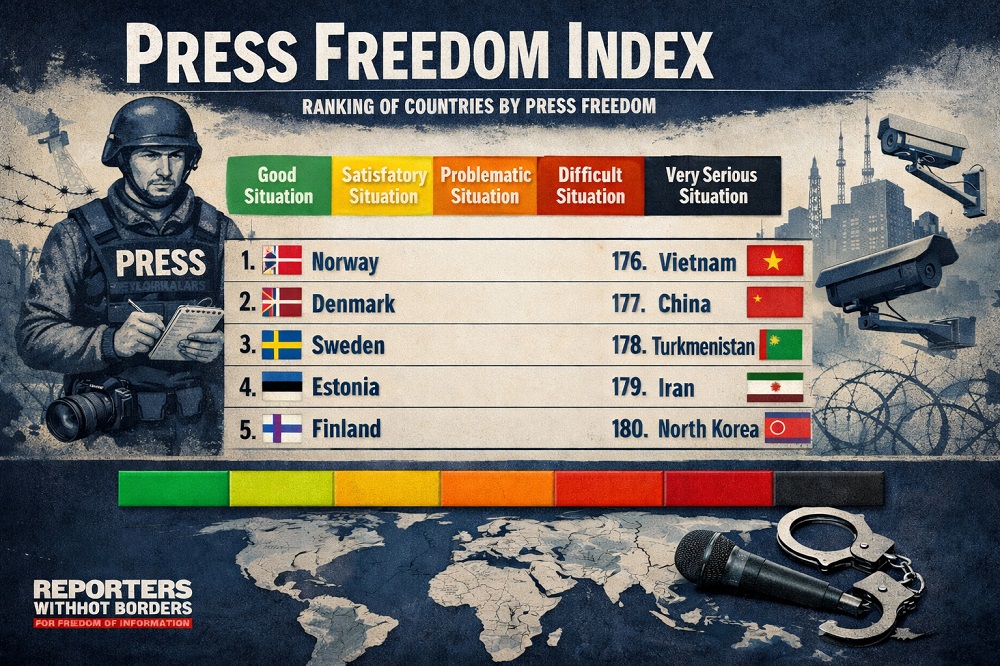
How the 2025 Press Freedom Index reshapes the global top 100
The 2025 World Press Freedom Index shows where journalism still operates with real protection in practice, not only on paper. It turns a broad idea — press freedom — into a comparable score that makes it easier to distinguish formal guarantees from the day-to-day conditions reporters and newsrooms actually face.
RSF’s 2025 edition matters because it captures not just censorship and direct repression, but also the quieter structural pressures that can hollow out journalism: weak media business models, opaque state support, concentrated ownership, political hostility and physical insecurity. In 2025, RSF’s global analysis says the worldwide situation slipped into the “difficult” category for the first time, with economic fragility acting as the strongest drag on the overall score.
The top of the 2025 table is overwhelmingly European. The top 10 is entirely Europe & Central Asia, and 18 of the top 20 come from the same broader region. By contrast, MENA contributes only one entry to the top 100: Qatar at rank 79.
Continue exploring
More StatRanker pages connected by topic, category or ranking theme.
Top 100 Countries by Democracy Index (EIU), 2025 Edition
Open rankingTop 100 Movies of All Time (2025 Edition): A Transparent Multi-Source Ranking Method
Open rankingWhat stands out at the top of the 2025 ranking
Countries at the top do more than avoid open censorship. They usually combine strong legal protections, low physical risk for journalists, high institutional trust, comparatively pluralistic media markets and a political culture that creates less routine friction for reporting. That combination helps explain why the top of the ranking is so regionally concentrated.
Europe’s dominance is especially striking in 2025. Norway remains first, Estonia jumps into second, and the top ten is fully European. That does not make the region problem-free. Several high-ranking countries still show weaker economic conditions for journalism than their legal or safety scores suggest, which helps explain why RSF treats the economic indicator as the main global pressure point in 2025.
Still the global benchmark, with every contextual indicator sitting in the elite tier and no sign of systemic deterioration large enough to dislodge it from first place.
The sharpest improver inside the top tier. Its 2025 climb reflects broad-based strength rather than a single statistical spike, especially in the social and legal dimensions.
Combines a very strong economic environment for news media with a resilient legal framework, keeping it firmly in the European core of high-scoring systems.
Remains one of the world’s safest and institutionally strongest media environments, even after a small year-over-year slip in score.
Continues to score at a very high level across the board, showing that strong institutions and media norms still translate into consistently high press-freedom outcomes.
Still part of the Nordic frontier, but a weaker year on the economic side pushed it slightly lower in the ranking despite staying above 86 points.
Balances a high safety score with strong political conditions for journalism and keeps its place among the world’s most robust media environments.
Sits just below the “good” threshold. It remains a high performer, but its economic context for journalism is notably weaker than its legal and safety profile.
A stable high-scoring case with strong legal protection and safety conditions, though not quite as balanced across all five indicators as the top Nordic group.
The new entrant to the 2025 top ten. Its gain shows how meaningful improvement in a mid-high score range can still translate into a visible jump in rank.
Table 1. Top 10 countries by Press Freedom Index score, 2025
| Rank | Country / entry | Score | Status |
|---|---|---|---|
| 1 | Norway | 92.31 | Good |
| 2 | Estonia | 89.46 | Good |
| 3 | Netherlands | 88.64 | Good |
| 4 | Sweden | 88.13 | Good |
| 5 | Finland | 87.18 | Good |
| 6 | Denmark | 86.93 | Good |
| 7 | Ireland | 86.92 | Good |
| 8 | Portugal | 84.26 | Satisfactory |
| 9 | Switzerland | 83.98 | Satisfactory |
| 10 | Czechia | 83.96 | Satisfactory |
Only seven countries worldwide remain in RSF’s “good” category in 2025. Portugal, Switzerland and Czechia stay in the top 10 despite sitting just below the 85-point threshold that separates “good” from “satisfactory.”
Chart 1. Top 20 countries by Press Freedom Index score, 2025
The Top 20 makes the regional concentration impossible to miss. Eighteen of the first twenty countries are in Europe & Central Asia. New Zealand is the only Asia-Pacific entry in the Top 20, while Trinidad and Tobago is the only representative from the Americas in that upper tier.
The score gap inside the top tier matters as well. Norway leads on 92.31, while the twentieth-ranked United Kingdom stands at 78.89. In other words, countries can all look strong in rank terms while still being separated by more than thirteen points on the underlying scale.
Table 2. Top 100 ranked entries in the Press Freedom Index, 2025
The full top 100 is collected below in one place so readers can compare score levels, regional patterns, status groups and year-over-year movement without jumping between country pages. The controls make it easier to isolate a region, focus on the strongest improvers or check how tightly scores cluster around the middle of the ranking.
| Rank | Country / entry | Score 2025 | Status |
|---|---|---|---|
| 1 |
Norway
Europe & Central Asia · Δ score vs 2024: +0.42 · Rank change: 0
|
92.31 | Good |
| 2 |
Estonia
Europe & Central Asia · Δ score vs 2024: +3.02 · Rank change: +4
|
89.46 | Good |
| 3 |
Netherlands
Europe & Central Asia · Δ score vs 2024: +0.91 · Rank change: +1
|
88.64 | Good |
| 4 |
Sweden
Europe & Central Asia · Δ score vs 2024: −0.19 · Rank change: -1
|
88.13 | Good |
| 5 |
Finland
Europe & Central Asia · Δ score vs 2024: +0.63 · Rank change: 0
|
87.18 | Good |
| 6 |
Denmark
Europe & Central Asia · Δ score vs 2024: −2.67 · Rank change: -4
|
86.93 | Good |
| 7 |
Ireland
Europe & Central Asia · Δ score vs 2024: +1.33 · Rank change: +1
|
86.92 | Good |
| 8 |
Portugal
Europe & Central Asia · Δ score vs 2024: −1.64 · Rank change: -1
|
84.26 | Satisfactory |
| 9 |
Switzerland
Europe & Central Asia · Δ score vs 2024: −0.03 · Rank change: 0
|
83.98 | Satisfactory |
| 10 |
Czechia
Europe & Central Asia · Δ score vs 2024: +3.82 · Rank change: +7
|
83.96 | Satisfactory |
| 11 |
Germany
Europe & Central Asia · Δ score vs 2024: +0.01 · Rank change: -1
|
83.85 | Satisfactory |
| 12 |
Liechtenstein
Europe & Central Asia · Δ score vs 2024: +1.90 · Rank change: +3
|
83.42 | Satisfactory |
| 13 |
Luxembourg
Europe & Central Asia · Δ score vs 2024: −0.76 · Rank change: -2
|
83.04 | Satisfactory |
| 14 |
Lithuania
Europe & Central Asia · Δ score vs 2024: +0.54 · Rank change: -1
|
82.27 | Satisfactory |
| 15 |
Latvia
Europe & Central Asia · Δ score vs 2024: −1.08 · Rank change: -3
|
81.82 | Satisfactory |
| 16 |
New Zealand
Asia-Pacific · Δ score vs 2024: +1.65 · Rank change: +3
|
81.37 | Satisfactory |
| 17 |
Iceland
Europe & Central Asia · Δ score vs 2024: +1.23 · Rank change: +1
|
81.36 | Satisfactory |
| 18 |
Belgium
Europe & Central Asia · Δ score vs 2024: −1.37 · Rank change: -2
|
80.12 | Satisfactory |
| 19 |
Trinidad and Tobago
Americas · Δ score vs 2024: +3.02 · Rank change: +6
|
79.71 | Satisfactory |
| 20 |
United Kingdom
Europe & Central Asia · Δ score vs 2024: +1.38 · Rank change: +3
|
78.89 | Satisfactory |
| 21 |
Canada
Americas · Δ score vs 2024: −2.95 · Rank change: -7
|
78.75 | Satisfactory |
| 22 |
Austria
Europe & Central Asia · Δ score vs 2024: +3.43 · Rank change: +10
|
78.12 | Satisfactory |
| 23 |
Spain
Europe & Central Asia · Δ score vs 2024: +1.34 · Rank change: +7
|
77.35 | Satisfactory |
| 24 |
Taiwan
Asia-Pacific · Δ score vs 2024: +0.91 · Rank change: +3
|
77.04 | Satisfactory |
| 25 |
France
Europe & Central Asia · Δ score vs 2024: −2.03 · Rank change: -4
|
76.62 | Satisfactory |
| 26 |
Jamaica
Americas · Δ score vs 2024: −1.47 · Rank change: -2
|
75.83 | Satisfactory |
| 27 |
South Africa
Africa · Δ score vs 2024: +1.98 · Rank change: +11
|
75.71 | Satisfactory |
| 28 |
Namibia
Africa · Δ score vs 2024: +1.19 · Rank change: +6
|
75.35 | Satisfactory |
| 29 |
Australia
Asia-Pacific · Δ score vs 2024: +1.73 · Rank change: +10
|
75.15 | Satisfactory |
| 30 |
Cabo Verde
Africa · Δ score vs 2024: +2.21 · Rank change: +11
|
74.98 | Satisfactory |
| 31 |
Poland
Europe & Central Asia · Δ score vs 2024: +5.62 · Rank change: +16
|
74.79 | Satisfactory |
| 32 |
Suriname
Americas · Δ score vs 2024: −1.62 · Rank change: -4
|
74.49 | Satisfactory |
| 33 |
Slovenia
Europe & Central Asia · Δ score vs 2024: +1.46 · Rank change: +9
|
74.06 | Satisfactory |
| 34 |
Armenia
Europe & Central Asia · Δ score vs 2024: +2.36 · Rank change: +9
|
73.96 | Satisfactory |
| 35 |
Moldova
Europe & Central Asia · Δ score vs 2024: −1.50 · Rank change: -4
|
73.36 | Satisfactory |
| 36 |
Costa Rica
Americas · Δ score vs 2024: −3.04 · Rank change: -10
|
73.09 | Satisfactory |
| 37 |
Montenegro
Europe & Central Asia · Δ score vs 2024: −0.38 · Rank change: +3
|
72.83 | Satisfactory |
| 38 |
Slovakia
Europe & Central Asia · Δ score vs 2024: −4.10 · Rank change: -9
|
71.93 | Satisfactory |
| 39 |
East Timor
Asia-Pacific · Δ score vs 2024: −7.13 · Rank change: -19
|
71.79 | Satisfactory |
| 40 |
Fiji
Asia-Pacific · Δ score vs 2024: −0.03 · Rank change: +4
|
71.20 | Satisfactory |
| 41 |
Gabon
Africa · Δ score vs 2024: +4.82 · Rank change: +15
|
70.65 | Satisfactory |
| 42 |
North Macedonia
Europe & Central Asia · Δ score vs 2024: −3.34 · Rank change: -6
|
70.44 | Satisfactory |
| 43 |
Dominican Republic
Americas · Δ score vs 2024: −4.02 · Rank change: -8
|
69.87 | Problematic |
| 44 |
Samoa
Asia-Pacific · Δ score vs 2024: −9.13 · Rank change: -22
|
69.28 | Problematic |
| 45 |
Seychelles
Africa · Δ score vs 2024: −5.19 · Rank change: -8
|
68.56 | Problematic |
| 46 |
Tonga
Asia-Pacific · Δ score vs 2024: −1.72 · Rank change: -1
|
68.39 | Problematic |
| 47 |
Belize
Americas · Δ score vs 2024: +1.47 · Rank change: +7
|
68.32 | Problematic |
| 48 |
OECS (grouped entry) Americas · Δ score vs 2024: +5.25 · Rank change: +20
|
68.08 | Problematic |
| 49 |
Italy
Europe & Central Asia · Δ score vs 2024: −1.79 · Rank change: -3
|
68.01 | Problematic |
| 50 |
Mauritania
Africa · Δ score vs 2024: −6.68 · Rank change: -17
|
67.52 | Problematic |
| 51 |
Mauritius
Africa · Δ score vs 2024: +1.76 · Rank change: +6
|
67.31 | Problematic |
| 52 |
Ghana
Africa · Δ score vs 2024: −0.58 · Rank change: -2
|
67.13 | Problematic |
| 53 |
Panama
Americas · Δ score vs 2024: +8.20 · Rank change: +30
|
66.75 | Problematic |
| 54 |
Liberia
Africa · Δ score vs 2024: +1.48 · Rank change: +6
|
66.61 | Problematic |
| 55 |
Romania
Europe & Central Asia · Δ score vs 2024: −2.03 · Rank change: -6
|
66.42 | Problematic |
| 56 |
Sierra Leone
Africa · Δ score vs 2024: +2.09 · Rank change: +8
|
66.36 | Problematic |
| 57 |
United States
Americas · Δ score vs 2024: −1.10 · Rank change: -2
|
65.49 | Problematic |
| 58 |
Gambia
Africa · Δ score vs 2024: −0.04 · Rank change: 0
|
65.49 | Problematic |
| 59 |
Uruguay
Americas · Δ score vs 2024: −2.52 · Rank change: -8
|
65.18 | Problematic |
| 60 |
Croatia
Europe & Central Asia · Δ score vs 2024: −4.59 · Rank change: -12
|
64.20 | Problematic |
| 61 |
South Korea
Asia-Pacific · Δ score vs 2024: −0.81 · Rank change: +1
|
64.06 | Problematic |
| 62 |
Ukraine
Europe & Central Asia · Δ score vs 2024: −1.07 · Rank change: -1
|
63.93 | Problematic |
| 63 |
Brazil
Americas · Δ score vs 2024: +5.21 · Rank change: +19
|
63.80 | Problematic |
| 64 |
Côte d'Ivoire
Africa · Δ score vs 2024: −3.20 · Rank change: -11
|
63.69 | Problematic |
| 65 |
Andorra
Europe & Central Asia · Δ score vs 2024: +1.86 · Rank change: +7
|
63.30 | Problematic |
| 66 |
Japan
Asia-Pacific · Δ score vs 2024: +1.02 · Rank change: +4
|
63.14 | Problematic |
| 67 |
Malta
Europe & Central Asia · Δ score vs 2024: +2.00 · Rank change: +6
|
62.96 | Problematic |
| 68 |
Hungary
Europe & Central Asia · Δ score vs 2024: −0.16 · Rank change: -1
|
62.82 | Problematic |
| 69 |
Chile
Americas · Δ score vs 2024: −5.07 · Rank change: -17
|
62.25 | Problematic |
| 70 |
Bulgaria
Europe & Central Asia · Δ score vs 2024: −4.54 · Rank change: -11
|
60.78 | Problematic |
| 71 |
Congo-Brazzaville
Africa · Δ score vs 2024: −1.99 · Rank change: -2
|
60.58 | Problematic |
| 72 |
Central African Republic
Africa · Δ score vs 2024: +0.03 · Rank change: +4
|
60.15 | Problematic |
| 73 |
Guyana
Americas · Δ score vs 2024: +0.02 · Rank change: +4
|
60.12 | Problematic |
| 74 |
Senegal
Africa · Δ score vs 2024: +3.99 · Rank change: +20
|
59.43 | Problematic |
| 75 |
Comoros
Africa · Δ score vs 2024: −2.20 · Rank change: -4
|
59.27 | Problematic |
| 76 |
Malawi
Africa · Δ score vs 2024: −5.26 · Rank change: -13
|
59.20 | Problematic |
| 77 |
Cyprus
Europe & Central Asia · Δ score vs 2024: −4.10 · Rank change: -12
|
59.04 | Problematic |
| 78 |
Papua New Guinea
Asia-Pacific · Δ score vs 2024: +2.33 · Rank change: +13
|
58.35 | Problematic |
| 79 |
Qatar
MENA · Δ score vs 2024: −0.23 · Rank change: +5
|
58.25 | Problematic |
| 80 |
Albania
Europe & Central Asia · Δ score vs 2024: +4.08 · Rank change: +19
|
58.18 | Problematic |
| 81 |
Botswana
Africa · Δ score vs 2024: −2.14 · Rank change: -2
|
57.64 | Problematic |
| 82 |
Zambia
Africa · Δ score vs 2024: +1.95 · Rank change: +13
|
57.33 | Problematic |
| 83 |
Niger
Africa · Δ score vs 2024: −2.66 · Rank change: -3
|
57.05 | Problematic |
| 84 |
Paraguay
Americas · Δ score vs 2024: +6.36 · Rank change: +31
|
56.84 | Problematic |
| 85 |
Thailand
Asia-Pacific · Δ score vs 2024: −1.40 · Rank change: +2
|
56.72 | Problematic |
| 86 |
Bosnia-Herzegovina
Europe & Central Asia · Δ score vs 2024: −2.52 · Rank change: -5
|
56.33 | Problematic |
| 87 |
Argentina
Americas · Δ score vs 2024: −6.99 · Rank change: -21
|
56.14 | Problematic |
| 88 |
Malaysia
Asia-Pacific · Δ score vs 2024: +4.02 · Rank change: +19
|
56.09 | Problematic |
| 89 |
Greece
Europe & Central Asia · Δ score vs 2024: −1.78 · Rank change: -1
|
55.37 | Problematic |
| 90 |
Nepal
Asia-Pacific · Δ score vs 2024: −5.32 · Rank change: -16
|
55.20 | Problematic |
| 91 |
Northern Cyprus
Europe & Central Asia · Δ score vs 2024: −1.88 · Rank change: -1
|
54.84 | Difficult |
| 92 |
Benin
Africa · Δ score vs 2024: −2.13 · Rank change: -3
|
54.60 | Difficult |
| 93 |
Bolivia
Americas · Δ score vs 2024: +5.21 · Rank change: +31
|
54.09 | Difficult |
| 94 |
Ecuador
Americas · Δ score vs 2024: +2.46 · Rank change: +16
|
53.76 | Difficult |
| 95 |
Tanzania
Africa · Δ score vs 2024: −1.12 · Rank change: +2
|
53.68 | Difficult |
| 96 |
Serbia
Europe & Central Asia · Δ score vs 2024: −0.93 · Rank change: +2
|
53.55 | Difficult |
| 97 |
Brunei
Asia-Pacific · Δ score vs 2024: +3.38 · Rank change: +20
|
53.47 | Difficult |
| 98 |
Eswatini
Africa · Δ score vs 2024: −5.45 · Rank change: -13
|
52.86 | Difficult |
| 99 |
Kosovo
Europe & Central Asia · Δ score vs 2024: −7.46 · Rank change: -24
|
52.73 | Difficult |
| 100 |
Angola
Africa · Δ score vs 2024: +0.23 · Rank change: +4
|
52.67 | Difficult |
Source: RSF World Press Freedom Index 2025 official dataset. Page updated April 18, 2026. Score change compares 2025 with the prior annual edition published by RSF.
Methodology
The 2025 Press Freedom Index uses an official RSF score from 0 to 100, where higher values mean a stronger environment for journalism. The score is not based on one variable alone. RSF combines two building blocks: a quantitative tally of abuses affecting journalists and media in connection with their work, and a qualitative survey completed by specialists including journalists, researchers, academics and human-rights defenders. Those inputs are then converted into five equally weighted contextual indicators: political context, legal framework, economic context, sociocultural context and safety.
For this page, the ranking year is the current 2025 RSF edition, and the Top 100 list is taken directly from the official country dataset published alongside the index. Country order is therefore based on the 2025 score, not on an average, and not on a modelled proxy year. Where the page refers to year-over-year movement, it uses RSF’s own prior-edition score and rank change fields to show direction of movement rather than building an external estimate.
Some limits still matter. Rank and score are not interchangeable: a country can move several places with only a modest score change if neighbouring countries are tightly clustered. The index measures the operating environment for journalism, not the quality of every outlet or the political preferences of citizens. International comparability is strong, but countries facing war, partial territorial control, abrupt legal shifts or sudden media shutdowns can change quickly in ways that a single annual score cannot fully capture. The score therefore makes most sense when read together with the five contextual indicators and the country narrative behind it.
Insights from the Top 100 distribution
The distribution is concentrated. Europe & Central Asia accounts for 43 of the top 100 entries and 18 of the top 20. That does not mean the whole region performs equally well, but it does show where the deepest institutional support for media freedom still sits in 2025: stronger legal safeguards, more pluralist news systems, better newsroom safety and a thicker tradition of independent reporting.
The “good” category is now rare. Across all 180 countries in the RSF dataset, only seven remain in the top green tier. Inside the top 100, the largest block is not “good” but problematic. So being in the upper half of the global table is not the same thing as having a genuinely secure press-freedom environment. Many countries in the middle of the top 100 still face recurring legal pressure, funding fragility, political hostility or uneven safety conditions.
Volatility increases below the elite tier. Panama, Paraguay, Poland and Brazil posted some of the strongest improvements inside the top 100, while Samoa, East Timor, Argentina and Chile recorded some of the sharpest setbacks. The middle of the table is therefore more politically and economically fragile than the top: reform can lift a country quickly, but the same is true for regulatory shocks, advertising pressure, ownership concentration or abrupt government hostility.
Outside Europe, strong scores become much scarcer. The Americas place 18 entries in the top 100 and Asia-Pacific 14, but MENA has just one — Qatar at rank 79. Africa contributes 24 entries, which is more than many readers might expect, yet none reaches the global top 20. Press freedom is not simply a rich-country story; it depends on institutions, state restraint, media economics and safety conditions moving together.
What this means for the reader
For ordinary readers, this ranking is not just about journalists. It is a practical signal about information risk. Countries with stronger press-freedom conditions usually give citizens better odds of accessing competing narratives, tracking corruption, questioning public spending and spotting policy failures earlier. Where the score is weak, public information often becomes more expensive, less plural and easier to manipulate.
For companies and investors, the index also works as a soft-risk indicator. A weak media environment can make due diligence harder, reduce transparency around procurement and regulation, and increase the cost of interpreting local political developments. For NGOs, educators and migration-minded households, it adds useful context around safety, civic space and institutional reliability.
For policymakers, the 2025 edition carries a blunt warning: formal constitutional guarantees are not enough if journalism cannot survive economically. A country can avoid the worst forms of physical repression and still see its score eroded by media capture, concentrated ownership, politically conditioned state advertising or newsrooms that can no longer fund reporting. In that sense, press freedom is partly a legal question, but also a market-structure and state-capacity question.
Chart 2. 2025 score vs change in rank among selected countries
This chart separates two ideas that are easy to confuse: a country’s level and its direction. Countries far to the right already have stronger press-freedom systems, but they can still slide. Countries closer to the middle can move upward quickly if reforms improve conditions for journalism or if nearby peers weaken.
Positive values on the vertical axis mean a country moved up the ranking compared with 2024. Negative values mean it lost places. Panama, Poland and Brazil stand out as notable improvers among the selected cases, while Samoa, Argentina and Russia show how quickly deterioration can appear in an annual ranking.
FAQ
Why is Norway still number one?
Because it remains exceptionally strong across all five RSF dimensions rather than relying on a single advantage. Norway pairs a very high safety score with a strong legal framework, robust political conditions and an economic environment that is still comparatively supportive for journalism.
Does a Top 20 rank mean the media sector has no problems?
No. Even countries near the top still face ownership concentration, newsroom funding pressure, online harassment or political disputes. A high rank means the overall environment is stronger than elsewhere, not that every newsroom operates without risk.
Why do some countries move a lot even when the score changes only a little?
The ranking is relative. When many countries sit close together, a one-point gain or loss can move a country several places. That is why the score itself is usually more informative than rank alone when you compare neighbouring countries.
What does RSF actually measure in this index?
RSF combines a quantitative tally of abuses against journalists and media with a qualitative assessment gathered from specialists. The final score is built from five equally weighted indicators: political context, legal framework, economic context, sociocultural context and safety.
Why is the economic dimension so important in 2025?
RSF’s 2025 global analysis says the economic indicator fell to a historic low. Even where direct censorship is limited, weak business models, opaque state support, advertiser pressure and concentrated ownership can push media outlets toward dependence and self-censorship.
Is press freedom the same thing as democracy?
They are closely connected but not identical. Democracies can still have weak media markets, political intimidation or concentrated ownership, while the index also captures practical conditions for reporting, not just formal constitutional guarantees.
How should readers use this ranking wisely?
Use the score as a comparative signal, then read it together with country context, media-law changes, safety risks and ownership structure. Treat it as a starting point for deeper analysis, not as a standalone verdict on an entire society.
Sources
The official ranking page with country scores, regional analysis and direct access to the annual dataset.
Explains the 0–100 scale, the abuse tally, the expert questionnaire and the five equally weighted contextual indicators.
Provides the key annual interpretation: economic fragility became the leading structural threat and pushed the world situation into the “difficult” category.
Useful for broader institutional context around press freedom, freedom of expression and the policy debate during the 2025 cycle.
Official UN-system reference for journalist safety and impunity trends, which helps interpret the safety dimension behind annual ranking outcomes.
Shows how the UN frames the measurement of killings, kidnappings, enforced disappearances, arbitrary detention and torture of journalists and media workers.
Related rankings
More StatRanker pages connected by topic, category or ranking theme.
Top 100 Countries by Democracy Index (EIU), 2025 Edition
Open rankingTop 100 Movies of All Time (2025 Edition): A Transparent Multi-Source Ranking Method
Open ranking
StatRanker (Website)
administrator