Countries by Forest Area per Person ТОП-100, 2026
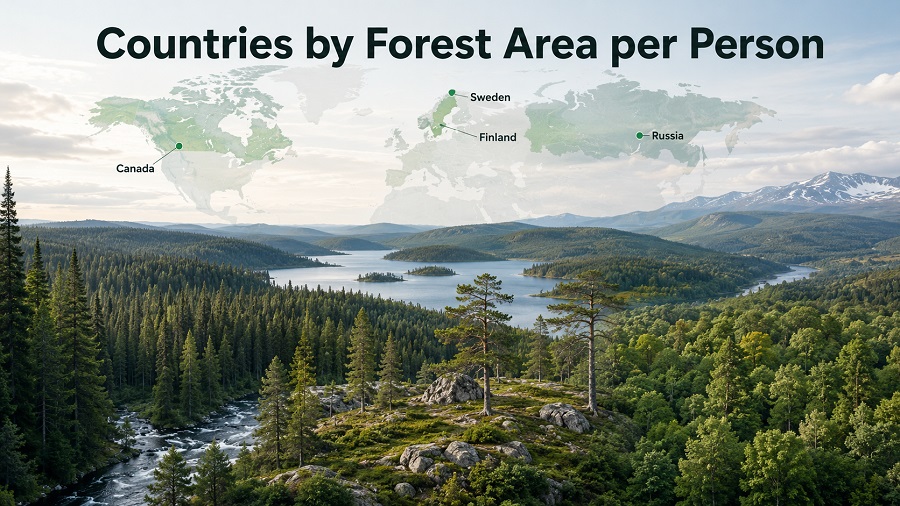
Forest Area per Person by Country: 2026 Edition
Forest area per person shows how much national forest area corresponds to each resident when total forest area is divided by population. It changes the usual forest ranking: countries with the largest absolute forest estates are not always the countries with the most forest per person.
Thank you for reading this post, don't forget to subscribe!This page is a 2026 edition based on the latest comparable international snapshot available for a cross-country table. Forest-area values are expressed in hectares, then divided by population. Because global forest statistics are released with a lag and population series are revised over time, the ranking should not be read as a direct forest measurement for calendar year 2026.
Suriname leads because a large tropical forest estate is divided by a small population.
Continue exploring
More StatRanker pages connected by topic, category or ranking theme.
Top 100 Countries by Forest Area per Capita, 2025
Open rankingThe result is shown in hectares per person. One hectare equals 10,000 square meters.
The ranking is an edition built from internationally comparable forest and population series, not a live 2026 forest survey.
A high value often reflects low population density as much as it reflects forest abundance.
Overview: why forest area per person changes the ranking
Total forest area mainly rewards geographic scale. Forest area per person adds demographic pressure to the comparison. A country can have enormous forests and still rank below a smaller country if its population is much larger. This is why Canada and Russia remain high, while Brazil falls below several less populous forest countries despite having one of the world’s largest forest estates.
The top of the ranking is shaped by two major patterns. In tropical South America and Central Africa, large rainforest areas are spread across small or moderate populations. In northern and boreal countries, extensive forest landscapes are paired with relatively low population density. The indicator therefore says more about the relationship between land, forests and population than about environmental performance alone.
Top 20 countries by forest area per person
The first 20 positions show a strong concentration at the top. Suriname and Guyana stand far above most countries, Gabon forms a second tier, and Canada is the highest-ranked large high-income economy in this table.
| Rank | Country | Forest area per person | Forest area |
|---|---|---|---|
| 1 | Suriname | 25.81 ha | 15.32 million ha |
| 2 | Guyana | 21.48 ha | 16.51 million ha |
| 3 | Gabon | 10.85 ha | 23.40 million ha |
| 4 | Canada | 9.43 ha | 346.98 million ha |
| 5 | Russia | 5.57 ha | 814.85 million ha |
| 6 | Australia | 5.07 ha | 125.37 million ha |
| 7 | Bolivia | 4.78 ha | 54.19 million ha |
| 8 | Botswana | 4.69 ha | 10.64 million ha |
| 9 | Central African Republic | 4.62 ha | 22.14 million ha |
| 10 | Congo | 4.17 ha | 22.30 million ha |
| 11 | Finland | 4.03 ha | 22.22 million ha |
| 12 | Mongolia | 3.98 ha | 12.36 million ha |
| 13 | Bhutan | 3.68 ha | 2.77 million ha |
| 14 | Papua New Guinea | 3.66 ha | 33.55 million ha |
| 15 | Belize | 3.63 ha | 1.36 million ha |
| 16 | Solomon Islands | 3.17 ha | 2.17 million ha |
| 17 | Sweden | 2.79 ha | 28.07 million ha |
| 18 | Zambia | 2.77 ha | 48.30 million ha |
| 19 | Laos | 2.73 ha | 19.14 million ha |
| 20 | Namibia | 2.70 ha | 6.77 million ha |
Values are rounded. The table ranks countries by hectares of forest per person and shows the forest-area numerator for context.
Chart: Top 20 forest area per person values
The bar chart uses the same values as the Top 20 table. The first two bars are much longer than the rest, which shows how exceptional the forest-per-person ratio is in Suriname and Guyana.
Fallback list if visual bars do not render:
- Suriname — 25.81 ha/person
- Guyana — 21.48 ha/person
- Gabon — 10.85 ha/person
- Canada — 9.43 ha/person
- Russia — 5.57 ha/person
- Australia — 5.07 ha/person
- Bolivia — 4.78 ha/person
- Botswana — 4.69 ha/person
- Central African Republic — 4.62 ha/person
- Congo — 4.17 ha/person
Methodology
The ranking is calculated as total forest area divided by population. Forest area is converted into hectares, and the result is presented as hectares of forest per person. The table is sorted from the highest value to the lowest value. Values are rounded to two decimals for the per-person metric and to two decimals for total forest area in millions of hectares.
The 2026 label refers to the publication edition and latest comparable data snapshot. The World Bank forest-area indicator available for international comparison is sourced to FAOSTAT and covers the series through 2023. The World Bank population indicator is sourced from UN World Population Prospects and national statistical systems and runs through 2024. That timing is why the page avoids calling the figures “2026 forest measurements.”
Only countries and reporting economies with enough forest-area and population data are included in the ranked table. Where countries have very close values, rounding can affect the visual order. Small rank differences should not be overinterpreted, especially for countries with similar forest-per-person values or recent population revisions.
The indicator has clear limits. It does not show whether forests are primary, degraded, fragmented, legally protected, publicly accessible or sustainably managed. A high value can reflect low population density rather than better policy. A low value can reflect dense settlement or limited land area rather than poor forest stewardship.
Main table: Top 100 countries by forest area per person
The table is written directly in HTML so that the rows remain visible without JavaScript. Search, sorting and the Top 10 / Top 20 / All control only filter or reorder existing rows.
| Rank | Country | Forest area per person | Forest area |
|---|---|---|---|
| 1 | Suriname | 25.81 ha | 15.32 million ha |
| 2 | Guyana | 21.48 ha | 16.51 million ha |
| 3 | Gabon | 10.85 ha | 23.40 million ha |
| 4 | Canada | 9.43 ha | 346.98 million ha |
| 5 | Russia | 5.57 ha | 814.85 million ha |
| 6 | Australia | 5.07 ha | 125.37 million ha |
| 7 | Bolivia | 4.78 ha | 54.19 million ha |
| 8 | Botswana | 4.69 ha | 10.64 million ha |
| 9 | Central African Republic | 4.62 ha | 22.14 million ha |
| 10 | Congo | 4.17 ha | 22.30 million ha |
| 11 | Finland | 4.03 ha | 22.22 million ha |
| 12 | Mongolia | 3.98 ha | 12.36 million ha |
| 13 | Bhutan | 3.68 ha | 2.77 million ha |
| 14 | Papua New Guinea | 3.66 ha | 33.55 million ha |
| 15 | Belize | 3.63 ha | 1.36 million ha |
| 16 | Solomon Islands | 3.17 ha | 2.17 million ha |
| 17 | Sweden | 2.79 ha | 28.07 million ha |
| 18 | Zambia | 2.77 ha | 48.30 million ha |
| 19 | Laos | 2.73 ha | 19.14 million ha |
| 20 | Namibia | 2.70 ha | 6.77 million ha |
| 21 | Brazil | 2.40 ha | 491.57 million ha |
| 22 | Peru | 2.35 ha | 73.64 million ha |
| 23 | Paraguay | 2.31 ha | 14.67 million ha |
| 24 | Norway | 2.30 ha | 12.12 million ha |
| 25 | Palau | 2.26 ha | 0.04 million ha |
| 26 | New Zealand | 2.11 ha | 10.15 million ha |
| 27 | Angola | 1.91 ha | 57.61 million ha |
| 28 | DR Congo | 1.74 ha | 151.96 million ha |
| 29 | Latvia | 1.73 ha | 3.36 million ha |
| 30 | Estonia | 1.69 ha | 2.23 million ha |
| 31 | Vanuatu | 1.58 ha | 0.44 million ha |
| 32 | Venezuela | 1.52 ha | 46.35 million ha |
| 33 | Montenegro | 1.33 ha | 0.83 million ha |
| 34 | Mozambique | 1.33 ha | 37.53 million ha |
| 35 | Bahamas | 1.32 ha | 0.52 million ha |
| 36 | Colombia | 1.21 ha | 58.45 million ha |
| 37 | Panama | 1.12 ha | 4.58 million ha |
| 38 | Fiji | 1.12 ha | 1.03 million ha |
| 39 | Guinea-Bissau | 1.04 ha | 1.95 million ha |
| 40 | Equatorial Guinea | 0.99 ha | 1.54 million ha |
| 41 | Chile | 0.99 ha | 18.34 million ha |
| 42 | United States | 0.94 ha | 310.65 million ha |
| 43 | Belarus | 0.91 ha | 8.67 million ha |
| 44 | Zimbabwe | 0.91 ha | 13.44 million ha |
| 45 | Brunei | 0.88 ha | 0.38 million ha |
| 46 | Liberia | 0.85 ha | 4.12 million ha |
| 47 | Samoa | 0.83 ha | 0.17 million ha |
| 48 | Tanzania | 0.81 ha | 45.32 million ha |
| 49 | Lithuania | 0.77 ha | 2.18 million ha |
| 50 | Cameroon | 0.76 ha | 18.38 million ha |
| 51 | Georgia | 0.74 ha | 2.82 million ha |
| 52 | Ecuador | 0.74 ha | 12.39 million ha |
| 53 | South Sudan | 0.70 ha | 7.16 million ha |
| 54 | Malaysia | 0.69 ha | 22.22 million ha |
| 55 | Bosnia and Herzegovina | 0.64 ha | 2.19 million ha |
| 56 | Turkmenistan | 0.63 ha | 4.13 million ha |
| 57 | Dominica | 0.62 ha | 0.04 million ha |
| 58 | Slovenia | 0.61 ha | 1.25 million ha |
| 59 | Argentina | 0.60 ha | 26.52 million ha |
| 60 | Micronesia | 0.59 ha | 0.06 million ha |
| 61 | Costa Rica | 0.57 ha | 2.82 million ha |
| 62 | Cambodia | 0.57 ha | 9.20 million ha |
| 63 | Uruguay | 0.56 ha | 1.89 million ha |
| 64 | Bulgaria | 0.55 ha | 3.86 million ha |
| 65 | Myanmar | 0.54 ha | 27.95 million ha |
| 66 | Mexico | 0.53 ha | 65.86 million ha |
| 67 | Timor-Leste | 0.53 ha | 0.66 million ha |
| 68 | Senegal | 0.53 ha | 8.19 million ha |
| 69 | North Macedonia | 0.51 ha | 1.00 million ha |
| 70 | Eswatini | 0.51 ha | 0.60 million ha |
| 71 | Guinea | 0.51 ha | 6.29 million ha |
| 72 | Nicaragua | 0.49 ha | 3.11 million ha |
| 73 | Eritrea | 0.48 ha | 1.50 million ha |
| 74 | Croatia | 0.47 ha | 1.92 million ha |
| 75 | Madagascar | 0.46 ha | 12.44 million ha |
| 76 | Honduras | 0.45 ha | 4.35 million ha |
| 77 | Sudan | 0.44 ha | 18.86 million ha |
| 78 | Austria | 0.44 ha | 3.87 million ha |
| 79 | Sierra Leone | 0.43 ha | 3.17 million ha |
| 80 | Somalia | 0.42 ha | 6.21 million ha |
| 81 | Spain | 0.39 ha | 18.49 million ha |
| 82 | Côte d’Ivoire | 0.39 ha | 10.40 million ha |
| 83 | Serbia | 0.38 ha | 2.72 million ha |
| 84 | Greece | 0.38 ha | 4.11 million ha |
| 85 | Seychelles | 0.36 ha | 0.04 million ha |
| 86 | Slovakia | 0.36 ha | 1.94 million ha |
| 87 | Romania | 0.36 ha | 7.00 million ha |
| 88 | Benin | 0.35 ha | 4.21 million ha |
| 89 | Indonesia | 0.34 ha | 89.64 million ha |
| 90 | Ghana | 0.31 ha | 9.39 million ha |
| 91 | Portugal | 0.31 ha | 3.16 million ha |
| 92 | Chad | 0.30 ha | 4.62 million ha |
| 93 | Cuba | 0.29 ha | 3.31 million ha |
| 94 | Marshall Islands | 0.27 ha | 0.01 million ha |
| 95 | Albania | 0.27 ha | 0.77 million ha |
| 96 | France | 0.26 ha | 17.22 million ha |
| 97 | Burkina Faso | 0.26 ha | 5.23 million ha |
| 98 | Sao Tome and Principe | 0.26 ha | 0.05 million ha |
| 99 | Saint Vincent and the Grenadines | 0.26 ha | 0.03 million ha |
| 100 | Czechia | 0.25 ha | 2.67 million ha |
Table note: values are rounded. The 2026 edition uses the latest comparable forest-area and population series available for international comparison. The table is useful for broad comparison, not for measuring forest quality or current-year land-cover change.
Insights from the forest area per person ranking
The ranking highlights how forest abundance per resident is concentrated in low-density countries. Suriname and Guyana stand far above most of the world because their populations are small relative to their tropical forest area. Gabon shows a similar Central African pattern, while Canada and Russia show the boreal version of the same relationship: enormous forest area spread across comparatively few people.
The middle of the ranking is more mixed. It includes countries with large forest estates but much larger populations, such as Brazil, Peru and Colombia, as well as smaller countries where forests still occupy a meaningful share of land. By the lower part of the Top 100, the metric is often shaped by population density, settlement patterns and the limited size of national forest estates rather than by one simple policy factor.
The main reading is that forest area per person is a resource-pressure indicator. It tells us how much forest exists relative to the number of residents, but it does not tell us whether that forest is primary, fragmented, degraded, protected or sustainably managed.
What this ranking means for readers
Forest area per person helps readers separate absolute forest size from demographic pressure. A high value can point to large carbon-storage potential, major habitat responsibility and land-management choices that affect climate and biodiversity far beyond national borders.
For low-ranked countries, the result should not be treated as failure by itself. Dense countries may have less forest per resident because land is limited and population is large. In those places, smaller forests can still be highly valuable for cooling, flood control, recreation, biodiversity corridors and soil protection.
The ranking works best as a starting point. It should be read together with forest-change data, protected-area data, wildfire risk, biodiversity indicators and land-governance context before drawing conclusions about environmental performance.
FAQ
Which country has the most forest area per person?
Suriname ranks first in this table. Its value is high because a large tropical forest estate is divided by a relatively small population.
Why is this different from total forest area?
Total forest area measures the size of a country’s forest estate. Forest area per person divides that area by population, so demographic scale changes the ranking.
Does a high value mean better forest policy?
No. A high value can reflect geography and low population density. It does not automatically mean strong protection, low deforestation, high biodiversity or good forest governance.
Is this a direct 2026 measurement?
No. The page is a 2026 edition based on the latest comparable international forest and population data. It should be interpreted as a snapshot, not as a live 2026 forest census.
Why do some very large countries rank below smaller countries?
Large total forest area is only one side of the formula. If a country also has a very large population, its hectares-per-person value can be lower than that of a smaller, sparsely populated country.
What does the metric leave out?
It leaves out forest quality, primary forest share, fragmentation, legal protection, public access, forest ownership, carbon density, wildfire risk and recent forest loss or gain.
Sources
- World Bank World Development Indicators: Forest area, AG.LND.FRST.K2. Used as the comparable forest-area source for the ranking. https://data.worldbank.org/indicator/AG.LND.FRST.K2
- World Bank World Development Indicators: Population, total, SP.POP.TOTL. Used for the population denominator in the per-person calculation. https://data.worldbank.org/indicator/SP.POP.TOTL
- FAO Global Forest Resources Assessment 2025. Used for international forest-resource context and forest definition. https://www.fao.org/forest-resources-assessment/en/
- FAO FRA 2025 data platform. Used as the current FAO reference point for forest-resource reporting. https://fra-data.fao.org/
- UN DESA World Population Prospects 2024. Used for population-estimate context behind international population series. https://population.un.org/wpp/
Related rankings
More StatRanker pages connected by topic, category or ranking theme.
Top 100 Countries by Forest Area per Capita, 2025
Open ranking
StatRanker (Website)
administrator