Top 100 Cities by Public Transport Quality, 2026
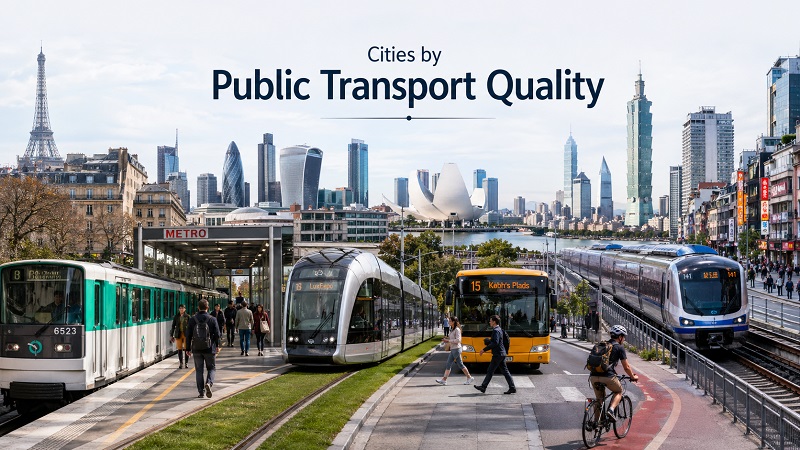
Mobility, Transport & Vehicles · 2026 comparison
Public Transport Quality in 2026: 100 Selected Cities Compared
Public transport quality is not the same as simply having a metro. A strong city system combines rapid rail, trams, buses, BRT, walking access, clear fares, frequent service, reliable operations and inclusive design. This comparison uses a composite Public Transport Quality Score to evaluate how usable public transport is for daily life across 100 selected cities.
This 2026 comparison is based on the latest comparable data available as of April 2026. Most underlying indicators refer to 2023–2025 because transport agencies, international databases and city observatories publish urban mobility statistics with a lag.
Continue exploring
More StatRanker rankings on public finance, tax burden, debt and government spending.
Cities by Public Transport Monthly Pass Price, 2026
Open rankingUS Cities by Air Quality, 2026
Open rankingCalifornia Cities by Air Quality, 2026
Open rankingKey findings from the 2026 comparison
Asian mega-systems dominate ridership
Tokyo, Singapore, Hong Kong, Seoul, Shanghai and Beijing rank near the top because they combine dense rail networks with very high daily usage and strong interchange design.
Europe leads on integration and access
Zurich, Vienna, Paris, Berlin, Amsterdam and Copenhagen show that quality depends on fares, frequency, regional rail, trams, walkability and dependable service, not only total network length.
North America remains uneven
New York is the strongest North American case because of its subway scale and 24-hour backbone, while many other cities lose points for lower coverage, car dependence or weaker rail density.
BRT can lift cities without large metros
Bogotá and Curitiba show that bus rapid transit can become a serious mobility backbone when corridors are frequent, legible and supported by feeder routes.
Methodology: how the Public Transport Quality Score is calculated
The Public Transport Quality Score is a composite 0–100 analytical index. It is designed for city comparison, not as an official UN, UITP or national-government ranking. Each component is normalised to a comparable scale and weighted according to its importance for daily user experience. Scores are rounded estimates; small decimal differences between cities should not be interpreted as statistically precise gaps.
The score combines rapid-transit infrastructure, ridership, coverage, service reliability, affordability and accessibility. Where a city lacks one internationally comparable indicator, the comparison uses documented proxies such as official network length, station density, annual ridership, GTFS coverage, published punctuality data, SDG 11.2.1 access indicators, local agency annual reports and commuter-experience datasets.
| Metric group | Weight | What it captures | Example indicators |
|---|---|---|---|
| Rapid transit network | 25% | Rail, metro, tram, BRT and urban backbone strength | Network km, stations, lines, interchange density |
| Ridership and usage | 20% | Whether residents actually use the system | Annual rides, trips per capita, transit mode share |
| Coverage and access | 20% | How much of the city is conveniently served | Population near stops and stations, SDG access logic |
| Frequency and reliability | 15% | Daily usability at peak and off-peak times | Headways, punctuality, waiting time, service span |
| Affordability and integration | 10% | Ticket simplicity and cost pressure | Passes, transfers, fare-to-income relation |
| Accessibility | 10% | Inclusive use for all passengers | Step-free stations, low-floor vehicles, lifts |
Data limitation: there is no single official global city-level dataset for this exact 100-city public transport quality comparison. The score is therefore a transparent analytical composite, not an official global public-transport index. Administrative boundaries, commuter-rail treatment, ridership definitions and post-pandemic recovery patterns can all affect city comparisons.
10 leading cities by public transport quality
The leading cities combine at least three strengths: dense rapid-transit networks, high actual usage and daily reliability. Metro scale matters, but compact European systems can compete with megacity networks when service frequency, ticket integration and access are exceptionally strong.
94.8/100
Strongest factor: Network scale and ridership.
Tokyo ranks highly because the system combines a strong rapid-transit backbone with daily usability rather than relying on a single transport mode.
93.7/100
Strongest factor: Reliability and integration.
Singapore performs strongly because the rail and bus system is easy to use, clean, frequent and closely connected with urban planning.
93.2/100
Strongest factor: High ridership and rail coverage.
Hong Kong’s dense rail network and high transit use make public transport the default mobility option for a large share of daily trips.
92.6/100
Strongest factor: Dense metro and fare integration.
Seoul combines extensive metro coverage, frequent service and integrated payment across rail and bus networks.
91.8/100
Strongest factor: Metro and regional rail density.
Paris scores highly because the metro, RER, tram and bus systems create one of the densest transit environments in Europe.
91.4/100
Strongest factor: Frequency and punctuality.
Zurich shows that a smaller city can compete globally when tram, rail, bus, fares and schedules are tightly integrated.
90.9/100
Strongest factor: Integrated fares and access.
Vienna’s score reflects a balanced public transport culture built around metro, tram, bus, affordable passes and strong urban coverage.
90.1/100
Strongest factor: Multimodal rail coverage.
London’s strength comes from the Underground, Elizabeth line, Overground, buses and commuter rail functioning as a broad metropolitan network.
89.5/100
Strongest factor: S-Bahn, U-Bahn and tram integration.
Berlin ranks highly because rail, tram and bus services give residents multiple practical ways to move without a car.
89.0/100
Strongest factor: Rapid transit scale.
Shanghai’s score is driven by one of the world’s largest metro networks and a rapid-transit backbone that supports long-distance urban travel.
Selected 100 cities by Public Transport Quality Score, 2026
Use the controls to compare selected cities by region and system type. The score is an analytical composite, not an official global transport index. Scores are rounded estimates on a 0–100 scale; small differences between cities should not be read as statistically precise gaps.
| No. | City | Score | Main strength |
|---|---|---|---|
| 1 | Tokyo, Japan | 94.8 | Network scale and ridership |
| 2 | Singapore | 93.7 | Reliability and integration |
| 3 | Hong Kong, China | 93.2 | High ridership and rail coverage |
| 4 | Seoul, South Korea | 92.6 | Dense metro and fare integration |
| 5 | Paris, France | 91.8 | Metro and regional rail density |
| 6 | Zurich, Switzerland | 91.4 | Frequency and punctuality |
| 7 | Vienna, Austria | 90.9 | Integrated fares and access |
| 8 | London, United Kingdom | 90.1 | Multimodal rail coverage |
| 9 | Berlin, Germany | 89.5 | S-Bahn, U-Bahn and tram integration |
| 10 | Shanghai, China | 89.0 | Rapid transit scale |
| 11 | Beijing, China | 88.6 | Large metro network |
| 12 | Amsterdam, Netherlands | 88.1 | Transit and cycling integration |
| 13 | Copenhagen, Denmark | 87.7 | Metro, rail and accessibility |
| 14 | Madrid, Spain | 87.3 | Metro coverage and affordability |
| 15 | Munich, Germany | 86.9 | Regional rail integration |
| 16 | Stockholm, Sweden | 86.5 | Regional access and reliability |
| 17 | Taipei, Taiwan | 86.1 | Clean, frequent metro service |
| 18 | Osaka, Japan | 85.8 | Rail density and ridership |
| 19 | New York City, United States | 85.4 | 24-hour subway scale |
| 20 | Milan, Italy | 85.0 | Metro and tram network |
| 21 | Barcelona, Spain | 84.6 | Metro coverage and interchange |
| 22 | Prague, Czechia | 84.2 | Tram and metro integration |
| 23 | Helsinki, Finland | 83.8 | Integrated regional network |
| 24 | Hamburg, Germany | 83.3 | S-Bahn and U-Bahn coverage |
| 25 | Brussels, Belgium | 82.9 | Metro, tram and regional access |
| 26 | Lyon, France | 82.5 | Metro, tram and trolleybus balance |
| 27 | Vancouver, Canada | 82.1 | Automated rail and coverage |
| 28 | Melbourne, Australia | 81.7 | Large tram network |
| 29 | Sydney, Australia | 81.2 | Rail, metro and ferry integration |
| 30 | Moscow, Russia | 80.9 | Metro frequency and station density |
| 31 | Warsaw, Poland | 80.5 | Transit modernization and integration |
| 32 | Lisbon, Portugal | 80.1 | Metro, rail and tram access |
| 33 | Budapest, Hungary | 79.8 | Historic metro and tram network |
| 34 | Dublin, Ireland | 79.4 | Rail, tram and bus upgrades |
| 35 | Oslo, Norway | 79.0 | Regional integration and electrification |
| 36 | Rotterdam, Netherlands | 78.6 | Metro and tram coverage |
| 37 | Boston, United States | 78.2 | Subway and commuter rail |
| 38 | Chicago, United States | 77.8 | Urban rail backbone |
| 39 | Montreal, Canada | 77.4 | Metro and bus integration |
| 40 | Toronto, Canada | 77.0 | Subway, streetcar and regional rail |
| 41 | San Francisco, United States | 76.6 | Regional rail and urban transit |
| 42 | Washington, DC, United States | 76.2 | Metro regional reach |
| 43 | Los Angeles, United States | 75.8 | Expanding rail network |
| 44 | Santiago, Chile | 75.4 | Metro coverage and ridership |
| 45 | Mexico City, Mexico | 75.0 | Large metro and BRT network |
| 46 | São Paulo, Brazil | 74.6 | Metro and commuter rail scale |
| 47 | Buenos Aires, Argentina | 74.2 | Subte and rail access |
| 48 | Bogotá, Colombia | 73.9 | High-capacity BRT |
| 49 | Rio de Janeiro, Brazil | 73.5 | Metro, rail and BRT corridors |
| 50 | Medellín, Colombia | 73.1 | Metro and cable-car integration |
| 51 | Istanbul, Turkey | 72.8 | Rapid network expansion |
| 52 | Athens, Greece | 72.4 | Metro and suburban rail |
| 53 | Rome, Italy | 72.0 | Metro, tram and bus coverage |
| 54 | Naples, Italy | 71.6 | Metro and regional rail |
| 55 | Valencia, Spain | 71.3 | Metrovalencia and tram access |
| 56 | Bilbao, Spain | 70.9 | Compact high-quality metro |
| 57 | Porto, Portugal | 70.5 | Light rail and regional reach |
| 58 | Manchester, United Kingdom | 70.1 | Metrolink and rail access |
| 59 | Birmingham, United Kingdom | 69.8 | Rail and tram development |
| 60 | Edinburgh, United Kingdom | 69.4 | Tram and bus network |
| 61 | Geneva, Switzerland | 69.0 | Cross-border transit integration |
| 62 | Basel, Switzerland | 68.7 | Tram and regional access |
| 63 | Frankfurt, Germany | 68.3 | S-Bahn and tram network |
| 64 | Cologne, Germany | 67.9 | Light rail and tram coverage |
| 65 | Düsseldorf, Germany | 67.5 | Regional and tram integration |
| 66 | Stuttgart, Germany | 67.1 | S-Bahn and Stadtbahn |
| 67 | Brisbane, Australia | 66.8 | Rail, busway and ferry links |
| 68 | Perth, Australia | 66.4 | Rail modernization and bus feeders |
| 69 | Auckland, New Zealand | 66.0 | Rail and bus network upgrades |
| 70 | Wellington, New Zealand | 65.7 | Rail and bus access |
| 71 | Dubai, United Arab Emirates | 65.3 | Automated metro backbone |
| 72 | Doha, Qatar | 64.9 | New metro and event capacity |
| 73 | Abu Dhabi, United Arab Emirates | 64.5 | Bus network and planned rail |
| 74 | Riyadh, Saudi Arabia | 64.1 | New metro investment |
| 75 | Tel Aviv, Israel | 63.8 | Light rail and bus network |
| 76 | Jerusalem, Israel | 63.4 | Light rail corridor |
| 77 | Cairo, Egypt | 63.0 | Africa’s largest metro backbone |
| 78 | Casablanca, Morocco | 62.6 | Tram network and urban coverage |
| 79 | Rabat, Morocco | 62.2 | Modern tram access |
| 80 | Tunis, Tunisia | 61.8 | Light rail and suburban rail |
| 81 | Cape Town, South Africa | 61.4 | Rail and bus corridors |
| 82 | Johannesburg, South Africa | 61.0 | Gautrain and BRT corridors |
| 83 | Nairobi, Kenya | 60.6 | Emerging BRT and rail upgrades |
| 84 | Addis Ababa, Ethiopia | 60.2 | Light rail backbone |
| 85 | Lagos, Nigeria | 59.8 | Rail and BRT expansion |
| 86 | Delhi, India | 59.5 | Large metro expansion |
| 87 | Mumbai, India | 59.1 | Suburban rail and metro growth |
| 88 | Bengaluru, India | 58.7 | Metro expansion and bus feeders |
| 89 | Chennai, India | 58.3 | Metro and suburban rail |
| 90 | Kolkata, India | 57.9 | Metro and suburban rail |
| 91 | Bangkok, Thailand | 57.5 | Urban rail expansion |
| 92 | Kuala Lumpur, Malaysia | 57.1 | Rail network and affordability |
| 93 | Jakarta, Indonesia | 56.7 | MRT, LRT and BRT mix |
| 94 | Manila, Philippines | 56.3 | Rail and busway development |
| 95 | Hanoi, Vietnam | 55.9 | New urban rail system |
| 96 | Ho Chi Minh City, Vietnam | 55.5 | Emerging metro network |
| 97 | Lima, Peru | 55.1 | Metro and BRT corridors |
| 98 | Quito, Ecuador | 54.7 | New metro backbone |
| 99 | Guadalajara, Mexico | 54.3 | Light rail and BRT |
| 100 | Curitiba, Brazil | 53.9 | BRT network legacy |
Source: composite StatRanker Public Transport Quality Score, based on UITP metro and urban mobility datasets, SDG access-to-public-transport methodology, city transit agencies, open-data feeds and commuter-experience sources. No single official source publishes this exact 100-city public transport quality comparison. The table is an analytical comparison of selected cities, not an official global transport index. Updated: April 25, 2026. Data years vary by city, mainly 2023–2025.
Chart 1. Selected top 20 Public Transport Quality Scores
The bar chart compares selected leading systems by composite quality score and keeps the highest-scoring cities easy to scan.
Chart 2. Network scale vs. public transport quality
This scatter chart compares selected cities with broadly comparable network-scale indicators. It shows why a large network is helpful but not enough: compact cities can rank highly when frequency, reliability, integration and access are strong.
Selected examples: Tokyo, Singapore, Hong Kong, Seoul, Paris, Zurich, Vienna and London combine high network strength with high public transport quality. Bogotá and Curitiba show how BRT can support a strong score even without a metro-heavy system.
What the comparison shows
The strongest systems are not only large; they are legible, frequent and useful across a full urban day. A long metro network can lift a city’s score, but weak station access, fragmented fares or unreliable feeder buses reduce real-world quality.
Asia dominates the very top by passenger volume and rail intensity. Tokyo, Seoul, Hong Kong, Singapore, Shanghai and Beijing benefit from dense corridors, high-frequency rail and a culture of daily transit use. Europe’s strongest cities perform differently: Zurich, Vienna, Berlin, Amsterdam and Copenhagen rank highly because rail, tram, bus, cycling and walking networks work as one urban mobility system.
The middle of the ranking is shaped by cities with one major strength and one clear weakness. Some have extensive rail but lower accessibility; others have good fares and bus coverage but limited rapid transit. The lower part of the selected 100 includes fast-improving systems where new metro, light-rail or BRT investment is raising quality from a weaker base.
What public transport quality means for daily life
For residents, a high-quality system means lower dependence on private cars, shorter and more predictable commutes, better access to jobs and education, and lower household transport costs. For people considering relocation, transport quality can matter as much as rent or salary because it determines how much of the city is practically reachable.
For visitors, strong public transport changes the cost and stress of a trip: airport connections, clear ticketing, night service and reliable transfers can make a city easier to navigate without taxis. For businesses, transit quality affects access to workers, retail footfall and the resilience of office districts. For city governments, it is closely tied to air quality, road safety, emissions and long-term land-use efficiency.
FAQ: public transport quality comparison
What makes a city’s public transport system high quality?
A high-quality system combines coverage, frequency, reliability, affordability, accessibility and real ridership. A city can have a metro and still perform poorly if the service is infrequent, hard to reach or poorly integrated with buses and regional rail.
Why can a smaller city rank above a megacity?
Quality is measured from the user’s perspective. Zurich or Vienna can compete with much larger cities because their networks are frequent, integrated and easy to use across the whole urban area.
Is metro always better than bus or tram?
No. Metro gives high capacity on dense corridors, but trams, buses and BRT can deliver better coverage when they are frequent, protected from traffic and integrated with rail and ticketing.
Why are Tokyo, Seoul and Hong Kong near the top?
They combine dense rail coverage, very high ridership, frequent service and strong interchange patterns. Their public transport systems are central to daily mobility rather than a secondary option.
Why do some rich car-oriented cities rank lower?
High income does not automatically create strong public transport. Low density, car-oriented land use, fragmented agencies and limited rail coverage can reduce the practical usefulness of transit.
Are the 2026 values collected in 2026?
No. This 2026 comparison uses the latest data available as of April 2026. Most transport datasets refer to 2023–2025 because official city statistics are usually published after the measurement year.
Is this an official UN or UITP index?
No. It is an analytical composite score. UITP, UN-Habitat, SDG indicators, city agencies and open transport data provide the evidence base, but the final weighting and city score are calculated for this comparison.
Sources and data notes
No single official source publishes this exact 100-city public transport quality comparison. This comparison uses official and institutionally credible transport sources wherever possible. City-level data are harmonised because agencies differ in how they count annual passengers, transfers, service kilometres and metropolitan boundaries.
- UITP — Global Metro Figures 2024. Used for metro systems, network length, lines, stops and ridership context. https://www.uitp.org/publications/global-metro-figures-2024/
- UITP — CityTransitData / public transport data. Used for urban mobility indicators, ridership, infrastructure, service and coverage context. https://citytransit.uitp.org/
- UN-Habitat / SDG indicator 11.2.1. Used for the concept of convenient access to public transport and population coverage. https://unstats.un.org/sdgs/metadata/files/Metadata-11-02-01.pdf
- Moovit Global Public Transport Report 2024. Used as a commuter-experience layer for waiting time, commute time, transfers and user patterns. https://moovitapp.com/report
- TomTom Traffic Index. Used as road-delay context, not as a direct public-transport-quality score. https://www.tomtom.com/traffic-index/
- Local transit agencies and city open-data portals. Used for official network maps, annual reports, ridership, accessibility updates, GTFS feeds and service information.
Related rankings
More StatRanker rankings on public finance, tax burden, debt and government spending.