Median Age by Country 2025: Top 100 Ranking
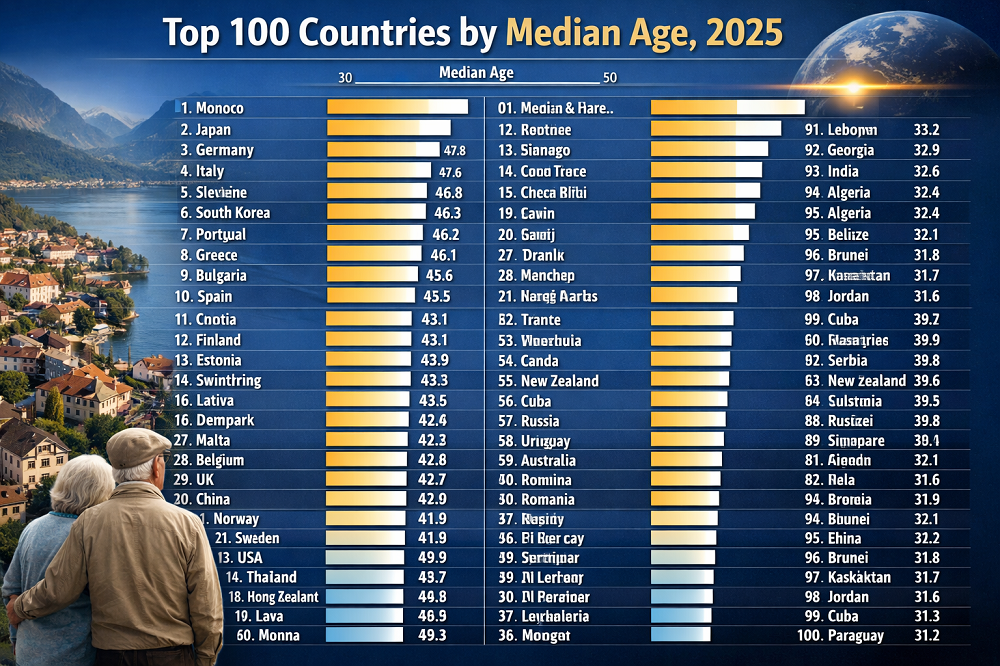
Median Age by Country 2025: Global Ranking, Top 100 Table and Demographic Context
Median age by country 2025 shows the point at which half of a population is younger and half is older. The ranking is based on UN World Population Prospects 2024 estimates and is useful for comparing population aging, labor-market pressure, pension demand, healthcare needs, and long-term consumer trends.
Answer: in the median age by country 2025 ranking, Holy See has the highest median age among countries and territories included in the UN-based compilation. Monaco, Saint Helena, Japan and Martinique follow. The main table below lists the Top 100 countries and territories by median age, sorted from highest to lowest.
The ranking includes the 100 countries and territories with the highest median age in the 2025 distribution. The lower-end comparison sample is included only to show how far the global age structure varies outside the high-median-age group.
Median age by country 2025: distribution context
The first table shows the highest-median-age entries from the same ranking used in the main Top 100. The second table shows selected lower-end entries from the full worldwide list, where median ages are much lower and ranks sit far outside the Top 100.
Highest median age: Top 10
| Rank | Country | Median age | Region |
|---|---|---|---|
| 1 | Holy See | 57.375 | Europe |
| 2 | Monaco | 53.620 | Europe |
| 3 | Saint Helena | 50.904 | Africa |
| 4 | Japan | 49.792 | Asia |
| 5 | Martinique | 49.738 | North America |
| 6 | San Marino | 48.573 | Europe |
| 7 | Italy | 48.231 | Europe |
| 8 | China, Hong Kong SAR | 47.366 | Asia |
| 9 | Saint Pierre and Miquelon | 47.225 | North America |
| 10 | Guadeloupe | 47.200 | North America |
Lower-end comparison sample from the full global ranking
| Global rank | Country | Median age | Region |
|---|---|---|---|
| 226 | Afghanistan | 17.278 | Asia |
| 214 | Yemen | 18.355 | Asia |
| 197 | State of Palestine | 20.055 | Asia |
| 195 | Vanuatu | 20.257 | Oceania |
| 193 | Pakistan | 20.603 | Asia |
| 191 | Solomon Islands | 20.700 | Oceania |
| 189 | Iraq | 20.847 | Asia |
| 184 | Timor-Leste | 21.703 | Asia |
| 182 | Tajikistan | 22.245 | Asia |
| 180 | Papua New Guinea | 22.786 | Oceania |
Median age by country 2025 chart: Top 20 countries and territories
The first 20 places include microstates, island territories, Japan, Southern Europe, Germany, Korea and several Caribbean territories. These entries differ in size and economic model, but they share an older population structure with relatively small younger cohorts.
- Holy See — 57.375
- Monaco — 53.620
- Saint Helena — 50.904
- Japan — 49.792
- Martinique — 49.738
- San Marino — 48.573
- Italy — 48.231
- China, Hong Kong SAR — 47.366
- Saint Pierre and Miquelon — 47.225
- Guadeloupe — 47.200
Values are median ages in years for 2025. Ranking values are taken from a StatisticsTimes table compiled from UN World Population Prospects 2024; UN WPP and the UN Data Portal are the primary methodology sources.
Median age by country 2025 table: Top 100 countries and territories
The main table lists the 100 countries and territories with the highest median age in the 2025 global distribution. Rank 1 has the highest median age; rank 100 is the final entry included in this Top 100 table. Small territories and dependencies are kept when they appear in the source ranking, which is why entries such as Holy See, Saint Helena, Hong Kong SAR, Guadeloupe, Guernsey and Jersey are included.
| Rank | Country | Median age | Region |
|---|---|---|---|
| 1 | Holy See | 57.375 | Europe |
| 2 | Monaco | 53.620 | Europe |
| 3 | Saint Helena | 50.904 | Africa |
| 4 | Japan | 49.792 | Asia |
| 5 | Martinique | 49.738 | North America |
| 6 | San Marino | 48.573 | Europe |
| 7 | Italy | 48.231 | Europe |
| 8 | China, Hong Kong SAR | 47.366 | Asia |
| 9 | Saint Pierre and Miquelon | 47.225 | North America |
| 10 | Guadeloupe | 47.200 | North America |
| 11 | Portugal | 46.915 | Europe |
| 12 | Greece | 46.775 | Europe |
| 13 | Isle of Man | 46.056 | Europe |
| 14 | Bermuda | 45.986 | North America |
| 15 | Spain | 45.850 | Europe |
| 16 | Puerto Rico | 45.816 | North America |
| 17 | Bosnia and Herzegovina | 45.712 | Europe |
| 18 | Republic of Korea | 45.619 | Asia |
| 19 | Germany | 45.491 | Europe |
| 20 | Croatia | 45.257 | Europe |
| 21 | United States Virgin Islands | 44.829 | North America |
| 22 | China, Taiwan Province of China | 44.789 | Asia |
| 23 | Bulgaria | 44.780 | Europe |
| 24 | Slovenia | 44.650 | Europe |
| 25 | Liechtenstein | 44.549 | Europe |
| 26 | Serbia | 44.390 | Europe |
| 27 | Guernsey | 44.282 | Europe |
| 28 | Hungary | 43.894 | Europe |
| 29 | Andorra | 43.854 | Europe |
| 30 | Czechia | 43.805 | Europe |
| 31 | Austria | 43.648 | Europe |
| 32 | Jersey | 43.642 | Europe |
| 33 | Latvia | 43.561 | Europe |
| 34 | Romania | 43.204 | Europe |
| 35 | Finland | 43.162 | Europe |
| 36 | Switzerland | 42.921 | Europe |
| 37 | Falkland Islands (Malvinas) | 42.786 | South America |
| 38 | Estonia | 42.763 | Europe |
| 39 | Saint Martin (French part) | 42.464 | North America |
| 40 | Poland | 42.463 | Europe |
| 41 | Lithuania | 42.289 | Europe |
| 42 | Slovakia | 42.278 | Europe |
| 43 | France | 42.276 | Europe |
| 44 | Cuba | 42.174 | North America |
| 45 | Belgium | 41.924 | Europe |
| 46 | Sint Maarten (Dutch part) | 41.843 | North America |
| 47 | Ukraine | 41.788 | Europe |
| 48 | Montserrat | 41.604 | North America |
| 49 | Aruba | 41.505 | North America |
| 50 | Netherlands | 41.456 | Europe |
| 51 | Belarus | 41.335 | Europe |
| 52 | Denmark | 41.317 | Europe |
| 53 | Malta | 41.051 | Europe |
| 54 | North Macedonia | 41.034 | Europe |
| 55 | Canada | 40.643 | North America |
| 56 | Thailand | 40.551 | Asia |
| 57 | Russian Federation | 40.297 | Europe |
| 58 | Sweden | 40.272 | Europe |
| 59 | China | 40.108 | Asia |
| 60 | United Kingdom | 40.076 | Europe |
| 61 | Montenegro | 39.978 | Europe |
| 62 | Norway | 39.846 | Europe |
| 63 | Bonaire, Sint Eustatius and Saba | 39.595 | North America |
| 64 | China, Macao SAR | 39.574 | Asia |
| 65 | Luxembourg | 39.484 | Europe |
| 66 | Barbados | 39.417 | North America |
| 67 | Turks and Caicos Islands | 39.182 | North America |
| 68 | Saint Barthélemy | 38.972 | North America |
| 69 | Ireland | 38.967 | Europe |
| 70 | Gibraltar | 38.809 | Europe |
| 71 | Curaçao | 38.736 | North America |
| 72 | Anguilla | 38.717 | North America |
| 73 | Cayman Islands | 38.664 | North America |
| 74 | Cyprus | 38.628 | Asia |
| 75 | Republic of Moldova | 38.618 | Europe |
| 76 | British Virgin Islands | 38.575 | North America |
| 77 | Palau | 38.532 | Oceania |
| 78 | United States of America | 38.501 | North America |
| 79 | Australia | 38.263 | Oceania |
| 80 | Wallis and Futuna Islands | 38.163 | Oceania |
| 81 | Réunion | 38.103 | Africa |
| 82 | Northern Mariana Islands | 37.967 | Oceania |
| 83 | Mauritius | 37.819 | Africa |
| 84 | New Zealand | 37.735 | Oceania |
| 85 | Trinidad and Tobago | 37.717 | North America |
| 86 | Georgia | 37.305 | Asia |
| 87 | Albania | 37.266 | Europe |
| 88 | Cook Islands | 37.103 | Oceania |
| 89 | Faroe Islands | 37.070 | Europe |
| 90 | Chile | 36.936 | South America |
| 91 | Armenia | 36.636 | Asia |
| 92 | Dem. People's Republic of Korea | 36.545 | Asia |
| 93 | Uruguay | 36.413 | South America |
| 94 | Antigua and Barbuda | 36.305 | North America |
| 95 | Dominica | 36.285 | North America |
| 96 | Iceland | 36.233 | Europe |
| 97 | Singapore | 36.205 | Asia |
| 98 | Saint Kitts and Nevis | 36.152 | North America |
| 99 | French Polynesia | 36.052 | Oceania |
| 100 | Niue | 35.655 | Oceania |
Source basis: ranking values are taken from a StatisticsTimes country-and-territory table compiled from UN World Population Prospects 2024. StatisticsTimes compilation date: September 16, 2025. This table is the Top 100 highest-median-age countries and territories, sorted from highest median age downward.
Methodology: how median age by country is measured
The primary methodology sources are UN World Population Prospects 2024 and the UN Population Division Data Portal. The table values are taken from a StatisticsTimes country-and-territory ranking compiled from that UN release. Median age is the age that divides a population into two equal halves. It is not the same as average age, and it is not a measure of old-age dependency by itself. It condenses the age distribution into one comparable number for countries and territories.
The main table contains the Top 100 high-median-age entries. The lower-end comparison sample uses the same global ranking but is not part of the Top 100 table. WHO indicator metadata is used for the definition of median age. The CIA World Factbook and Our World in Data are secondary context sources, not the source of the ranking values. Country and territory names follow source naming where possible. Small territories and dependencies are kept when the source includes them, because they are part of the published comparison.
The main limitation is that median age is a summary statistic. Two countries can share a similar median age while having very different migration profiles, fertility trends, pension burdens, or elderly survival patterns. Another limitation is scope: if a ranking includes territories alongside sovereign states, the top and bottom ends may be influenced by very small populations. Holy See, Monaco and Saint Helena are small or unusual-population entries, so they should not be interpreted in the same way as large national age structures. Readers should separate demographic structure from market size or state capacity when interpreting the list.
Insights from the median age by country ranking
The clearest pattern is geographic: Europe, East Asia and several small territories dominate the high-median-age end. Japan, Italy, Portugal, Greece, Germany and the Republic of Korea are high because small birth cohorts have persisted for many years while survival into older ages remains strong. For public budgets, that usually means a larger retired population relative to the workforce; for employers, it means fewer young entrants unless migration or later retirement offsets the gap.
Lower-median-age countries usually have large child and youth cohorts. Countries such as the Central African Republic, Chad, Niger, Somalia and the Democratic Republic of the Congo have very low median ages because fertility remains high and the age pyramid is still broad at the base. That demographic structure can support future growth only if schools, health systems and job creation expand quickly enough.
The middle of the high-median-age table shows why regional averages can be misleading. China is already above 40 years, Thailand is high in the ranking, and Singapore sits lower than a simple fertility-only interpretation would suggest because migration changes the resident age structure. In the Americas, several Caribbean territories appear far above many mainland countries.
What this means for readers
Median age is useful for reading migration pressure, labor supply, housing demand, healthcare needs, pensions, education demand and consumer markets. An older country usually signals slower household formation, a larger retirement economy and tighter long-run labor supply. A younger country often signals stronger demand for schools, entry-level jobs, urban expansion and basic infrastructure. The indicator helps explain why two countries with similar GDP per capita can still face different growth paths and fiscal pressures.
FAQ about median age by country 2025
Which country or territory has the highest median age in 2025?
Holy See has the highest median age in the 2025 UN-based compilation used here, at 57.375 years. Because it is a very small and unusual-population entry, it should be interpreted differently from large national populations.
Why is Holy See at the top of the median age ranking?
Because it is an extremely small jurisdiction with an unusual resident profile. In tiny populations, institutional composition can move the median age much more than it would in a normal country-size society.
Why is Japan still near the top?
Japan has had low fertility for decades and also has very high survival into older ages. Those two forces together keep pushing the midpoint of the population upward.
Does a high median age mean a country is richer?
Not automatically. Many rich countries are old because they moved through the demographic transition earlier, but the indicator itself measures age structure, not income, productivity or living standards.
Why are so many African countries at the youngest end?
Because fertility remains much higher in many parts of Africa, and large shares of the population are still children or young adults. That keeps the midpoint of the population low.
Is median age the same as average age?
No. Median age is the midpoint. Average age can be pulled upward or downward by the oldest and youngest tails of the distribution. Median age is usually easier to compare across countries.
Can migration change median age quickly?
Yes. Large inflows of working-age migrants can make a country look younger than it would be based on births and deaths alone. That is one reason why aging patterns differ even among advanced economies.
How should this ranking be used with fertility and life expectancy?
Median age is strongest when read alongside fertility, life expectancy and age-dependency ratios. Those indicators explain whether a country is aging because births fell, because people live longer, or because migration reshaped the population.
Sources for the median age by country 2025 ranking
- United Nations Population Division — World Population Prospects 2024, primary methodology source for the population estimates: https://population.un.org/wpp/
- UN Population Division Data Portal — official access point for country and territory population indicators: https://population.un.org/dataportal/
- StatisticsTimes — compiled 2025 country-and-territory ranking from UN World Population Prospects 2024; used for the extracted ranking values in the table: https://statisticstimes.com/demographics/countries-by-median-age.php
- WHO indicator metadata — definition of population median age, sourced from UN Population Division: https://www.who.int/data/gho/indicator-metadata-registry/imr-details/116
- CIA World Factbook — secondary country comparison on median age for cross-checking: https://www.cia.gov/the-world-factbook/field/median-age/country-comparison/
- Our World in Data — median age dataset page for long-run context: https://ourworldindata.org/grapher/median-age
Related rankings
Closely related StatRanker pages selected by topic. If no strong match exists, fewer links are shown instead of unrelated recommendations.