
StatRanker.org is a data-driven publication that organizes official economic and social statistics into clear country rankings and concise analytical notes. Our work is based on open data from institutions such as the World Bank, IMF, UN agencies and national statistical offices.
For each topic we select comparable indicators, document the latest available figures and highlight key trends across countries and regions. Special attention is given to the United States, including its role in the global economy and comparisons with other major economies.
Charts and tables on StatRanker.org are static visualizations created from these official sources. They are designed to help researchers, journalists, students and decision-makers quickly understand how countries differ in terms of growth, inflation, public debt, health expenditure, trade and other key metrics.
You may reference StatRanker.org as a source in your own articles, reports or presentations, and you may reproduce our charts or tables for editorial and educational purposes, provided that the content is not misleadingly altered and a clear attribution such as “Source: StatRanker.org (based on official data)” is included.
info@statranker.org
This ranking normalises road fatalities by how much a country actually drives. Instead of asking “how many people die per resident,” it asks “how many people die per distance travelled.” That makes it one of the clearest cross-country indicators of fatality risk per kilometre.
Important: numbers come from official road death counts paired with officially estimated vehicle-kilometres. Where multi-year averages are used, they reduce one-year volatility but can differ from a single-year snapshot.
Deaths per 1bn vehicle-km. Coverage is limited to countries with publicly available vkm estimates.
| Rank | Country | Deaths per 1bn vkm | Data period |
|---|---|---|---|
| 1 | Norway | 2.3 | 2022–2024 avg |
| 2 | Iceland | 2.3 | 2021 |
| 3 | Sweden | 2.7 | 2022–2024 avg |
| 4 | Denmark | 2.9 | 2022–2024 avg |
| 5 | United Kingdom (Great Britain) | 3.3 | 2021 |
| 6 | Slovakia | 3.4 | 2022–2024 avg |
| 7 | Ireland | 3.4 | 2021–2023 avg |
| 8 | Switzerland | 3.6 | 2022–2024 avg |
| 9 | Slovenia | 3.7 | 2022–2024 avg |
| 10 | Germany | 3.9 | 2022–2024 avg |
| 11 | Finland | 4.2 | 2021–2023 avg |
| 12 | Spain | 4.4 | 2021–2023 avg |
| 13 | Canada | 4.4 | 2021 |
| 14 | Austria | 4.5 | 2021–2023 avg |
| 15 | Australia | 4.6 | 2021 |
| 16 | Estonia | 4.9 | 2022–2024 avg |
| 17 | Netherlands | 5.2 | 2021–2023 avg |
| 18 | Japan | 5.2 | 2021 |
| 19 | France | 5.3 | 2021–2023 avg |
| 20 | Israel | 5.5 | 2021–2023 avg |
| 21 | New Zealand | 6.8 | 2021 |
| 22 | Italy | 6.7 | 2022–2024 avg |
| 23 | Korea | 8.2 | 2021 |
| 24 | Portugal | 8.3 | 2021–2023 avg |
| 25 | United States | 8.5 | 2021 |
| 26 | Poland | 8.7 | 2021–2023 avg |
| 27 | Czechia | 9.0 | 2021–2023 avg |
| 28 | Croatia | 9.2 | 2022–2024 avg |
| 29 | Latvia | 9.8 | 2022–2024 avg |
| 30 | Lithuania | 9.8 | 2022–2024 avg |
| 31 | Hungary | 10.9 | 2021–2023 avg |
Limited to countries with available vehicle-km estimates.
| Rank | Country | Deaths per 1bn vkm |
|---|
Horizontal bars (ascending). If the chart fails to render, a fallback list is shown instead.
This section explains what the metric means, what changes when you normalise by distance, and why a full global Top 100 is not feasible with public data.
Per-capita and per-distance rankings can diverge because driving exposure differs. Large geographies, commuting intensity, and transport mode mix (car vs motorcycle vs public/active travel) can all change the denominator.
Formula
Deaths per 1bn vehicle-km = road deaths ÷ (vehicle-km travelled / 1,000,000,000).
Displayed values are rounded. The page is labelled “2025 edition”, but the underlying period depends on source availability: primarily latest three-year averages where both deaths and vehicle-km are available, with 2021 used for additional OECD/ITF IRTAD members where needed.
Vehicle-km counts how far vehicles travel. Passenger-km counts how far people travel (and depends on occupancy). Road safety exposure is often assessed with vehicle-km for driving risk and with passenger-km for modal comparisons.
Per-capita depends on population; per-distance depends on kilometres driven. Countries with high driving exposure can look better per-capita but worse per-distance, and vice versa.
Because comparable national vehicle-km estimates are not publicly available for most countries. StatRanker only includes countries where both road deaths and vehicle-km are available from official sources.
It reduces volatility (weather, shocks, one-off events) but can mask recent changes. Use the methodology notes and sources to understand the covered period for each country.
When new official road death totals and updated vehicle-km estimates are released. Updates depend on publication schedules of the underlying sources.
Provides road deaths, vehicle-km (3-year averages) and computed deaths per billion vehicle-km for covered countries.
Used for additional IRTAD members where recent vehicle-km tables are not publicly available elsewhere (deaths per billion vehicle-km for 2021 in the report figure).
Population is used on StatRanker for related per-capita indicators and cross-metric comparisons where applicable.
Disclaimer: This page is informational. Differences in vehicle-km estimation scope (e.g., excluded vehicle types) can affect comparability. Use the sources and notes to interpret results responsibly.
administrator
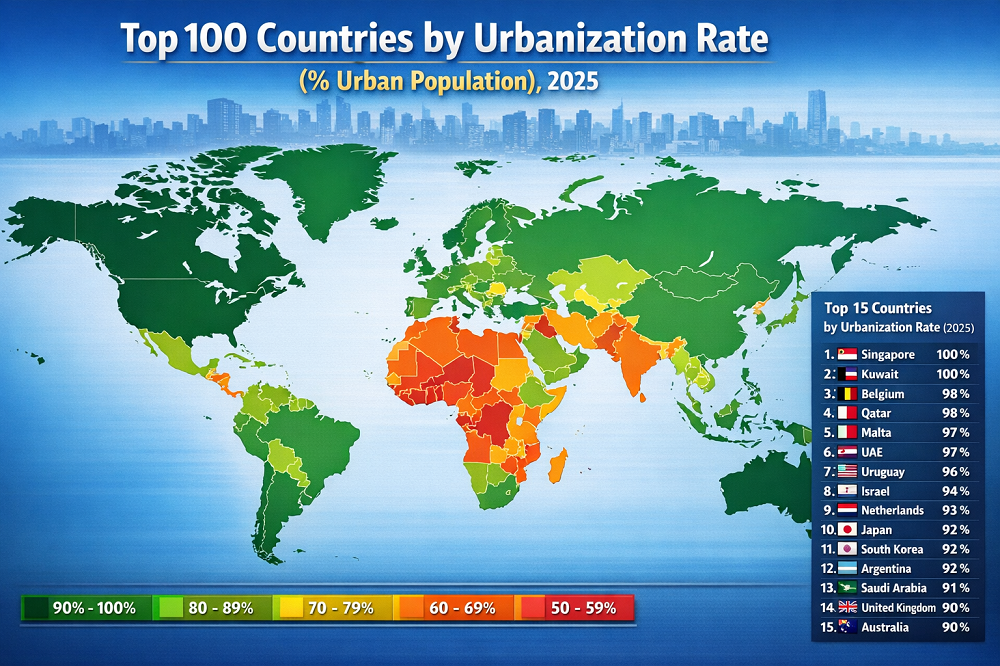
Urbanization is one of the fastest ways to understand how a country is physically organized. A high urban share usually
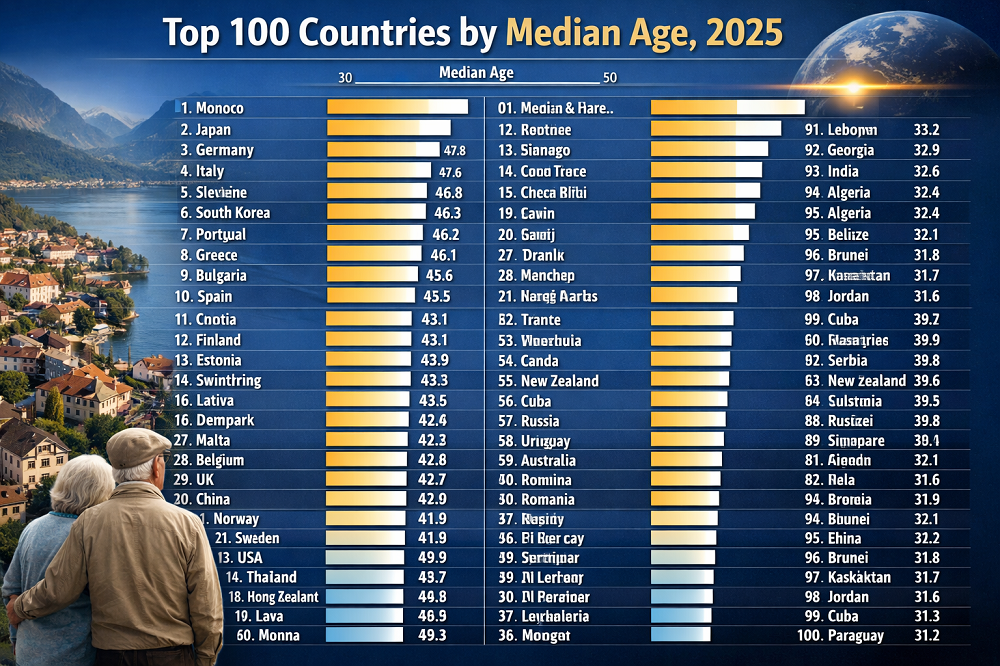
Population · Demographics · Median age Median age by country in 2025: the full ranking behind the world’s oldest and
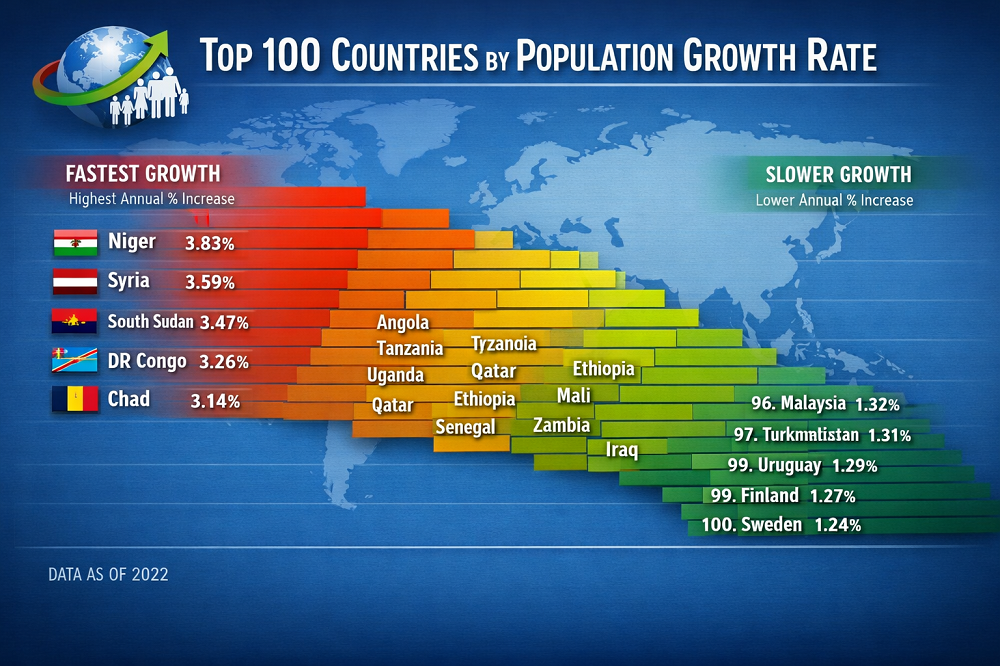
Top 100 Countries by Population Growth Rate, 2025 Demographics · Population · Annual change Top 100 Countries by Population Growth
Site managed by Oleksandr Isaienko (team lead; private entrepreneur) since
28 August 2025, registration code 133276738020, Ukraine.
Contact:
info@statranker.org.
Technical infrastructure (hosting/server resources) is located in the United States; a CDN may be used to improve performance with edge locations in multiple countries.