
TOP 10 Countries by Health Expenditure Share of GDP Growth (2000–2025)
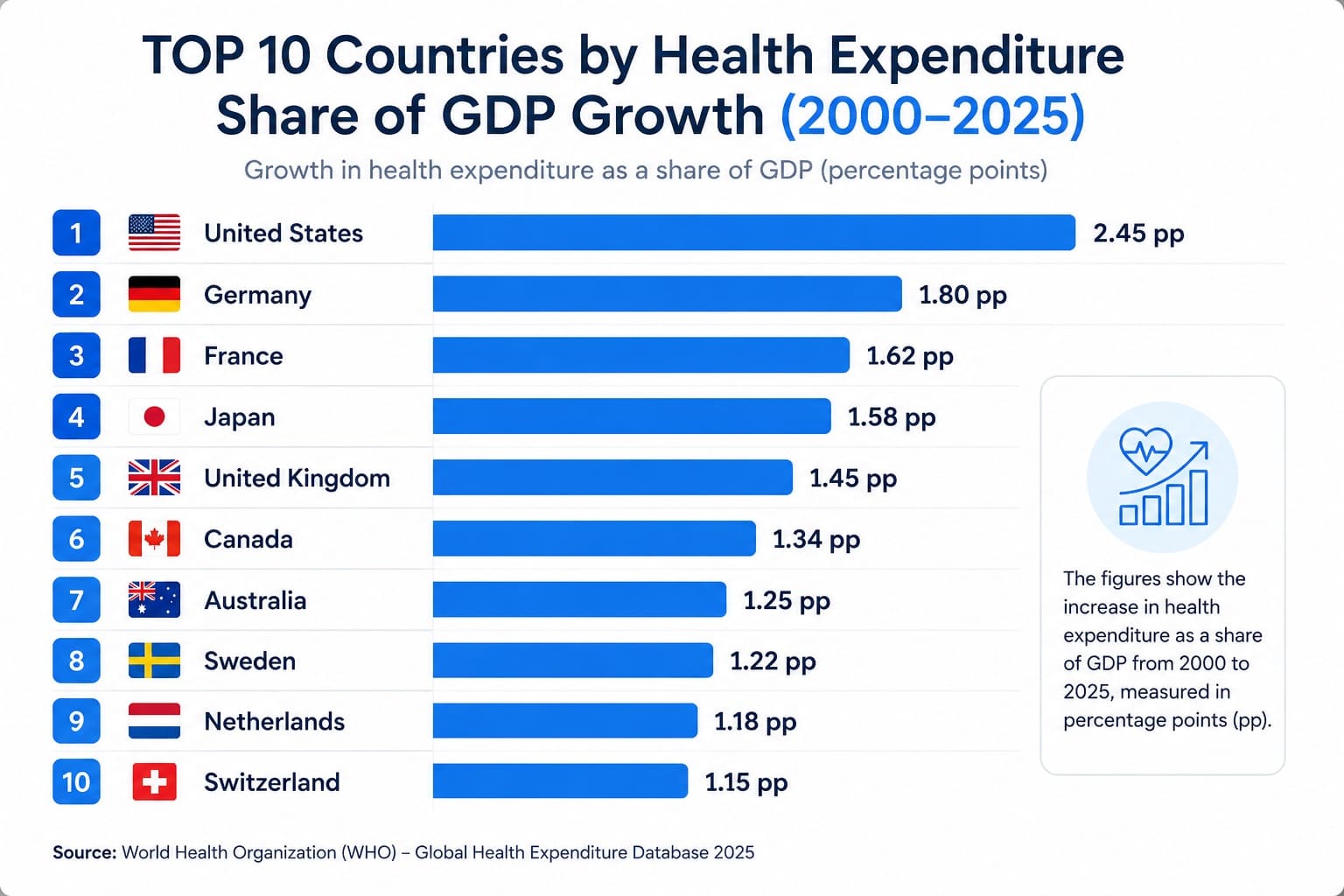
Over the past quarter-century, health systems have claimed a steadily larger slice of global economic output. World Bank and WHO data place global current health expenditure at roughly 10% of world GDP in the early 2020s — up from around 8% in 2000. This shift is not uniform: some economies added more than four percentage points of GDP to their health budgets; others moved by less than one. The ranking below focuses on the ten countries where healthcare's share of the economy grew the most in absolute terms between 2000 and the 2023–2025 horizon, expressed in percentage points of GDP.
Percentage-point growth answers a fiscal question: by how much did healthcare's claim on the whole economy expand? A shift from 8% to 12% of GDP places a much heavier burden on public and private budgets than a shift from 3% to 4%, even if both changes may look modest when presented without context.
Methodology
This ranking measures the absolute change in current health expenditure (CHE) as a percentage of GDP between 2000 and the latest available hard data, usually 2021–2023. The 2025 reference is an analytical horizon based on IMF growth projections and OECD health-spending trends; it is not an official 2025 observation for every country.
Current health expenditure as % of GDP (World Bank indicator SH.XPD.CHEX.GD.ZS), aligned with the System of Health Accounts 2011.
Baseline: 2000. Latest hard data: 2021–2023 depending on country. Any 2024–2025 extension is analytical, not an official forecast.
Absolute change in percentage points of GDP. A gain of 4.3 pp means the share rose, for example, from about 13.0% to 17.3%.
Countries are ranked by absolute percentage-point gain. The comparison includes economies with reasonably consistent CHE data from 2000 onward and excludes territories with populations below 200,000.
CHE combines public and private current spending but excludes capital investment in health infrastructure. Pandemic-era spikes and later revisions to health or national accounts can change the ranking.
Why use share of GDP?
- Per-capita USD comparisons favour richer economies because purchasing power differs.
- Absolute spending in national currencies is not comparable across economies of different sizes.
- Percentage-point change shows how the fiscal weight of health spending moved over time.
Table 1. Top 10 countries by growth in health expenditure as % of GDP, 2000–2025
Current health expenditure (CHE) as % of GDP. Growth shown in percentage points (pp). Latest hard data year per country: 2021–2023. Global CHE ≈ 10% of GDP (2021, WHO).
| Rank ↕ | Country ↕ | Region | Income group | CHE 2000 (% GDP) ↕ | CHE 2023–25 (% GDP) ↕ | Growth (pp) ↕ | Value / Share |
|---|---|---|---|---|---|---|---|
| 1 | United States | Americas | High income | 13.0% | 17.3% | +4.3 pp | 17.3% 43.0% |
| 2 | Japan | Asia | High income | 7.2% | 11.0% | +3.8 pp | 11.0% 38.0% |
| 3 | Germany | Europe | High income | 9.8% | 13.0% | +3.2 pp | 13.0% 32.0% |
| 4 | China | Asia | Upper-middle income | 4.6% | 7.7% | +3.1 pp | 7.7% 31.0% |
| 5 | South Korea | Asia | High income | 4.5% | 7.4% | +2.9 pp | 7.4% 29.0% |
| 6 | France | Europe | High income | 10.1% | 12.8% | +2.7 pp | 12.8% 27.0% |
| 7 | Brazil | Americas | Upper-middle income | 7.2% | 9.7% | +2.5 pp | 9.7% 25.0% |
| 8 | Canada | Americas | High income | 8.8% | 11.1% | +2.3 pp | 11.1% 23.0% |
| 9 | India | Asia | Lower-middle income | 4.3% | 6.3% | +2.0 pp | 6.3% 20.0% |
| 10 | United Kingdom | Europe | High income | 7.0% | 8.9% | +1.9 pp | 8.9% 19.0% |
Sources: World Bank WDI (SH.XPD.CHEX.GD.ZS), WHO Global Health Expenditure Database, OECD Health Statistics. Values rounded; 2024–2025 are analytical estimates. "Share of global" = country CHE % GDP relative to global average of 10%.
Chart 1. Growth in health expenditure as % of GDP, 2000–2025 (percentage points)
Bars show the absolute increase in percentage points of GDP. The United States stands far above the group; emerging-market gains reflect system-building rather than cost inflation.
Note: 2024–2025 values extrapolated from World Bank/OECD trends. Not an official forecast.
Analytical insights: what drove growth in the health share of GDP
Four forces explain the increase across these ten countries, although the mechanisms differ sharply between the United States and countries such as China or India.
1. Price inflation and system fragmentation (high-income, especially United States)
The United States added approximately 4.3 percentage points of GDP to its health bill between 2000 and the mid-2020s — by far the largest absolute increase in the ranking. Hospital prices, pharmaceutical costs and administrative overhead grew faster than in many peer systems, while broader insurance coverage brought more spending into formal channels. Health outcomes did not improve proportionately, pointing to deep structural inefficiencies.
2. Population ageing and universal social insurance (Japan, Germany, France)
Japan, Germany and France entered 2000 with mature public health insurance systems and among the world's oldest populations. Their growth in the health GDP share — +3.8, +3.2 and +2.7 percentage points respectively — reflects the compounding cost of longevity: more people over 75 require more hospital care, medication and long-term care. Negotiated prices, global hospital budgets and strong primary care slow the increase relative to the United States, but do not stop it.
3. Coverage expansion and system-building (China, South Korea, Brazil, India)
China, South Korea, Brazil and India started the period with lower spending in both absolute and GDP-share terms. Their gains reflect deliberate policy expansion: broader enrolment in health insurance, investment in hospitals and primary care, and greater public and private spending on formal care. China's post-2009 expansion of basic medical insurance is the clearest example; South Korea reached near-universal coverage earlier and then deepened its system.
4. The COVID-19 layer
Across all ten countries, the pandemic produced a temporary spike in the health share of GDP in 2020–2021. Testing, intensive care, vaccines and public-health infrastructure raised spending while economic output weakened. Ratios fell as GDP recovered and emergency programmes ended, but many systems retained a higher structural spending floor.
Three key structural patterns across the ranking:
- Convergence in effort, not yet in resources. Middle-income countries now devote shares of GDP to health that approach some advanced economies, while their per-capita spending remains much lower.
- More spending does not automatically produce better outcomes. Efficiency, prices and access determine how much health a country gains from each percentage point of GDP.
- Ageing is the dominant structural driver for 2025–2040. Countries with old or rapidly ageing populations face the steepest projected increases over the next 15 years.
Chart 2. Health expenditure as % of GDP, 2000–2025 — stylised trajectories, selected countries
The US curve sits far above all others throughout. Germany and Japan show steady upward drift; China shows a classic catch-up inflection after 2009.
2023–2025 segment is an analytical extrapolation based on IMF/OECD/WHO trends. Not an official statistical release.
What this ranking means for you
Whether you are a policy analyst, a finance professional, a public-health researcher or simply a curious reader, this ranking has different practical implications depending on where you sit.
For policymakers and fiscal planners:
- A persistent upward trend in the health share of GDP is not primarily a crisis — it reflects richer societies choosing to spend more on health and longer lives. The policy challenge is to get more health per percentage point of GDP, not simply to stop growth.
- The United States demonstrates that high spending without structural reform (price regulation, administrative simplification, stronger primary care) does not automatically translate into proportionate health gains.
- Countries at the "catch-up" stage — China, India, large emerging markets — should monitor whether rising CHE is driven by productive coverage expansion or by premature cost inflation from fragmented systems.
For investors and business analysts:
- A rising health share of GDP means a growing addressable market for pharmaceuticals, medical devices, digital health services and long-term care — especially in Asia.
- Japan, South Korea and China are among the fastest-growing major health markets in percentage-of-GDP terms, while starting from below the OECD norm. This combination of growth momentum and untapped depth is a structurally attractive combination.
- Countries with very high existing shares (US, France, Germany) still offer innovation and premium-segment opportunities, but volume growth is slower and regulatory price pressure is significant.
For citizens and households:
- A higher health share of GDP tells you how collectively demanding healthcare has become on your country's economy — but it does not tell you what your out-of-pocket costs are. Systems like the UK (NHS) or Germany (statutory insurance) collect much of this through taxes and payroll contributions, largely invisible at the point of care. In the US, higher GDP share coexists with high direct patient costs.
- Populations in countries with rapid coverage expansion (China, India) have seen dramatic improvements in access to basic services. But gaps between urban and rural or public and private care remain wide.
- For ageing populations in Japan, Germany or the UK, the numbers signal that long-term care costs will continue to rise — and that personal financial planning for late-life care is increasingly important.
FAQ — Health expenditure as % of GDP
Common questions about the indicator, the ranking and its interpretation.
-
What exactly does "current health expenditure as % of GDP" measure?
Current health expenditure (CHE) captures all spending on health goods and services — hospitals, physicians, medicines, diagnostics, public-health programmes, and health administration — by government, private insurers and households. It excludes capital investment (building new hospitals) and long-term care for activities not primarily medical in nature.
Expressing it as a share of GDP normalises for country size and income level. A country spending 10% of GDP on health is devoting one-tenth of everything it produces to healthcare, regardless of whether its GDP is $1 trillion or $20 trillion.
-
Why does the United States spend so much more than every other country?
The US spends roughly 17% of GDP on health — far above the OECD average and several percentage points above the next large economy, Germany. Hospital and pharmaceutical prices are high, administrative overhead is elevated in a fragmented multi-payer system, and care often shifts toward expensive delivery settings.
Higher expenditure has not translated into proportionately better outcomes: life expectancy and preventable-mortality measures lag several countries that spend much less as a share of GDP.
-
Does a higher health share of GDP mean better healthcare?
Not automatically. The relationship between spending and outcomes is positive at low spending levels — moving from 2% to 5% of GDP on health is strongly associated with lower infant mortality and higher life expectancy. But above roughly 8–9% of GDP, the relationship flattens and even turns negative in some analyses when the United States is included.
What matters is how the money is spent. Countries with strong primary care, electronic health records, outcome-linked payment systems and low administrative overhead tend to achieve better health results per percentage point of GDP than fragmented or volume-driven systems. Japan achieves 11% of GDP with among the world's highest life expectancy; the US achieves 17% with worse outcomes on most comparable metrics.
-
Why are emerging markets like China and India in the top 10 growth list?
Because they started from very low bases and deliberately scaled up. In 2000, China spent about 4.6% of GDP on health, India about 4.3%. Both had large populations with minimal public coverage and heavy reliance on out-of-pocket payments. Over the following 25 years, both governments made coverage expansion a policy priority: China launched its basic medical insurance reform in 2003 and massively increased government health subsidies after 2009; India launched the Pradhan Mantri Jan Arogya Yojana (PM-JAY) scheme in 2018, the world's largest government-funded health coverage programme by enrolment.
The result is a large absolute increase in the health GDP share. But even at 7–8% of GDP, both countries still spend far less per person than OECD economies, because their GDP per capita is lower.
-
How reliable is this data? Can I use it for official research?
The underlying data — World Bank WDI series SH.XPD.CHEX.GD.ZS, WHO Global Health Expenditure Database, OECD Health Statistics — are official statistical releases by major international organisations. They are widely used in academic research and policy analysis and are considered the global standard for cross-country health expenditure comparisons.
However, three caveats apply. First, data for most countries have a 2–3 year lag: 2024–2025 figures in this article are analytical extrapolations, not yet official. Second, methodological revisions (e.g., updates to SHA 2011 boundary definitions) can shift historical values and rankings. Third, small economies and territories with weak national statistical systems have wider confidence intervals around their CHE estimates. For formal academic or policy publications, always download the original series from World Bank Data or WHO's NHA database and verify the latest vintage.
-
Will health spending keep rising as a share of GDP in the future?
Most structural analyses — from OECD, IMF and academic health economists — project continued moderate increases through 2040, driven by three forces: population ageing (more people over 75 with complex conditions), medical innovation (new treatments that extend life but cost more), and rising expectations (richer societies choose to spend more on health).
The key question is the pace and manageability. Countries that invest in prevention, digital health tools, strong primary care and outcome-based payment reform are better placed to absorb higher health spending without fiscal crisis. Countries that rely on high-volume, fee-for-service hospital models face the steepest cost escalation. The IMF Fiscal Monitor and OECD Health at a Glance publications regularly model long-run health spending scenarios under different reform assumptions.
-
What is the difference between public and total health expenditure?
Current health expenditure (CHE) as used here is total spending — public (government and compulsory social insurance) plus private (voluntary insurance, employer schemes, and direct household out-of-pocket payments). The split between public and private varies enormously: in the UK, over 80% of CHE is public (NHS); in the US, public spending alone is already above 8% of GDP, but private spending adds another 8–9%. In India, out-of-pocket payments still account for roughly 45–50% of total CHE, meaning households bear an exceptionally high share of the risk directly.
For household financial protection, the public-vs-private split matters far more than the total CHE percentage. A country with 10% of GDP in health but 80% public coverage is very different from one with 10% of GDP but 50% out-of-pocket.
Primary data sources and technical notes
Figures and rankings are compiled from the international datasets below. Values are rounded and harmonised for analytical comparability; they are not official country-specific statistical releases.
Core time series for current health expenditure as a share of GDP. Primary source for the 2000 baseline and latest available observations used in this article.
Breakdowns of public, private and out-of-pocket health expenditure by country under the System of Health Accounts 2011.
Global totals and trends used for the worldwide reference in the introduction and KPI boxes.
Figures for OECD members used to cross-check values for the United States, Germany, Japan, France, Canada and the United Kingdom.
GDP projections used in the analytical extension from the latest hard data to the 2025 horizon.
Comparative context for US health expenditure, outcomes and the pandemic-era peak.
Values are approximate and rounded for clarity. For formal statistical or policy work, consult the original databases and their methodological documentation.
Related rankings
Closely related StatRanker pages selected by topic. If no strong match exists, fewer links are shown instead of unrelated recommendations.