

Top 100 Banks by Total Assets, 2026
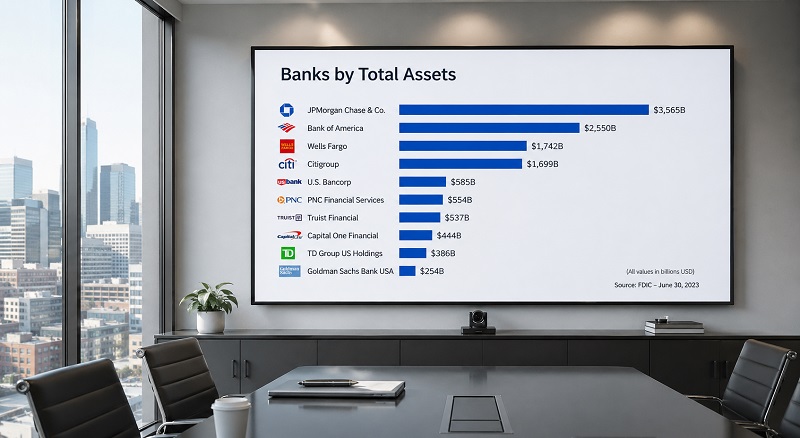
Largest Banks by Total Assets: 2026 Snapshot
Updated: April 26, 2026
Total assets show the size of a bank’s balance sheet: loans, securities, cash, interbank claims, trading assets and other items reported under its accounting rules. For banks, this is a useful scale metric because the business depends on deposits, credit creation, market activity and balance-sheet capacity.
This 2026 snapshot uses public data on large banks by total assets, expressed in U.S. dollars. The figures work best as a size benchmark. They do not measure profitability, capital strength, credit quality, liquidity, market value or safety on their own. A bank can have a very large balance sheet and weak returns; another can be smaller by assets and much more valuable in equity markets.
Continue exploring
More StatRanker pages connected by topic, category or ranking theme.
Industrial and Commercial Bank of China appears first, reflecting the size of China’s state-linked commercial banking system.
The ten largest banks together hold roughly $45.82 trillion in reported assets.
Asian banks make up much of the upper part of the list, led by China’s megabanks, Japan’s universal groups and major Korean, Singaporean and Indian lenders.
Total assets show balance-sheet size. They do not show capital adequacy, loan quality, liquidity coverage, profitability or resolution risk.
What the upper end of the list shows
The largest banks in the list reflect three factors: national banking scale, universal banking models and accounting comparability. China’s largest banks appear prominently because they combine huge retail deposit bases, state-linked lending networks and deep corporate banking franchises. Large U.S. banks also sit high in the list, but U.S. GAAP netting rules for derivatives can make their reported balance sheets look smaller than those of comparable IFRS-reporting institutions.
European and Japanese banks remain prominent because many still operate universal models: corporate lending, securities portfolios, investment banking, wealth management, payments and custody under one group. The list does not identify the “best banks.” It shows where the largest banking balance sheets sit.
Leading banks by total assets
Its balance sheet reflects a vast domestic deposit base, a large corporate lending network and a systemic role in China’s credit system.
A broad branch network and large public-sector-linked lending activity support one of the world’s largest balance sheets.
Its size comes from corporate finance, infrastructure exposure and a major position in China’s household and business banking market.
Bank of China combines domestic scale with a relatively international footprint in trade finance and cross-border banking.
The largest U.S. bank by assets spans consumer banking, corporate lending, trading, payments, custody and investment banking.
Its balance sheet reflects a major U.S. deposit franchise, mortgage and consumer lending, securities portfolios and corporate banking.
HSBC remains one of the largest cross-border banking groups, with strong exposure to Asia-linked trade and corporate banking.
BNP Paribas has one of Europe’s largest balance sheets, supported by corporate, retail and investment banking.
Its French retail base, corporate banking operations and insurance-linked financial services support a large asset total.
MUFG’s position reflects Japan’s large banking system, corporate lending relationships and global securities and trust operations.
Leading banks quick table
| Position | Bank | Country | Total assets |
|---|---|---|---|
| 1 | Industrial and Commercial Bank of China | China | $7,585.85B |
| 2 | Agricultural Bank of China | China | $6,979.43B |
| 3 | China Construction Bank | China | $6,204.37B |
| 4 | Bank of China | China | $5,248.22B |
| 5 | JPMorgan Chase | United States | $4,424.90B |
| 6 | Bank of America | United States | $3,410.39B |
| 7 | HSBC | United Kingdom | $3,233.03B |
| 8 | BNP Paribas | France | $3,221.24B |
| 9 | Crédit Agricole | France | $2,789.12B |
| 10 | Mitsubishi UFJ Financial Group | Japan | $2,723.00B |
Charts: asset concentration and regional structure
Leading 20 banks by total assets
- Industrial and Commercial Bank of China — $7,585.85B
- Agricultural Bank of China — $6,979.43B
- China Construction Bank — $6,204.37B
- Bank of China — $5,248.22B
- JPMorgan Chase — $4,424.90B
- Bank of America — $3,410.39B
- HSBC — $3,233.03B
- BNP Paribas — $3,221.24B
- Crédit Agricole — $2,789.12B
- Mitsubishi UFJ Financial Group — $2,723.00B
Number of listed banks by region
- Asia — 40 banks
- Europe — 31 banks
- North America — 18 banks
- Oceania — 4 banks
- South America — 3 banks
- Middle East — 2 banks
The first chart shows the gap between the largest Chinese banks and the rest of the table. The second chart shows that the list is not centered only on the U.S. and Europe; Asian banks account for much of the count and the largest balance sheets.
Main asset table: 100 banks by total assets
Use the search and filters to compare banks by name, country, region and reported asset size. The table is an asset-size snapshot, not a measure of bank safety or profitability.
| Position | Bank | Country | Total assets |
|---|---|---|---|
| 1 | Industrial and Commercial Bank of China | China | $7,585.85B |
| 2 | Agricultural Bank of China | China | $6,979.43B |
| 3 | China Construction Bank | China | $6,204.37B |
| 4 | Bank of China | China | $5,248.22B |
| 5 | JPMorgan Chase | United States | $4,424.90B |
| 6 | Bank of America | United States | $3,410.39B |
| 7 | HSBC | United Kingdom | $3,233.03B |
| 8 | BNP Paribas | France | $3,221.24B |
| 9 | Crédit Agricole | France | $2,789.12B |
| 10 | Mitsubishi UFJ Financial Group | Japan | $2,723.00B |
| 11 | Postal Savings Bank of China | China | $2,697.74B |
| 12 | Citigroup | United States | $2,657.32B |
| 13 | Bank of Communications | China | $2,247.40B |
| 14 | Wells Fargo | United States | $2,148.63B |
| 15 | Barclays | United Kingdom | $2,079.00B |
| 16 | SMBC Group | Japan | $2,024.00B |
| 17 | Banco Santander | Spain | $1,942.50B |
| 18 | Mizuho Financial Group | Japan | $1,826.49B |
| 19 | Société Générale | France | $1,816.00B |
| 20 | Goldman Sachs | United States | $1,810.00B |
| 21 | China Merchants Bank | China | $1,776.38B |
| 22 | Groupe BPCE | France | $1,720.10B |
| 23 | Royal Bank of Canada | Canada | $1,659.82B |
| 24 | Deutsche Bank | Germany | $1,623.48B |
| 25 | UBS | Switzerland | $1,610.45B |
| 26 | Japan Post Bank | Japan | $1,568.20B |
| 27 | Industrial Bank | China | $1,540.12B |
| 28 | Toronto-Dominion Bank | Canada | $1,498.00B |
| 29 | China CITIC Bank | China | $1,396.44B |
| 30 | Crédit Mutuel | France | $1,325.10B |
| 31 | Shanghai Pudong Development Bank | China | $1,316.42B |
| 32 | Morgan Stanley | United States | $1,300.00B |
| 33 | Lloyds Banking Group | United Kingdom | $1,263.61B |
| 34 | ING Group | Netherlands | $1,238.00B |
| 35 | Intesa Sanpaolo | Italy | $1,107.00B |
| 36 | China Minsheng Bank | China | $1,105.40B |
| 37 | Bank of Montreal | Canada | $1,054.29B |
| 38 | Scotiabank | Canada | $1,044.00B |
| 39 | China Everbright Bank | China | $982.15B |
| 40 | NatWest Group | United Kingdom | $978.08B |
| 41 | Commonwealth Bank | Australia | $955.00B |
| 42 | Standard Chartered | United Kingdom | $919.96B |
| 43 | State Bank of India | India | $911.00B |
| 44 | Itaú Unibanco | Brazil | $898.00B |
| 45 | ANZ Group | Australia | $897.00B |
| 46 | UniCredit | Italy | $855.40B |
| 47 | Banco Bilbao Vizcaya Argentaria | Spain | $825.30B |
| 48 | Ping An Bank | China | $815.60B |
| 49 | Canadian Imperial Bank of Commerce | Canada | $798.89B |
| 50 | La Banque postale | France | $795.20B |
| 51 | Westpac | Australia | $766.40B |
| 52 | DZ Bank | Germany | $766.40B |
| 53 | National Australia Bank | Australia | $748.98B |
| 54 | U.S. Bancorp | United States | $692.35B |
| 55 | CaixaBank | Spain | $675.40B |
| 56 | Rabobank | Netherlands | $672.10B |
| 57 | Capital One | United States | $669.01B |
| 58 | Nordea | Finland | $665.80B |
| 59 | DBS Group | Singapore | $665.00B |
| 60 | Huaxia Bank | China | $615.20B |
| 61 | Commerzbank | Germany | $595.40B |
| 62 | Bank of Beijing | China | $592.30B |
| 63 | Sberbank of Russia | Russia | $585.20B |
| 64 | Norinchukin Bank | Japan | $575.60B |
| 65 | PNC Financial Services | United States | $573.57B |
| 66 | Bank of Jiangsu | China | $560.10B |
| 67 | Truist Financial Corp | United States | $547.54B |
| 68 | Danske Bank | Denmark | $535.40B |
| 69 | KB Financial Group | South Korea | $532.10B |
| 70 | Shinhan Financial Group | South Korea | $515.60B |
| 71 | HDFC Bank | India | $515.00B |
| 72 | Nationwide Building Society | United Kingdom | $512.40B |
| 73 | Sumitomo Mitsui Trust Holdings | Japan | $510.90B |
| 74 | China Guangfa Bank | China | $505.30B |
| 75 | Resona Holdings | Japan | $502.10B |
| 76 | Charles Schwab Corporation | United States | $495.20B |
| 77 | Oversea-Chinese Banking Corporation | Singapore | $475.60B |
| 78 | ABN AMRO | Netherlands | $472.30B |
| 79 | BNY Mellon | United States | $472.30B |
| 80 | China Zheshang Bank | China | $472.10B |
| 81 | Bank of Shanghai | China | $455.40B |
| 82 | Hana Financial Group | South Korea | $445.60B |
| 83 | Bank of Ningbo | China | $442.30B |
| 84 | Nonghyup Bank | South Korea | $432.10B |
| 85 | United Overseas Bank | Singapore | $410.20B |
| 86 | Banco do Brasil | Brazil | $405.30B |
| 87 | Woori Financial Group | South Korea | $402.10B |
| 88 | KBC Group | Belgium | $395.40B |
| 89 | Nomura Holdings | Japan | $392.10B |
| 90 | Landesbank Baden-Württemberg | Germany | $382.40B |
| 91 | Erste Group | Austria | $375.60B |
| 92 | National Bank of Canada | Canada | $372.10B |
| 93 | State Street Corporation | United States | $366.05B |
| 94 | Qatar National Bank | Qatar | $356.52B |
| 95 | Bank of Nanjing | China | $355.03B |
| 96 | SEB Group | Sweden | $339.65B |
| 97 | Raiffeisen Group | Switzerland | $337.25B |
| 98 | Banco Bradesco | Brazil | $331.96B |
| 99 | VTB Bank | Russia | $330.43B |
| 100 | First Abu Dhabi Bank | United Arab Emirates | $330.32B |
Source note: values are in U.S. dollars, billions, and reflect a public-source 2026 snapshot of large banks by reported assets. The figures may differ from S&P Global’s April 2025 list, which used earlier reported asset data. Accounting treatment, reporting date, currency conversion and merger adjustments can affect comparability. For formal analysis, use each bank’s latest annual report or regulatory filing as the primary reference.
Methodology
Total assets are taken as reported consolidated assets for each banking group and converted into U.S. dollars. For banks, this usually includes customer loans, interbank assets, cash and reserves, securities portfolios, recognized derivatives, trading assets, property, receivables and other financial assets. Because banks operate through their balance sheets, total assets are a useful first measure of size.
The page uses a 2026 snapshot based on publicly available global bank asset data. Global bank lists often rely on the latest fiscal year-end or quarterly statements available before publication, with many banks reporting at December year-end. When compilers convert non-U.S.-dollar filers, they typically use period-end exchange rates. As a result, currency movements can shift the order even when local-currency balance sheets change only modestly.
Values are rounded to two decimal places in U.S. dollars, billions. The table is sorted from highest to lowest reported assets. It does not restate every institution under one accounting standard. This matters because IFRS and U.S. GAAP can treat derivatives and netting differently, which affects reported balance-sheet size. The table is best used as an as-reported size comparison, not as a fully normalized risk-adjusted view.
Recent mergers, acquisitions and disposals can also affect the order. Some compiled datasets apply pro forma adjustments for large announced or completed transactions, while individual bank annual reports may not yet reflect those changes. For investment, regulatory or credit analysis, the bank’s own annual report, regulatory filing and capital disclosures remain the primary references.
This asset table does not measure bank safety. A large balance sheet can signal systemic importance, market reach and funding capacity, but it can also reflect low-margin lending, large securities books, derivative treatment, public-sector mandates or slow balance-sheet turnover. Bank strength also depends on CET1 capital, leverage ratio, liquidity coverage ratio, net interest margin, return on assets, non-performing loans, credit ratings and regulatory status.
Insights from the 2026 asset snapshot
Chinese megabanks stand out immediately. The first four positions are all Chinese institutions, and their asset totals are far above the rest of the field. This reflects China’s domestic credit system, large state-linked corporate borrowers, infrastructure lending, household deposits and the role banks play in economic policy.
The United States has fewer banks near the very top than many readers might expect from market capitalization lists. JPMorgan Chase, Bank of America, Citigroup, Wells Fargo, Goldman Sachs and Morgan Stanley all appear high in the table, but U.S. accounting treatment can reduce reported asset size compared with IFRS-reporting peers. U.S. banks often look stronger in market value and profitability comparisons than in pure asset-size comparisons.
Europe’s presence is broad rather than concentrated in one country. France, the United Kingdom, Germany, Spain, Italy, Switzerland, the Netherlands and the Nordics all appear through universal banks, cooperative groups, retail lenders and investment-banking-heavy institutions. The result is a fragmented banking landscape: many nationally important banks rather than one or two continent-wide giants.
The middle and lower parts of the list show regional champions. Canadian, Australian, Korean, Singaporean, Brazilian, Indian and Gulf banks appear because they are important in their domestic or regional financial systems. These institutions may be far smaller than China’s megabanks, but they can still matter greatly in their own economies.
The main point is concentration. A small number of banks hold extremely large balance sheets, and their lending standards, capital buffers and funding costs matter for global trade, housing finance, corporate credit and market liquidity. Still, the table gives only one view of a bank; it does not show whether an institution is attractive, resilient or well managed.
What this means for readers
For a student or researcher, the table is a quick map of where global banking capacity is located. It shows which institutions carry the largest balance sheets and which countries host them. For journalists and analysts, it gives context for systemic importance: when a very large bank changes strategy, tightens lending or faces asset-quality pressure, the effects can reach far beyond its home market.
For business readers, total assets help explain why certain banks are especially important in trade finance, corporate lending, custody, capital markets and cross-border payments. For investors, the table is only a starting point. Large assets can support fee income, deposit scale and market access, but they can also weigh on returns if margins are thin or risk-weighted assets are high. Assets are more useful when compared with capital, earnings quality, credit losses, liquidity and valuation.
For general readers, the main takeaway is simple: the biggest bank is not automatically the safest, most profitable or most innovative bank. Size matters because banks are critical infrastructure, but quality depends on how assets are funded, diversified, regulated and managed through the credit cycle.
FAQ
What does total assets mean for a bank?
Total assets include everything a bank reports on the asset side of its balance sheet: loans, cash, reserves, securities, trading assets, interbank claims and other recognized assets. It measures balance-sheet size, not profit or safety.
Is the largest bank also the safest bank?
No. A large bank may be systemically important, but safety depends on capital, liquidity, asset quality, funding stability, regulation and risk controls. Total assets alone do not show whether a bank can withstand stress.
Why do Chinese banks appear so high by total assets?
China’s largest banks serve a very large economy with extensive corporate lending, infrastructure finance, household deposits and state-linked credit activity. Their size reflects both the economy they serve and the role of banks in China’s financial system.
Why can bank asset lists differ between sources?
Lists can differ because of reporting dates, exchange rates, accounting standards, mergers and acquisitions, subsidiary treatment, pro forma adjustments and whether the source uses annual reports, regulatory filings or a compiled financial database.
How are non-U.S. bank assets converted into dollars?
Compiled lists usually convert local-currency assets into U.S. dollars using a period-end exchange rate or a defined snapshot rate. Currency swings can move a bank up or down even when the bank’s local-currency balance sheet has not changed much.
Are commercial banks and investment banks comparable by assets?
They can be compared by reported assets, but the meaning differs. A commercial bank’s assets may be dominated by loans, while an investment bank or custody bank may hold more trading, securities, collateral or client-related balance-sheet items. Business model matters.
What should be checked besides total assets?
Useful complementary metrics include the CET1 capital ratio, leverage ratio, liquidity coverage ratio, net interest margin, return on assets, return on equity, non-performing loan ratio, credit ratings, funding mix and systemic-bank classification.
Sources
-
S&P Global Market Intelligence — The world's largest banks by assets, 2025
Main public methodology reference for global bank asset data, including as-reported assets, currency conversion, pro forma M&A adjustments and mainland Chinese bank scale.
https://www.spglobal.com/market-intelligence/en/news-insights/articles/2025/4/the-worlds-largest-banks-by-assets-2025-88424232 -
The Banker — Top 1000 World Banks
Annual banking-industry reference for global bank size, strength and country-level trends.
https://www.thebanker.com/Rankings-data/Top-1000-World-Banks -
Bank for International Settlements
Background source for banking-system measurement, international regulatory context and systemic-risk interpretation.
https://www.bis.org/ -
Financial Stability Board — Global systemically important banks
Reference on systemic importance and why size alone does not determine safety or resilience.
https://www.fsb.org/work-of-the-fsb/market-and-institutional-resilience/global-systemically-important-financial-institutions-g-sifis/ -
Federal Reserve — Large financial institutions and supervision
U.S. banking context, including supervision of large banking organizations and balance-sheet oversight.
https://www.federalreserve.gov/supervisionreg.htm -
European Banking Authority
European regulatory context, capital and supervisory comparability of large European banks.
https://www.eba.europa.eu/ -
Individual bank annual reports and investor relations pages
Each bank’s own audited annual report or regulatory filing remains the primary source for consolidated total assets, accounting policies and reporting date.
Related rankings
More StatRanker pages connected by topic, category or ranking theme.
Countries by Foreign Exchange Reserves — 2025
Open rankingCountries with the Highest Bank NPL Ratios: 2026 Snapshot
Open rankingTop 100 Countries by Central Bank Policy Interest Rate (%), Dec 2025 Snapshot
Open rankingGold Production by Country 2026: 2025 USGS Mine-Production Estimates
Open ranking
StatRanker (Website)
administrator
