


Top 100 Countries by Female Labor Force Participation Rate in 2025
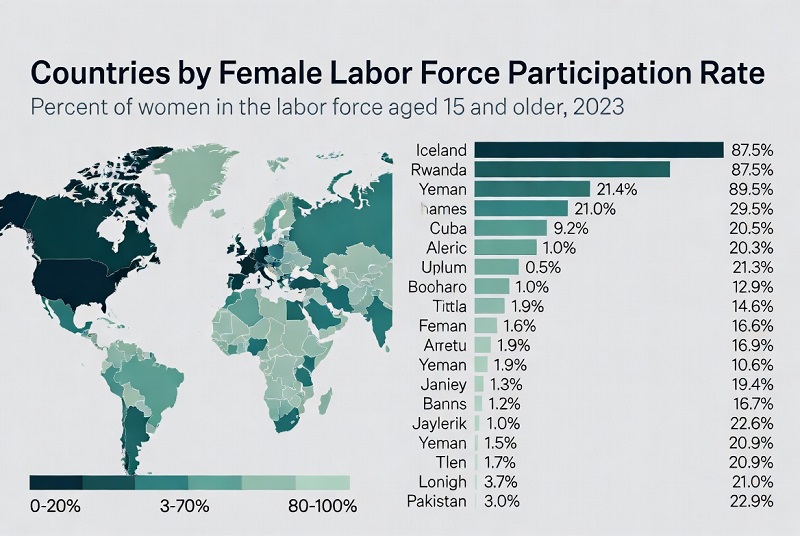
Why female labor force participation is one of the clearest cross-country signals in the 2025 labor-market picture
Female labor force participation rate measures the share of women aged 15 and over who are either employed or actively seeking work. For a global comparison, it is one of the most useful labor-market indicators because it sits exactly at the intersection of economic structure, household norms, childcare systems, education, informality, and demographic pressure.
Thank you for reading this post, don't forget to subscribe!For this 2025 edition, the most broadly comparable cross-country snapshot is the latest available 2024 ranking. The world average in that ranking is 51.13%, but the spread is wide: the very top of the table is above 80%, while a number of low-participation economies remain far below 30%.
Top 10 countries at the top of the 2025 snapshot
A first reading of the Top 10 immediately shows that this is not a “rich countries only” ranking. In fact, many of the highest participation rates appear in lower-income or lower-productivity economies where women’s work is deeply embedded in agriculture, household production, petty trade, or necessity-driven self-employment. That is why the indicator is powerful, but also why it has to be interpreted carefully.
Continue exploring
More StatRanker rankings on wages, income, housing costs and affordability.
OECD Countries by Take-Home Pay Share, 2026 Snapshot
Open rankingTop 99 Countries by Net Average Salary After Tax, 2026
Open rankingTop OECD Countries by Average Annual Wages, 2026 Snapshot
Open rankingMadagascar
Madagascar tops the ranking largely because female economic activity is widespread across agriculture, informal trade, and household-based work. The result signals breadth of participation, not necessarily high pay or formal-sector depth.
Solomon Islands
The Solomon Islands combine subsistence production, informal work, and limited separation between household and market activity. In such economies, women’s participation rates often stay very high.
Nigeria
Nigeria’s high score reflects a very large informal economy and strong necessity-driven work participation among women, especially in trade, services, and agriculture.
Tanzania
Tanzania’s female labor supply remains broad-based across rural activity, small enterprise, and informal services. High participation here says more about work prevalence than about job quality.
Burundi
Burundi illustrates the same pattern: women’s work is highly integrated into subsistence and household production, which lifts participation even in a low-income setting.
Mozambique
In Mozambique, a large share of women participate economically through agriculture and informal activities, keeping the labor-force share high on paper.
North Korea
North Korea ranks unusually high, but any interpretation should be cautious because institutional structure, data quality, and modeling assumptions matter more than in standard market economies.
Uganda
Uganda combines broad female involvement in farming, trading, and small-scale services. It is another example of high participation coexisting with low average productivity.
Benin
Benin’s score is supported by women’s strong role in commerce and agriculture. High inclusion in work is visible, but formalization and earnings remain a separate question.
Cambodia
Cambodia stands out because its high participation sits closer to an export-oriented manufacturing and services model than most economies around it in the Top 10.
Table 1. Top 10 countries by female labor force participation rate
| Rank | Country | Participation rate |
|---|---|---|
| 1 | Madagascar | 82.56% |
| 2 | Solomon Islands | 82.44% |
| 3 | Nigeria | 80.71% |
| 4 | Tanzania | 80.16% |
| 5 | Burundi | 79.86% |
| 6 | Mozambique | 78.12% |
| 7 | North Korea | 77.69% |
| 8 | Uganda | 76.50% |
| 9 | Benin | 74.32% |
| 10 | Cambodia | 73.96% |
Chart 1. Top 20 countries by female labor force participation rate
The Top 20 is dominated by Sub-Saharan Africa plus a small set of Pacific, Caribbean, and advanced European economies. What matters analytically is that the list mixes very different development models: high-participation agrarian economies, island economies, and a few advanced economies with strong female employment ecosystems.
Methodology
This ranking uses the World Bank indicator SL.TLF.CACT.FE.ZS, which measures female labor force participation as a share of the female population aged 15 and over. The underlying statistical base comes from the ILO modelled estimates series, which combines country-reported labor market observations with harmonized modelling to improve cross-country comparability.
Because the broad cross-country ranking currently surfaces 2024 as the most comparable global snapshot, this article treats 2024 as the proxy year for a 2025 edition. Values are rounded to two decimals and sorted from highest to lowest. Where country names appear in standardized English forms, the ranking still follows the same underlying World Bank-based series.
The main limitation is conceptual, not just technical. A very high female participation rate can mean strong inclusion in paid work, but it can also reflect necessity-driven labor, informality, unpaid family production, or low household income that makes non-participation impossible. The modeled nature of the ILO series also means some observations are estimated rather than directly observed, so the ranking is best used for broad comparison rather than for claiming that one country has “better jobs for women” than another.
Insights and takeaways from the ranking
The biggest insight is that high female participation is not the same thing as high female economic empowerment. Many of the countries at the top are not high-income economies. Instead, they are economies where women are heavily involved in farming, informal commerce, or subsistence-related work. In those settings, participation is high because economic life requires near-universal involvement, not because childcare, labor rights, wages, and career mobility are especially strong.
A second insight is that advanced economies do appear in the upper tier, but in a different way. Iceland, New Zealand, the Netherlands, Switzerland, Norway, and Sweden score highly through a mix of formal employment, dual-earner households, flexible labor markets, and better institutional support for women’s work. Their participation is usually linked to job quality, not just labor necessity.
A third insight is regional asymmetry. The top of the table contains many African economies and a few Asia-Pacific cases, while MENA and much of South Asia remain far less represented near the top. That pattern is consistent with long-running differences in social norms, family policy, sector composition, migration structures, and the availability of paid work that is compatible with women’s time constraints.
What this means for readers
If you are using this ranking for personal finance, migration, business, or macro analysis, treat it as a participation map, not as a quality-of-life scoreboard. A country with a 75% female participation rate can still have low wages, high informality, weak protections, and large unpaid care burdens. A country with a lower rate can still offer better pay, safer jobs, and stronger long-term career returns.
For investors and analysts, the indicator can reveal underused labor supply and long-run growth potential. Economies with low female participation often have a larger “reserve” of labor that could lift GDP if policy barriers fall. For households considering relocation, the ranking is a useful first screen, but it should always be paired with wage data, childcare access, working-time norms, female unemployment, and legal protections.
FAQ
Because this indicator measures participation, not earnings. In lower-income economies, women often work at very high rates in agriculture, self-employment, household production, or informal trade.
No. It tells you more women are economically active, but it says nothing by itself about pay, job security, hours, benefits, or career progression.
In many African economies, women’s work is deeply integrated into household survival, agriculture, and informal markets. That tends to push participation rates upward.
Advanced economies such as Iceland or the Netherlands combine high female participation with stronger formal employment systems, childcare infrastructure, and dual-earner household models.
The World Bank series is based on ILO modelled estimates. That improves comparability across countries, but it also means some values are partly estimated.
Because 2024 is the latest broadly comparable global ranking snapshot currently surfaced for this indicator. That makes it the most practical proxy for a 2025 cross-country edition.
Look at female unemployment, wage levels, hours worked, informality, childcare availability, and the female-to-male participation ratio. Those indicators tell you much more about labor-market quality.
Full Top 100 table and the shape of the distribution
The full ranking shows how compressed the middle of the table is. The cutoff for the Top 100 is only a little above the world average, which means small differences of one or two percentage points can move an economy by many positions. That is why this table works best as a comparison tool rather than as a verdict on whether women’s labor-market outcomes are “good” or “bad.”
The interactive view below keeps all 100 rows in the HTML source. With JavaScript on, it defaults to Top 20 for faster scanning. Because this indicator is a rate, the secondary toggle shows the gap versus the world average rather than a meaningless “share of global total.”
Table 2. Top 100 countries by female labor force participation rate, 2025 snapshot
| Rank | Country | Value | Region |
|---|---|---|---|
| 1 | Madagascar | 82.56%+31.43 pp | Africa |
| 2 | Solomon Islands | 82.44%+31.31 pp | Asia-Pacific |
| 3 | Nigeria | 80.71%+29.58 pp | Africa |
| 4 | Tanzania | 80.16%+29.03 pp | Africa |
| 5 | Burundi | 79.86%+28.73 pp | Africa |
| 6 | Mozambique | 78.12%+26.99 pp | Africa |
| 7 | North Korea | 77.69%+26.56 pp | Asia-Pacific |
| 8 | Uganda | 76.50%+25.37 pp | Africa |
| 9 | Benin | 74.32%+23.19 pp | Africa |
| 10 | Cambodia | 73.96%+22.83 pp | Asia-Pacific |
| 11 | Angola | 73.14%+22.01 pp | Africa |
| 12 | Bolivia | 72.46%+21.33 pp | Americas |
| 13 | Eritrea | 72.34%+21.21 pp | Africa |
| 14 | Liberia | 72.06%+20.93 pp | Africa |
| 15 | Iceland | 70.29%+19.16 pp | Europe |
| 16 | Moldova | 70.13%+19.00 pp | Europe |
| 17 | Vietnam | 69.13%+18.00 pp | Asia-Pacific |
| 18 | New Zealand | 66.94%+15.81 pp | Asia-Pacific |
| 19 | Bahamas | 66.49%+15.36 pp | Americas |
| 20 | Republic of the Congo | 66.29%+15.16 pp | Africa |
| 21 | Kazakhstan | 65.99%+14.86 pp | Asia-Pacific |
| 22 | Central African Republic | 65.78%+14.65 pp | Africa |
| 23 | Peru | 65.16%+14.03 pp | Americas |
| 24 | Botswana | 63.79%+12.66 pp | Africa |
| 25 | Qatar | 63.31%+12.18 pp | MENA |
| 26 | Malawi | 63.18%+12.05 pp | Africa |
| 27 | Netherlands | 62.88%+11.75 pp | Europe |
| 28 | Saint Lucia | 62.87%+11.74 pp | Americas |
| 29 | Cyprus | 62.41%+11.28 pp | Europe |
| 30 | Australia | 62.36%+11.23 pp | Asia-Pacific |
| 31 | Singapore | 62.35%+11.22 pp | Asia-Pacific |
| 32 | Democratic Republic of the Congo | 62.30%+11.17 pp | Africa |
| 33 | Kenya | 62.16%+11.03 pp | Africa |
| 34 | Israel | 62.04%+10.91 pp | MENA |
| 35 | Switzerland | 62.04%+10.91 pp | Europe |
| 36 | Norway | 61.72%+10.59 pp | Europe |
| 37 | Sweden | 61.68%+10.55 pp | Europe |
| 38 | Ghana | 61.52%+10.39 pp | Africa |
| 39 | Laos | 61.47%+10.34 pp | Asia-Pacific |
| 40 | Jamaica | 61.30%+10.17 pp | Americas |
| 41 | Canada | 61.03%+9.90 pp | Americas |
| 42 | Estonia | 60.83%+9.70 pp | Europe |
| 43 | Azerbaijan | 60.35%+9.22 pp | Asia-Pacific |
| 44 | Niger | 60.22%+9.09 pp | Africa |
| 45 | Ireland | 60.12%+8.99 pp | Europe |
| 46 | Haiti | 59.98%+8.85 pp | Americas |
| 47 | Denmark | 59.77%+8.64 pp | Europe |
| 48 | Barbados | 59.73%+8.60 pp | Americas |
| 49 | Zimbabwe | 59.62%+8.49 pp | Africa |
| 50 | China | 59.56%+8.43 pp | Asia-Pacific |
| 51 | Paraguay | 59.06%+7.93 pp | Americas |
| 52 | Thailand | 58.85%+7.72 pp | Asia-Pacific |
| 53 | Côte d’Ivoire | 58.84%+7.71 pp | Africa |
| 54 | Mali | 58.00%+6.87 pp | Africa |
| 55 | Macao SAR | 57.92%+6.79 pp | Asia-Pacific |
| 56 | Lithuania | 57.87%+6.74 pp | Europe |
| 57 | Rwanda | 57.87%+6.74 pp | Africa |
| 58 | Finland | 57.44%+6.31 pp | Europe |
| 59 | Uruguay | 57.33%+6.20 pp | Americas |
| 60 | United Kingdom | 57.28%+6.15 pp | Europe |
| 61 | Ethiopia | 57.27%+6.14 pp | Africa |
| 62 | Luxembourg | 57.10%+5.97 pp | Europe |
| 63 | Belarus | 56.94%+5.81 pp | Europe |
| 64 | Cameroon | 56.52%+5.39 pp | Africa |
| 65 | United States | 56.51%+5.38 pp | Americas |
| 66 | Bhutan | 56.46%+5.33 pp | Asia-Pacific |
| 67 | Guinea-Bissau | 56.46%+5.33 pp | Africa |
| 68 | Armenia | 56.42%+5.29 pp | Asia-Pacific |
| 69 | Togo | 56.10%+4.97 pp | Africa |
| 70 | South Korea | 56.02%+4.89 pp | Asia-Pacific |
| 71 | Saint Vincent and the Grenadines | 55.81%+4.68 pp | Americas |
| 72 | Germany | 55.64%+4.51 pp | Europe |
| 73 | Austria | 55.55%+4.42 pp | Europe |
| 74 | Namibia | 55.43%+4.30 pp | Africa |
| 75 | Slovakia | 55.43%+4.30 pp | Europe |
| 76 | Japan | 55.30%+4.17 pp | Asia-Pacific |
| 77 | Malta | 55.29%+4.16 pp | Europe |
| 78 | Latvia | 55.05%+3.92 pp | Europe |
| 79 | Georgia | 55.00%+3.87 pp | Asia-Pacific |
| 80 | Portugal | 54.69%+3.56 pp | Europe |
| 81 | Russia | 54.63%+3.50 pp | Europe |
| 82 | United Arab Emirates | 54.10%+2.97 pp | MENA |
| 83 | Hungary | 53.89%+2.76 pp | Europe |
| 84 | Zambia | 53.85%+2.72 pp | Africa |
| 85 | Vanuatu | 53.74%+2.61 pp | Asia-Pacific |
| 86 | Albania | 53.51%+2.38 pp | Europe |
| 87 | Slovenia | 53.26%+2.13 pp | Europe |
| 88 | Brunei | 53.19%+2.06 pp | Asia-Pacific |
| 89 | Mongolia | 53.07%+1.94 pp | Asia-Pacific |
| 90 | Czechia | 53.06%+1.93 pp | Europe |
| 91 | Brazil | 53.03%+1.90 pp | Americas |
| 92 | South Africa | 52.99%+1.86 pp | Africa |
| 93 | Kyrgyzstan | 52.95%+1.82 pp | Asia-Pacific |
| 94 | Argentina | 52.94%+1.81 pp | Americas |
| 95 | Dominican Republic | 52.90%+1.77 pp | Americas |
| 96 | Equatorial Guinea | 52.75%+1.62 pp | Africa |
| 97 | Panama | 52.67%+1.54 pp | Americas |
| 98 | Spain | 52.60%+1.47 pp | Europe |
| 99 | Indonesia | 52.58%+1.45 pp | Asia-Pacific |
| 100 | Ecuador | 52.44%+1.31 pp | Americas |
Source: World Bank indicator SL.TLF.CACT.FE.ZS, based on ILO modelled estimates; ranking values aligned to the latest broadly comparable 2024 cross-country snapshot and presented here as a 2025 edition table.
Chart 2. How quickly the ranking slope falls from rank 1 to rank 100
This scatter uses rank on the horizontal axis and the participation rate on the vertical axis. It is a simple but useful way to see whether the ranking is tightly packed or sharply tiered. In this case, the upper end is steep, the middle is dense, and the Top 100 cutoff still sits only modestly above the world average.
Interpretation note: a high rank does not automatically imply higher wages, stronger job security, or better work-life balance. It shows a larger share of women participating in the labor market.
How to interpret the female labor force participation hierarchy in 2025
The first lesson from this ranking is that female participation is shaped by very different development paths. One path is the necessity model: women participate because household survival, farming, and informal trade require it. That is why many lower-income African economies appear near the very top. Another path is the institutional inclusion model: women participate at high rates because formal labor markets, childcare systems, education, anti-discrimination rules, and social norms make long-run paid work more feasible. That is why Iceland, the Netherlands, New Zealand, Norway, and Sweden also rank strongly.
The second lesson is that the middle of the table is more compressed than many readers expect. Rank 100 still sits only slightly above the world average. That means policymakers should not over-read small differences in rank position. A movement from rank 72 to rank 58 may reflect only a narrow change in participation, while the deeper story lies in whether women are entering formal, higher-productivity, better-paid work.
The third lesson is that low participation remains one of the clearest signs of unrealized labor supply. Where women’s participation stays very low, economies may be leaving education, skills, and productive potential underused. In that sense, female labor force participation is not only a gender statistic. It is also a growth, fiscal, and demographic resilience statistic.
Use this ranking as a gateway indicator. It tells you where women are active in the labor market, but not whether that activity is formal, safe, well-paid, or compatible with unpaid care responsibilities.
Policy takeaways
- For low-participation economies: the biggest gains usually come from reducing structural barriers such as childcare shortages, legal restrictions, transport constraints, and hiring discrimination.
- For high-participation but low-income economies: the priority is not simply getting more women into work, but shifting women into more productive, formal, and better-paid jobs.
- For advanced economies: preserving high female participation increasingly depends on flexible work design, affordable care systems, tax incentives that do not penalize second earners, and re-entry pathways after childbirth or care breaks.
- For analysts and investors: countries with large female participation gaps may hold untapped labor supply that can matter for medium-term growth, household income, and tax capacity if policy conditions improve.
- For social policy: participation should be read next to wages, hours, job security, and informality. High participation alone is not the end goal; the end goal is better economic opportunity.
Sources
Core definition and country series for labor force participation rate, female (% of female population ages 15+) (modeled ILO estimate).
Official metadata entry explaining concept, code, and long definition for the indicator.
Methodological notes on how nationally reported labor statistics are harmonized and modelled for international comparability.
https://ilostat.ilo.org/resources/concepts-and-definitions/ilo-modelled-estimates/
Processed data page that summarizes methodology, update timing, and the World Bank / ILO source lineage.
https://ourworldindata.org/grapher/female-labor-force-participation-rates
Context pages and gender-focused visual material on labor market participation and related barriers.
Used as a practical ranking page to read the latest cross-country ordering for the 2024 snapshot when building the Top 100 table.
https://www.theglobaleconomy.com/rankings/female_labor_force_participation/
Related rankings
More StatRanker rankings on wages, income, housing costs and affordability.
Median Household Income by State: 2026 Snapshot Based on 2024 ACS Data
Open rankingTop 100 Countries by Real Median Household Income (PPP), 2025
Open rankingTop 100 Countries by Real Wage Growth (2020–2025), 2025 Update
Open rankingTop 35 Countries by Minimum Wage (Real, PPP), 2025
Open rankingPPP-Adjusted Average Wages by Country, 2024
Open rankingCountries Where Wages Beat Inflation: Official Real Wage Growth Ranking, 2020–2025
Open rankingTOP 10 Countries by Income Share of the Top 1% (Latest Data)
Open rankingTOP 10 Countries by Real Wage Growth (2020–2025)
Open ranking
StatRanker (Website)
administrator
