StatRanker.org is a data-driven publication that organizes official economic and social statistics into clear country rankings and concise analytical notes. Our work is based on open data from institutions such as the World Bank, IMF, UN agencies and national statistical offices.
For each topic we select comparable indicators, document the latest available figures and highlight key trends across countries and regions. Special attention is given to the United States, including its role in the global economy and comparisons with other major economies.
Charts and tables on StatRanker.org are static visualizations created from these official sources. They are designed to help researchers, journalists, students and decision-makers quickly understand how countries differ in terms of growth, inflation, public debt, health expenditure, trade and other key metrics.
You may reference StatRanker.org as a source in your own articles, reports or presentations, and you may reproduce our charts or tables for editorial and educational purposes, provided that the content is not misleadingly altered and a clear attribution such as “Source: StatRanker.org (based on official data)” is included.
info@statranker.org
A central bank policy rate (also called a benchmark, key, or monetary policy rate) is the interest rate that anchors short-term funding conditions in an economy. Some central banks set a single “policy rate”, while others operate a corridor (deposit / lending facilities) or guide money-market rates via liquidity operations. In all cases, the goal is similar: influence inflation, credit, currency pressure, and demand—without creating unnecessary volatility in the financial system.
This ranking uses a plain-English “snapshot” approach: we compare headline policy rates across countries as of December 2025. A high nominal policy rate often signals one (or several) of the following: persistent inflation, currency defense under capital outflows, a credibility rebuild after past inflation, or fiscal-financial risk that forces the central bank to keep conditions tight. A low rate can mean subdued inflation, weak demand, or a deliberate easing cycle after earlier tightening.
| Rank | Country | Policy rate |
|---|
A global ranking is useful, but it can be misleading if you read it like a scoreboard. Central banks react to different mixes of inflation dynamics, currency regimes, credit cycles, and fiscal conditions. A 6% policy rate in a low-inflation, high-credibility system can be restrictive; the same 6% rate in a country with 10–15% inflation may still be accommodative in real terms. That is why investors and analysts often translate “nominal policy rate” into a rough “real policy stance” by subtracting inflation (or expected inflation).
In 2025, many economies lived in a two-speed world. Some were clearly in policy easing mode after earlier tightening, because inflation fell and growth slowed. Others had to keep rates elevated due to sticky inflation, FX pressure, or the need to restore monetary credibility. Countries with very high rates often face a combination of inflation persistence and confidence risks: the policy rate becomes a signal as much as a tool—used to anchor expectations and discourage self-reinforcing price and currency spirals.
Next: a distribution view—how many of the Top 100 sit in each policy-rate “bucket.” This helps you see clustering rather than only extremes.
Use the search box to find a country instantly and the sort toggle to switch between “highest rate first” and “lowest rate first” within the Top 100 set. This is meant for comparisons and context—not as a forecast tool. Policy rates can change quickly after inflation surprises, currency shocks, or shifts in fiscal stance, so treat any snapshot as a point-in-time reference.
A practical way to use this list is to build “peer groups.” Compare countries with similar inflation history or exchange-rate regimes rather than comparing every country to every other country. For example, an economy that pegs its currency may move rates in lockstep with the anchor currency, while a floating-rate inflation-targeter may adjust rates pre-emptively based on domestic forecasts. Likewise, a country with shallow local capital markets may rely on the policy rate mainly as a signal, while market rates and credit conditions respond with delays.
| Rank | Country | Policy rate (%) |
|---|
Methodology: headline benchmark policy rates (nominal) for December 2025. Where central banks operate a corridor, the published “policy / key / benchmark” rate is used as shown in the compilation source. Always verify the most recent decision on the central bank site if you need “today’s” level for trading or compliance.
Caveats: policy rates are not directly comparable across different operating frameworks; some countries rely on reserve requirements, capital controls, or administrative credit tools. Also, a high policy rate can coexist with weak transmission if bank lending is regulated or dollarized. Use this ranking as a starting point, then zoom into inflation, FX regime, and credibility indicators.
Use these official sources to verify “current” benchmark / key policy rates and the most recent decisions. For global comparisons and historical series, BIS provides a consolidated dataset; for exact “today” rates, always check the relevant central bank release.
Tip for compliance/anti-plagiarism: keep this “Primary sources” block as a separate section at the end, and avoid using Wikipedia as the only reference. You can still cite Wikipedia for convenience, but it should not be the single source for rate levels.
administrator
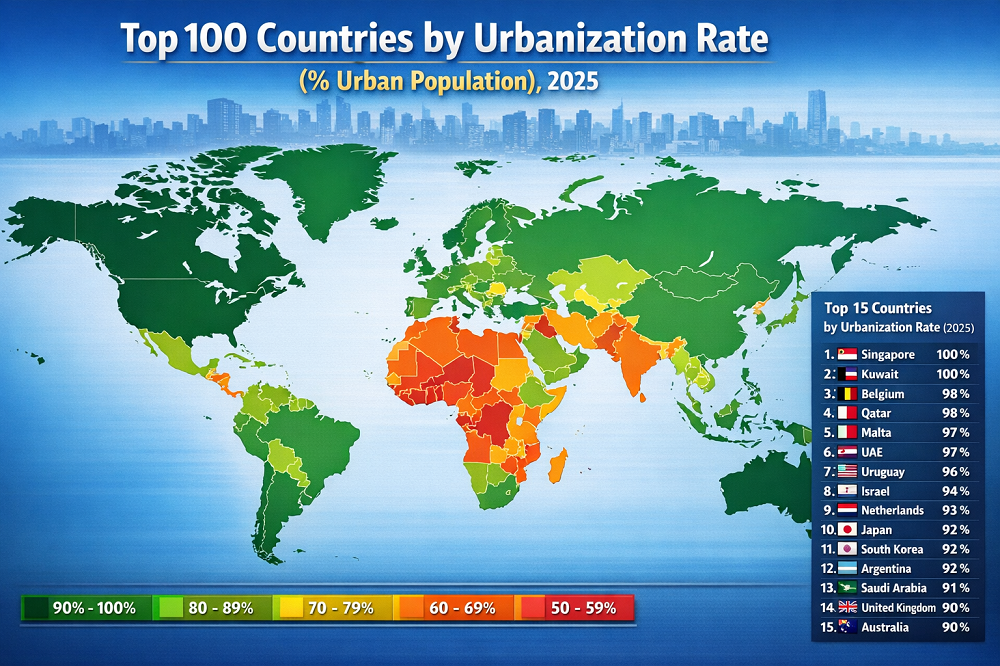
Urbanization is one of the fastest ways to understand how a country is physically organized. A high urban share usually
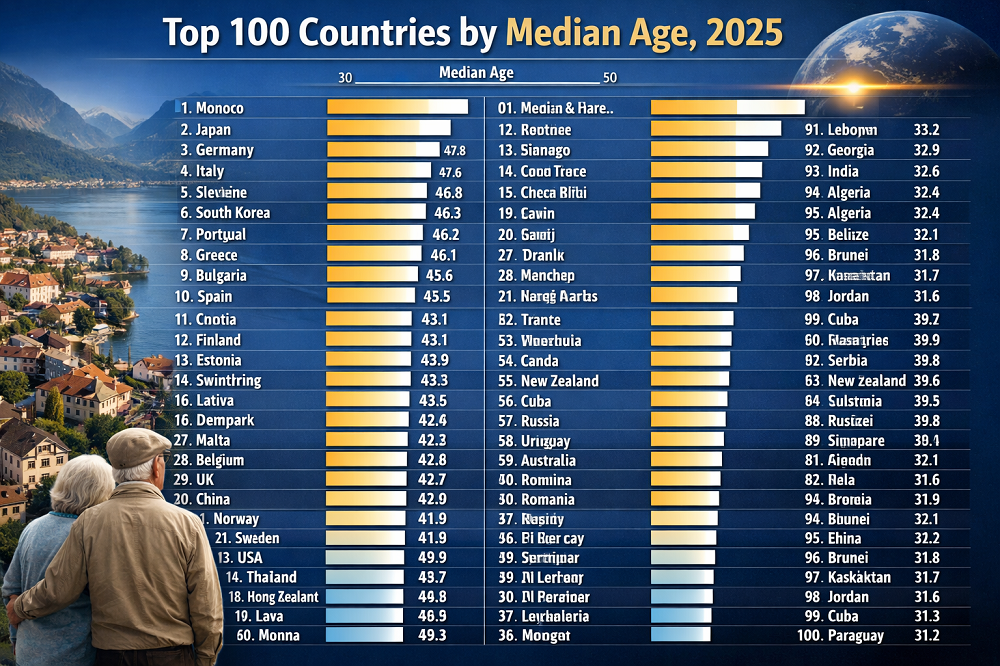
Population · Demographics · Median age Median age by country in 2025: the full ranking behind the world’s oldest and
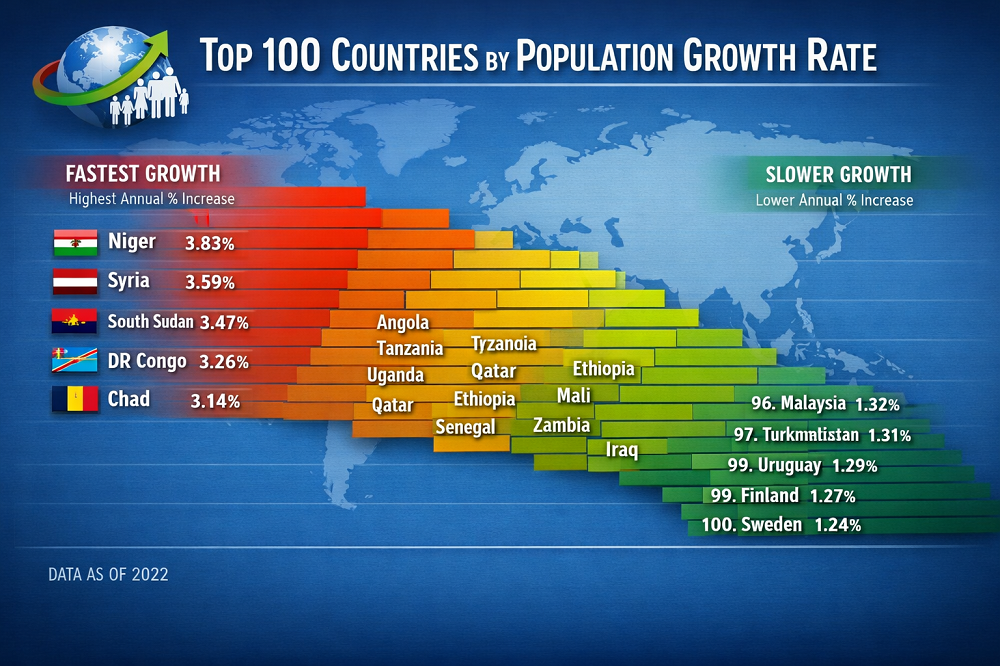
Top 100 Countries by Population Growth Rate, 2025 Demographics · Population · Annual change Top 100 Countries by Population Growth
Site managed by Oleksandr Isaienko (team lead; private entrepreneur) since
28 August 2025, registration code 133276738020, Ukraine.
Contact:
info@statranker.org.
Technical infrastructure (hosting/server resources) is located in the United States; a CDN may be used to improve performance with edge locations in multiple countries.