Top 100 Companies by Market Capitalization, 2026
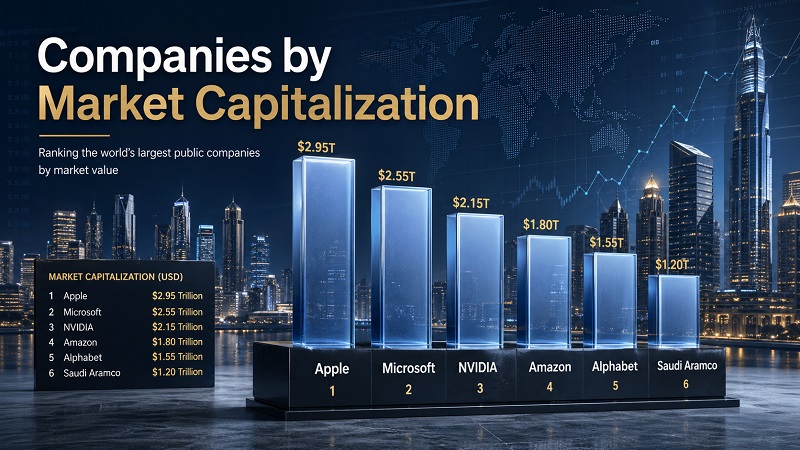
The world’s largest public companies by market value
Market capitalization measures the equity value investors assign to a publicly traded company. It changes with share prices, share counts, corporate actions and foreign-exchange conversion, so this ranking is a dated snapshot rather than a fixed annual total.
The upper end of the 2026 ranking is dominated by AI infrastructure, semiconductors, cloud platforms, digital advertising, consumer ecosystems and a smaller group of financial, healthcare, retail, industrial and energy giants. A high market value signals equity-market scale and investor expectations; it does not prove that a company has the highest revenue, the highest profit, the largest workforce or the lowest risk.
What the top of the ranking shows
The Top 10 is tightly clustered around a few business models: accelerator chips, cloud computing, search and advertising, operating systems, e-commerce, social platforms, electric vehicles and scaled retail. NVIDIA leads because equity markets price the company as the central supplier of AI computing capacity; Alphabet, Apple, Microsoft and Amazon remain near the top because each combines global reach with unusually large profit pools.
Continue exploring
More StatRanker pages connected by topic, category or ranking theme.
The country pattern is just as important as the company pattern. U.S. companies dominate the top tier because they combine global customer bases, deep equity markets, high index ownership and large pools of institutional capital. Taiwan appears through the semiconductor supply chain; China through internet platforms, energy and banks; Europe through luxury, pharmaceuticals, industrial technology, banking and materials.
The ranking can change quickly. A strong earnings report, a rate move, a regulatory decision, an AI-spending cycle or a currency shift can move tens or hundreds of billions of dollars in market value. This makes the table a dated market snapshot, not a permanent hierarchy of corporate strength.
Top 100 companies by market capitalization, 2026 snapshot
The table uses the April 24, 2026 FinanceCharts market-value snapshot as the ranking base. Companies are ranked by U.S.-dollar market capitalization. Secondary market-cap sources may show slightly different values because live prices, exchange rates and share counts update at different times.
| Rank | Company | Country | Market Cap |
|---|---|---|---|
| 1 | NVIDIA | United States | $5.279T |
| 2 | Alphabet | United States | $4.164T |
| 3 | Apple | United States | $3.971T |
| 4 | Microsoft | United States | $3.150T |
| 5 | Amazon.com | United States | $2.839T |
| 6 | Broadcom | United States | $1.996T |
| 7 | Taiwan Semiconductor Manufacturing | Taiwan | $1.803T |
| 8 | Meta Platforms | United States | $1.710T |
| 9 | Tesla | United States | $1.416T |
| 10 | Walmart | United States | $1.038T |
| 11 | Berkshire Hathaway | United States | $1.014T |
| 12 | Samsung Electronics | South Korea | $959.447B |
| 13 | Eli Lilly and Co | United States | $837.648B |
| 14 | JPMorgan Chase & Co | United States | $832.142B |
| 15 | Tencent Holdings | China | $655.977B |
| 16 | Exxon Mobil | United States | $627.233B |
| 17 | Visa | United States | $588.785B |
| 18 | Advanced Micro Devices | United States | $565.328B |
| 19 | ASML Holding | Netherlands | $562.733B |
| 20 | Micron Technology | United States | $560.416B |
| 21 | Johnson & Johnson | United States | $549.134B |
| 22 | Oracle | United States | $499.138B |
| 23 | Mastercard | United States | $450.637B |
| 24 | Costco Wholesale | United States | $448.389B |
| 25 | Intel | United States | $408.760B |
| 26 | Netflix | United States | $389.452B |
| 27 | Caterpillar | United States | $385.858B |
| 28 | Industrial and Commercial Bank of China | China | $378.022B |
| 29 | Bank of America | United States | $370.344B |
| 30 | Chevron | United States | $367.340B |
| 31 | Agricultural Bank of China | China | $352.072B |
| 32 | AbbVie | United States | $351.542B |
| 33 | Cisco Systems | United States | $351.027B |
| 34 | Procter & Gamble | United States | $345.044B |
| 35 | Palantir Technologies | United States | $341.100B |
| 36 | Lam Research | United States | $334.315B |
| 37 | Home Depot | United States | $334.038B |
| 38 | Roche Holding | Switzerland | $330.088B |
| 39 | Applied Materials | United States | $329.840B |
| 40 | Coca-Cola | United States | $329.720B |
| 41 | UnitedHealth Group | United States | $321.907B |
| 42 | PetroChina | China | $309.482B |
| 43 | GE Vernova | United States | $308.359B |
| 44 | China Construction Bank | China | $300.720B |
| 45 | Alibaba Group Holding | Hong Kong | $300.711B |
| 46 | Morgan Stanley | United States | $297.419B |
| 47 | General Electric | United States | $296.829B |
| 48 | BHP Group | Australia | $284.600B |
| 49 | LVMH Moet Hennessy Louis Vuitton | France | $276.569B |
| 50 | Merck & Co | United States | $276.219B |
| 51 | Goldman Sachs Group | United States | $273.477B |
| 52 | Nestle | Switzerland | $257.400B |
| 53 | Toyota Motor | Japan | $255.210B |
| 54 | Philip Morris International | United States | $255.092B |
| 55 | Bank of China | China | $252.238B |
| 56 | KLA | United States | $252.053B |
| 57 | Texas Instruments | United States | $251.821B |
| 58 | Arm Holdings | United Kingdom | $249.368B |
| 59 | Royal Bank of Canada | Canada | $244.423B |
| 60 | Wells Fargo & Co | United States | $243.428B |
| 61 | Rio Tinto | Australia | $239.616B |
| 62 | Linde | United Kingdom | $236.452B |
| 63 | L'Oreal | France | $234.587B |
| 64 | RTX | United States | $234.363B |
| 65 | HSBC Holdings | United Kingdom | $230.044B |
| 66 | Arista Networks | United States | $223.488B |
| 67 | AstraZeneca | United Kingdom | $221.766B |
| 68 | Citigroup | United States | $219.665B |
| 69 | AP Moeller - Maersk | Denmark | $219.210B |
| 70 | Aker BP ASA | Norway | $219.122B |
| 71 | Siemens | Germany | $217.229B |
| 72 | International Business Machines | United States | $216.573B |
| 73 | American Express | United States | $215.226B |
| 74 | McDonald's | United States | $213.561B |
| 75 | PepsiCo | United States | $212.170B |
| 76 | Novozymes | Denmark | $210.572B |
| 77 | Novartis | Switzerland | $209.388B |
| 78 | SoftBank Group | Japan | $208.920B |
| 79 | International Container Terminal Services | Philippines | $208.804B |
| 80 | T-Mobile US | United States | $208.445B |
| 81 | Commonwealth Bank of Australia | Australia | $206.812B |
| 82 | SAP | Germany | $206.488B |
| 83 | Hermes International SCA | France | $205.098B |
| 84 | Nextera Energy | United States | $199.272B |
| 85 | Verizon Communications | United States | $195.837B |
| 86 | Industria de Diseno Textil | Spain | $195.275B |
| 87 | Analog Devices | United States | $194.750B |
| 88 | Mitsubishi UFJ Financial Group | Japan | $192.946B |
| 89 | Amgen | United States | $187.176B |
| 90 | Amphenol | United States | $184.286B |
| 91 | Boeing | United States | $183.970B |
| 92 | Shell | United Kingdom | $183.836B |
| 93 | Novo Nordisk | Denmark | $183.587B |
| 94 | AT&T | United States | $182.585B |
| 95 | Siemens Energy | Germany | $182.560B |
| 96 | Walt Disney | United States | $181.581B |
| 97 | Schneider Electric | France | $181.247B |
| 98 | Banco Santander | Spain | $178.450B |
| 99 | Toronto-Dominion Bank | Canada | $177.512B |
| 100 | Qualcomm | United States | $176.496B |
Source: FinanceCharts “Biggest Companies in the World by Market Cap for Apr 2026,” last updated April 24, 2026. Secondary checks used MarketCapOf, CompaniesMarketCap, exchange pages and company filings where relevant. Top 100 combined market capitalization used for share calculations: approximately $55.90 trillion.
Top 20 companies by market capitalization
The chart shows the steep drop from the first five companies to the rest of the Top 20. NVIDIA, Alphabet, Apple, Microsoft and Amazon sit far above most global listed companies, while Broadcom, Taiwan Semiconductor Manufacturing, ASML, AMD, Micron and other chip-linked names show how strongly AI infrastructure has reshaped the upper tier of equity markets.
- NVIDIA — $5.279T
- Alphabet — $4.164T
- Apple — $3.971T
- Microsoft — $3.150T
- Amazon.com — $2.839T
- Broadcom — $1.996T
- Taiwan Semiconductor Manufacturing — $1.803T
- Meta Platforms — $1.710T
- Tesla — $1.416T
- Walmart — $1.038T
Sector concentration in the Top 100
Information Technology is the clearest value cluster because the market assigns high multiples to companies connected with AI chips, cloud computing, software platforms, device ecosystems and semiconductor equipment. Financials remain numerous because global banks, card networks and insurers have large equity bases and durable earnings, but they usually trade at lower multiples than the most scalable technology firms. Communication Services is smaller by count but large by value because Alphabet and Meta sit near the top of the list.
| Sector | Companies | Market Cap | Share |
|---|---|---|---|
| Information Technology | 25 | ≈ $27.08T | ≈ 48.4% |
| Financials | 19 | ≈ $6.82T | ≈ 12.2% |
| Communication Services | 10 | ≈ $7.84T | ≈ 14.0% |
| Consumer Discretionary | 10 | ≈ $5.24T | ≈ 9.4% |
| Health Care | 10 | ≈ $3.43T | ≈ 6.1% |
| Energy | 6 | ≈ $1.93T | ≈ 3.5% |
| Industrials, Materials, Staples, Utilities | 20 | ≈ $3.56T | ≈ 6.4% |
Methodology
Market capitalization is calculated as share price multiplied by shares outstanding. For this ranking, companies are ordered by U.S.-dollar market capitalization using the FinanceCharts April 24, 2026 snapshot. Values are rounded for readability, with trillions used above $1 trillion and billions used below that threshold.
The ranking includes publicly traded operating companies with observable equity-market prices. Private companies, exchange-traded funds, closed-end funds, cryptocurrencies, indexes and non-operating vehicles are excluded. Where a company has more than one listing or share class, the ranking treats market value at the company level rather than as a comparison between individual trading lines.
Live market-cap sources often disagree by small amounts. The most common reasons are update timing, exchange-rate conversion, treatment of local listings versus ADRs, free-float conventions, delayed share-count updates and class-share structures such as Alphabet, Berkshire Hathaway or dual-listed international groups. The table therefore uses one primary ranking source for consistency and secondary sources only for plausibility checks.
Market capitalization is not enterprise value. It measures equity value only and does not subtract cash or add debt. It is also not the same as revenue, net income, assets, brand value or economic importance. Buybacks, secondary offerings, stock splits, compensation-related issuance, currency movements and intraday price changes can all move market cap without any immediate change in the underlying business.
Insights from the 2026 market-cap ranking
Value is concentrated in a narrow group of companies that sit closest to global digital infrastructure. NVIDIA, Broadcom, TSMC, ASML, AMD and Micron show how much public-market value is now tied to AI compute, memory, advanced chips and semiconductor equipment. Alphabet, Microsoft, Amazon and Meta add the software, cloud and advertising layers built on top of that infrastructure.
Revenue scale and market value do not move in lockstep. Walmart, Exxon Mobil, Toyota and large banks generate enormous sales or assets, yet they usually trade at lower valuation multiples than companies with faster expected earnings growth, stronger software economics or perceived AI upside. That is why a smaller-revenue company can rank above a much larger seller of goods or commodities.
The geography of the list reflects capital-market depth as much as corporate performance. The United States has the largest cluster because its leading public companies combine global businesses with liquid listings and heavy institutional ownership. Asia contributes semiconductor manufacturers, internet platforms, banks and industrial champions. Europe is more visible in luxury, pharmaceuticals, industrial systems, materials and banking than in mega-cap software platforms.
The cutoff is high: the 100th company is still valued at roughly $176.5 billion. Many well-known global businesses sit outside the table not because they are small, but because the top of the equity market has become exceptionally concentrated around a handful of trillion-dollar and near-trillion-dollar companies.
What this means for readers
Investors can use the ranking to see where portfolio concentration risk may be hiding. Index funds and large-cap portfolios often have heavy exposure to the same mega-cap technology and platform companies, so a market-cap table helps reveal whether performance is being driven by a broad market or by a small set of names.
Business readers can use the list to understand which industries capital markets are rewarding now. AI infrastructure, semiconductors, cloud platforms, digital payments, software, luxury goods, healthcare innovation and large financial networks attract high valuations because investors expect durable earnings, pricing power or long growth runways.
For everyday readers, the ranking helps separate “largest by stock-market value” from “largest by sales,” “largest employer” or “safest company.” Market capitalization is useful because it is timely and comparable across listed companies, but it is volatile by design and should not be treated as a full measure of corporate quality.
FAQ
What does market capitalization mean?
Market capitalization is the total stock-market value of a public company’s equity. It is calculated by multiplying the current share price by the number of shares outstanding.
Is the largest company by market cap also the most profitable?
Not necessarily. Market cap reflects what investors are willing to pay for the company’s equity. It includes expectations about future growth, risk, margins, interest rates and investor sentiment, not only current profit.
Why do technology companies dominate the top of the ranking?
Large technology companies often have global scale, high margins, recurring revenue, platform effects and exposure to AI, cloud or semiconductor demand. Those characteristics can produce higher valuation multiples than slower-growing industries.
Why does the ranking change so often?
Share prices move every trading day. Market cap can also change when companies issue shares, buy back stock, split shares or report earnings that alter investor expectations.
Are private companies included?
No. Private companies do not have a continuously observable public share price, so they are excluded from this public-company market-cap ranking.
What is the difference between market cap and enterprise value?
Market cap measures equity value only. Enterprise value adjusts for debt, cash and other claims, which makes it more useful for comparing takeover value or capital structure across companies.
Why can two sources show different market cap values?
Differences can come from update timing, exchange rates, share-class treatment, ADR conversion, delayed prices and the exact shares-outstanding figure used by the source.
Does a higher market cap mean a better company?
No. A higher market cap means the equity market assigns a larger total value to the company. It does not automatically mean stronger management, better returns, lower risk or a better product.
Sources
- FinanceCharts — Biggest Companies in the World by Market Cap. Primary ranking source for the April 24, 2026 market-cap snapshot, including company names, country labels, sector labels and market-cap values.
- MarketCapOf — Largest Companies by Market Cap. Secondary live-ranking check used to compare the largest public companies and detect obvious ordering conflicts.
- CompaniesMarketCap — Companies ranked by market capitalization. Secondary reference for market-cap definitions, private-company exclusion logic and broad public-company comparisons.
- SEC EDGAR. Filing source for U.S.-listed issuers, especially share-count context, corporate actions and class-share structures.
- Nasdaq Market Activity. Exchange quotation reference for Nasdaq-listed companies and market-data context.
- NYSE Listed Company Directory. Listing reference for NYSE-traded companies and exchange status checks.
- World Federation of Exchanges Statistics. Background source for global equity-market structure and listed-market context.
Related rankings
More StatRanker pages connected by topic, category or ranking theme.
Stock Market for Beginners: Where to Invest in 2025?
Open rankingReal Estate Market in 2026: Investments and Returns
Open rankingTop 100 Countries by Corruption Perceptions Index, 2025
Open rankingTop 100 Destinations by FDI Inflows, 2025
Open ranking
StatRanker (Website)
administrator