Top 100 Safest Cities in the World, 2026
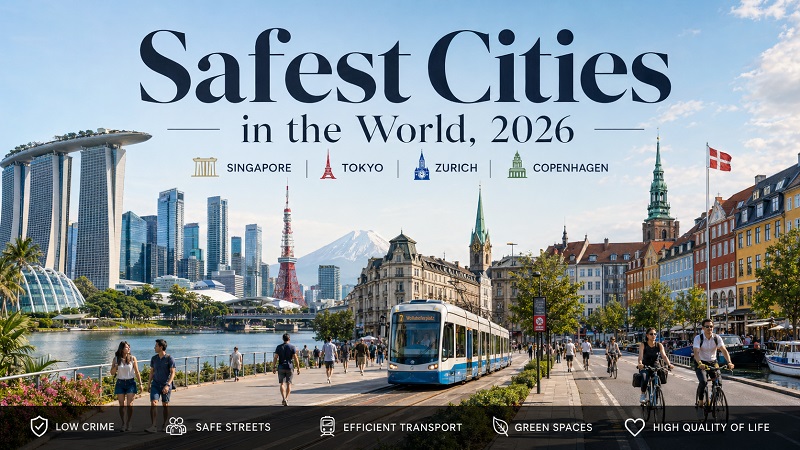
A practical comparison of high-safety cities and crime-data context
The safest cities in the world are not simply places where residents say they feel comfortable. Serious city-safety comparison has to separate lethal violence, street crime, public-order conditions, reporting culture, policing transparency and neighbourhood-level variation. This 2026 snapshot compares selected major cities with high safety-index scores, then interprets the result alongside official crime and homicide data where those sources are available rather than presenting it as a government league table or a strict official global Top 100.
Updated: April 25, 2026. Data year: 2026 safety-index snapshot with official crime and homicide sources used for methodological context. There is no single official global ranking of the world’s safest cities, and this table should be read as a selected high-safety city comparison rather than an official Top 100.
What the table ranks. The ranking is ordered by the Numbeo Safety Index, a city-level perception score where higher values indicate stronger reported feelings of safety.
Continue exploring
More StatRanker rankings on health systems, outcomes and medical capacity.
Most Expensive U.S. Counties 2026: Top 100 by Median Home Value
Open rankingLargest Cities in the World by Population: 2026 Snapshot Based on UN 2025 Estimates
Open rankingLargest U.S. Cities by Population: 2026 Snapshot Based on 2025 Census Estimates
Open rankingWhat should be checked separately. Homicide, serious violence, robbery, assault and burglary are official crime indicators, but city-level definitions and reporting systems differ by country.
How to read the result. Treat the score as a practical comparison of perceived urban safety, then verify local police data, neighbourhood conditions and recent travel or relocation guidance.
The table score comes from the 2026 city safety-index layer and is used as a practical comparison tool. Because public snapshots and current ranking views can differ, the list should not be treated as a definitive official Top 100 or as proof that one city has the lowest homicide rate or total crime rate worldwide.
What stands out among high-safety cities
The selected high-safety group is concentrated in Gulf cities, East Asian hubs, Nordic and Alpine cities, selected Central European cities and several smaller high-income urban centres. These places tend to combine low perceived street crime, visible public order, reliable infrastructure and relatively strong trust in everyday urban systems. At the same time, “safe for residents,” “safe for tourists” and “safe at night in every district” are not identical claims.
Homicide is usually the most comparable serious-crime indicator, but city-level homicide is not published consistently for every city in a global list. Theft, harassment, scams, burglary and assault are even harder to compare because police definitions and reporting behaviour differ sharply between countries. That is why this page keeps the ranking cautious and explains the limitations rather than implying a level of official precision the data do not support.
Very high perceived safety and strong public-order enforcement place Abu Dhabi among the leading cities in the 2026 city snapshot.
Perception and enforcement environment should be interpreted alongside official police and legal context.
Low perceived street-crime risk and high public-order confidence place the city among the strongest Gulf entries in the comparison.
Smaller urban scale can make direct comparison with megacities misleading.
Ajman scores highly in everyday perceived safety, particularly for personal security and public-order confidence.
City boundaries and commuting patterns should be checked before relocation decisions.
Doha combines high perceived personal safety with strong formal security systems and controlled urban public spaces.
A high city score does not remove the need to understand local law and neighbourhood context.
Sharjah’s ranking reflects a strong low-crime perception and a regional pattern of high public-order confidence.
Perceived safety is strongest when supported by transparent, recent police data.
Dubai ranks highly because residents and visitors generally report strong personal security in a heavily managed global city.
Tourist safety, resident safety and labour-market conditions are separate topics.
Taipei combines high public trust, low perceived violent risk and strong everyday urban management.
Dense cities can still have district-level differences in theft, traffic and nightlife exposure.
Muscat performs strongly on perceived safety and public-order confidence, especially compared with many larger capitals.
Lower reported crime does not always mean identical reporting behaviour across countries.
The Hague leads the European part of the ranking with a strong safety score and high institutional confidence.
Official European crime data are better documented than in many regions, but they are still not perfectly harmonised at city level.
Tampere reflects the Nordic pattern of high personal-security confidence, strong institutions and relatively low fear of violent crime.
Weather, cost of living, housing and employment still matter for real relocation choices.
Selected 100 high-safety cities in the 2026 city-safety snapshot
The table uses a compact four-column format so the comparison remains readable on desktop and mobile. The score is the 2026 city safety-index value, where higher means safer perceived conditions. The “key basis” field explains how the row should be interpreted rather than pretending that every city has identical official crime-data coverage. This is a selected 100-city comparison, not a verified official Top 100 list.
| No. | City / Country | Safety score | Key basis |
|---|---|---|---|
| 1 | Abu Dhabi, United Arab Emirates | 88.9 | Very high perceived safety; official crime context needed for hard-rate comparison. |
| 2 | Ras al-Khaimah, United Arab Emirates | 86.6 | Low perceived crime risk in a smaller Gulf urban setting. |
| 3 | Ajman, United Arab Emirates | 86.5 | High public-order confidence and low perceived street-crime exposure. |
| 4 | Doha, Qatar | 84.5 | Strong perceived personal security in a highly managed capital city. |
| 5 | Sharjah, United Arab Emirates | 84.5 | High perceived safety; best read with local police-statistics context. |
| 6 | Dubai, United Arab Emirates | 83.9 | High perceived safety in a global visitor and business hub. |
| 7 | Taipei, Taiwan | 83.5 | Strong urban order, public trust and low perceived violent-crime risk. |
| 8 | Muscat, Oman | 81.3 | High perceived personal security and low everyday fear of crime. |
| 9 | The Hague, Netherlands | 80.0 | Strong European institutional context and high perceived urban safety. |
| 10 | Tampere, Finland | 79.6 | Nordic safety profile with high trust and low perceived violent risk. |
| 11 | Eindhoven, Netherlands | 79.1 | Low perceived crime and stable urban-management environment. |
| 12 | Utrecht, Netherlands | 79.0 | High perceived safety in a dense but well-managed city. |
| 13 | Trondheim, Norway | 78.9 | Nordic trust, low perceived danger and strong civic infrastructure. |
| 14 | Munich, Germany | 78.9 | Large-city safety profile with relatively high perceived order. |
| 15 | Tartu, Estonia | 78.7 | Smaller-city scale and strong perceived personal security. |
| 16 | Zagreb, Croatia | 78.6 | High perceived safety for a national capital. |
| 17 | Hong Kong, Hong Kong (China) | 78.6 | Dense global city with high perceived personal-security score. |
| 18 | Groningen, Netherlands | 78.4 | High perceived safety in a smaller Dutch urban setting. |
| 19 | Lugano, Switzerland | 78.4 | Swiss institutional setting and low perceived street-crime exposure. |
| 20 | Tallinn, Estonia | 78.3 | Capital-city profile with strong perceived safety and public order. |
| 21 | Ljubljana, Slovenia | 78.2 | Compact capital with high perceived personal security. |
| 22 | Chiang Mai, Thailand | 77.9 | High perceived safety for residents and visitors; petty-theft risk still varies by area. |
| 23 | Yerevan, Armenia | 77.8 | High perceived personal safety in a capital-city setting. |
| 24 | Cluj-Napoca, Romania | 77.6 | Strong safety perception in a growing Central European tech city. |
| 25 | Quebec City, Canada | 77.6 | High perceived safety and smaller-city exposure compared with major metros. |
| 26 | Singapore, Singapore | 77.5 | Strong public order, low perceived violent risk and highly visible urban management. |
| 27 | Zurich, Switzerland | 76.6 | High institutional trust and low perceived street-crime risk. |
| 28 | Rijeka, Croatia | 76.5 | Compact coastal city with strong perceived everyday safety. |
| 29 | Merida, Mexico | 76.3 | Regional outlier with strong safety reputation compared with many larger Latin American cities. |
| 30 | Gent, Belgium | 76.2 | High perceived safety in a mid-sized European city. |
| 31 | Bergen, Norway | 76.2 | Nordic smaller-city profile with low perceived violent risk. |
| 32 | Reykjavik, Iceland | 76.0 | Small capital with high social trust and low perceived threat. |
| 33 | Riyadh, Saudi Arabia | 75.4 | High public-order confidence in a large capital. |
| 34 | Brno, Czech Republic | 75.4 | Central European city with strong perceived everyday safety. |
| 35 | Seoul, South Korea | 75.3 | Major Asian metropolis with strong personal-safety perception. |
| 36 | Prague, Czech Republic | 75.2 | High perceived safety; tourist zones still require petty-theft awareness. |
| 37 | Krakow, Poland | 75.2 | Strong perceived safety in a major visitor and student city. |
| 38 | Eskisehir, Turkey | 75.1 | High safety perception for a mid-sized urban centre. |
| 39 | Shenzhen, China | 75.1 | Large high-density city with strong perceived public order. |
| 40 | Jeddah, Saudi Arabia | 75.0 | High perceived security in a major coastal city. |
| 41 | Stavanger, Norway | 74.9 | Smaller Nordic city with high trust and low perceived danger. |
| 42 | Brasov, Romania | 74.9 | High perceived safety in a mid-sized city and tourist setting. |
| 43 | Tokyo, Japan | 74.9 | Megacity with strong safety perception, transit order and low violent-crime fear. |
| 44 | Beijing, China | 74.9 | Capital with high public-order perception; official comparability needs context. |
| 45 | Zaragoza, Spain | 74.8 | Strong perceived safety in a mid-sized Spanish city. |
| 46 | Wroclaw, Poland | 74.7 | High safety perception in a growing Central European city. |
| 47 | Helsinki, Finland | 74.6 | Nordic capital with strong institutional trust and personal-safety perception. |
| 48 | Tbilisi, Georgia | 74.6 | High perceived safety in a capital with strong visitor interest. |
| 49 | Timisoara, Romania | 74.6 | Strong local safety perception in a mid-sized European city. |
| 50 | Warsaw, Poland | 74.6 | Large capital with comparatively high perceived personal safety. |
| 51 | Mangalore, India | 74.4 | High perceived safety relative to many larger South Asian cities. |
| 52 | Copenhagen, Denmark | 74.3 | Nordic capital with strong broader urban-safety reputation. |
| 53 | Amsterdam, Netherlands | 74.3 | High safety score; visitor districts may have different theft and nuisance exposure. |
| 54 | Oakville, Canada | 74.1 | Suburban-scale city with high perceived safety. |
| 55 | Tel Aviv-Yafo, Israel | 74.1 | High urban safety perception; geopolitical risk is separate from street-crime scoring. |
| 56 | Bern, Switzerland | 74.1 | Swiss capital with high trust and low perceived crime risk. |
| 57 | Rotterdam, Netherlands | 74.0 | Large port city with a high current safety score. |
| 58 | Tashkent, Uzbekistan | 73.8 | Capital with strong perceived public-order conditions. |
| 59 | Shanghai, China | 73.5 | Megacity with high perceived order and low personal-crime fear. |
| 60 | Graz, Austria | 72.8 | High perceived safety in a mid-sized Austrian city. |
| 61 | Trieste, Italy | 72.4 | Strong perceived safety compared with many larger Italian cities. |
| 62 | Poznan, Poland | 72.3 | Stable Central European city-safety perception. |
| 63 | Nizhny Novgorod, Russia | 72.2 | High perceived safety; official comparability should be treated cautiously. |
| 64 | Luxembourg, Luxembourg | 72.1 | Small high-income capital with strong perceived safety. |
| 65 | Lausanne, Switzerland | 71.9 | Swiss city with high perceived order and low street-crime fear. |
| 66 | Canberra, Australia | 71.8 | Capital with comparatively strong safety perception. |
| 67 | Vienna, Austria | 71.6 | Large capital with strong urban systems and high perceived safety. |
| 68 | Bucharest, Romania | 71.5 | Capital-city score supported by improving perceived safety. |
| 69 | Davao, Philippines | 71.4 | High perceived safety relative to many large regional cities. |
| 70 | Guangzhou, China | 71.4 | Large-city safety perception with strong public-order context. |
| 71 | Madrid, Spain | 71.3 | Major capital with comparatively high perceived personal safety. |
| 72 | Bursa, Turkey | 71.3 | Large city with solid safety perception. |
| 73 | Kuwait City, Kuwait | 71.2 | Capital with high perceived public-order conditions. |
| 74 | Burlington, Canada | 71.1 | Smaller Canadian city with high perceived safety. |
| 75 | Penang, Malaysia | 70.8 | Tourism and resident-safety perception remain comparatively strong. |
| 76 | Antalya, Turkey | 70.7 | Visitor-heavy city with solid perceived safety; tourist-zone risk differs by area. |
| 77 | Geneva, Switzerland | 70.6 | International city with strong institutional and personal-safety profile. |
| 78 | Dresden, Germany | 70.2 | Mid-sized German city with solid perceived order. |
| 79 | Stuttgart, Germany | 70.0 | Large-city profile with relatively strong perceived safety. |
| 80 | Nuremberg, Germany | 70.0 | German urban setting with stable safety perception. |
| 81 | Split, Croatia | 69.9 | Coastal visitor city with solid personal-safety perception. |
| 82 | Baku, Azerbaijan | 69.9 | Capital with high perceived public order. |
| 83 | Vilnius, Lithuania | 69.9 | Baltic capital with strong perceived safety. |
| 84 | Vadodara, India | 69.6 | High perceived safety compared with many larger South Asian metros. |
| 85 | Edinburgh, United Kingdom | 69.6 | Capital and tourism hub with comparatively strong perceived safety. |
| 86 | Bratislava, Slovakia | 69.5 | Compact capital with solid perceived personal security. |
| 87 | San Sebastian, Spain | 69.5 | Visitor-friendly city with high perceived safety. |
| 88 | Galway, Ireland | 69.1 | Smaller-city profile with solid perceived personal safety. |
| 89 | Malaga, Spain | 69.0 | Tourism hub with good safety perception; visitor-zone theft risk still varies. |
| 90 | Ottawa, Canada | 69.0 | National capital with solid perceived safety and institutional context. |
| 91 | Gdansk, Poland | 68.7 | Major Polish city with solid perceived urban safety. |
| 92 | Basel, Switzerland | 68.6 | Swiss urban profile with comparatively low perceived crime risk. |
| 93 | Islamabad, Pakistan | 68.6 | Capital with higher perceived safety than many larger national metros. |
| 94 | Ahmedabad, India | 68.5 | Large South Asian city with solid perceived safety score. |
| 95 | Nicosia, Cyprus | 68.0 | Capital with moderate-to-high perceived personal security. |
| 96 | Lund, Sweden | 67.9 | University city with generally strong perceived safety. |
| 97 | Freiburg im Breisgau, Germany | 67.7 | Mid-sized German city with solid urban-safety perception. |
| 98 | Lisbon, Portugal | 67.4 | Capital and tourist hub with solid perceived safety; petty theft differs by district. |
| 99 | Dusseldorf, Germany | 67.3 | Large German city with moderate-to-high perceived safety. |
| 100 | Montreal, Canada | 67.2 | Large Canadian city with solid safety perception, though district-level risk varies. |
Source: Numbeo Safety Index by City 2026, interpreted as perception-based city-safety data. Official homicide and police statistics are used for methodology and validation context where available. The score is not an official crime rate, and the table is a selected high-safety city comparison rather than a verified official Top 100. Updated: April 25, 2026.
Chart: Selected high-safety cities by safety score
The chart mirrors the same score used in the table and provides a quick visual comparison of selected high-safety cities.
Methodology
“Safest city” is a broad label, so the ranking is intentionally cautious. A city can score well because residents report low fear of crime, but official crime rates, police definitions and actual victimisation may tell a more complicated story. Homicide per 100,000 residents is usually the hardest and most internationally comparable safety indicator because murder is less dependent on victim reporting than theft, harassment or fraud. However, reliable homicide rates are often published at national, regional or police-district level rather than in a consistent global city table.
The visible score in this article is the 2026 city safety-index value, used as a comparable global perception layer. Official indicators such as homicide, serious violence, robbery, assault, police-recorded trends and reporting transparency are used to interpret the comparison, not to recalculate the table score. Where official city data are not directly comparable, the page avoids overstating what the data can prove and treats the result as an analytical snapshot, not an official statistical league table.
The main limitations are definitional and geographic. One country may classify robbery, assault or harassment differently from another; residents may be more or less likely to report offences to police; and “city” may mean city proper, municipality, metropolitan area or police jurisdiction. A low recorded-crime number can reflect low actual crime, but it can also reflect under-reporting or weak trust in institutions. For practical use, this ranking should be paired with neighbourhood-level checks, local police dashboards and current travel or relocation guidance.
Key insights from the comparison
- Gulf cities dominate the very top. Abu Dhabi, Ras al-Khaimah, Ajman, Doha, Sharjah and Dubai all appear in the upper tier, reflecting very high perceived public-order confidence.
- East Asian cities remain strong. Taipei, Hong Kong, Singapore, Seoul, Tokyo and several large Chinese cities score well on perceived day-to-day personal safety.
- Europe is broad rather than top-heavy. Dutch, Nordic, Swiss, Central European and Baltic cities appear throughout the Top 100, often because of trust, infrastructure and relatively low fear of violent crime.
- Tourist hubs need a separate reading. Cities such as Dubai, Prague, Amsterdam, Lisbon, Malaga and Penang may feel safe overall while still having district-level exposure to pickpocketing, scams or nightlife incidents.
- Large cities can still rank well. Tokyo, Seoul, Shanghai, Madrid, Vienna and Singapore show that urban scale does not automatically mean high personal-safety risk.
- Official comparability remains the weak point. Homicide is more comparable than most crime categories, but city-level definitions and boundaries still vary enough to make a single official worldwide ranking impossible.
What this means for readers
A high safety score is useful for first-stage comparison, especially for families, students, remote workers, international employees, retirees and frequent travellers. It can help identify cities where everyday personal-security concerns are comparatively low, public spaces feel manageable and residents report confidence in local order.
The ranking should not be used as a relocation decision by itself. Real safety depends on the neighbourhood, housing location, transport routes, nightlife exposure, gender-specific experience, local law, healthcare access and the difference between resident and tourist risk. Before moving or investing, readers should check local police reports, neighbourhood crime maps, current travel advisories and recent resident feedback.
FAQ
Is there an official global ranking of the safest cities?
No. There is no single official global city-safety ranking that covers all major cities using one standard method. This page is an analytical comparison using a safety-index score and official crime-data principles for interpretation; it is not an official global Top 100.
Why is homicide rate so important?
Homicide is one of the most consistently recorded serious crimes. It is less affected by victim willingness to report than theft, scams or harassment, so it is usually the strongest hard-safety anchor for cross-country comparison.
Why not use Numbeo alone?
Numbeo is useful for perception and lived-experience comparison, but it is survey-based and should not be treated as official police or statistical data. A responsible ranking explains that difference clearly.
Can a city feel safe but still have hidden risks?
Yes. Perception varies by neighbourhood, time of day, transport mode, gender, language ability and whether a person is a resident or visitor. Some risks, such as scams or domestic violence, may not be visible in street-safety perception.
Are capital cities always safer?
No. Some capitals are highly secure and well-policed, while others have higher crime exposure because they concentrate inequality, nightlife, tourism, protest activity or informal economies.
Why do famous global cities sometimes rank lower?
Large global cities often have more reported theft, transit incidents, nightlife exposure and district-level inequality. That does not always mean severe violence is high, but it can reduce perceived safety.
Does low recorded crime always mean low actual crime?
Not always. Low recorded crime can reflect real safety, but it can also reflect under-reporting, narrow legal definitions or low trust in police. This is why data transparency matters.
Is this ranking more useful for tourists or residents?
It is useful as a broad comparison for both, but tourists should focus on central districts, transport, scams and nightlife. Residents should also check schools, housing areas, commute safety and local police data.
Sources and data notes
Updated: April 25, 2026.
The comparison uses a city safety-index score to compare selected cities internationally, while official sources provide methodological grounding. Official sources are prioritised for interpreting violent crime and homicide, while survey-based sources are treated as perception data.
Related rankings
More StatRanker rankings on health systems, outcomes and medical capacity.