TOP 10 Most Urbanized Countries (2025)
Top 10 Most Urbanized Countries (2025): urban share, mega-cities and metropolitan systems
More than half of the world’s population already lives in urban areas, and by 2050 that share is projected to reach roughly 70%, according to the United Nations’ World Urbanization Prospects and related UN-Habitat reports. Yet some countries have reached that future early: their populations are almost entirely urban, with measured urban shares of 100% or very close to it.
This article looks at the Top 10 most urbanized countries and territories around 2025, focusing on:
- Urban share – the percentage of the population living in urban areas.
- Urbanization 2025 dynamics – how quickly the urban share is still changing.
- Metropolitan areas and mega-cities – the structure of large urban regions in each case.
How “most urbanized” is defined
International comparisons of urbanization rely primarily on the indicator “urban population (% of total population)”, published by the World Bank and based on the United Nations Population Division. Urban population is defined as people living in areas that national statistical offices classify as urban. That means:
- Definitions of “urban” vary across countries (density thresholds, administrative status, infrastructure criteria).
- Micro-states and city-states can reach a measured value of 100% urban population because effectively all residents live in a single city or built-up area.
- It is possible for a country with 100% urban population to still have a positive or negative rate of urbanization if the total population changes over time.
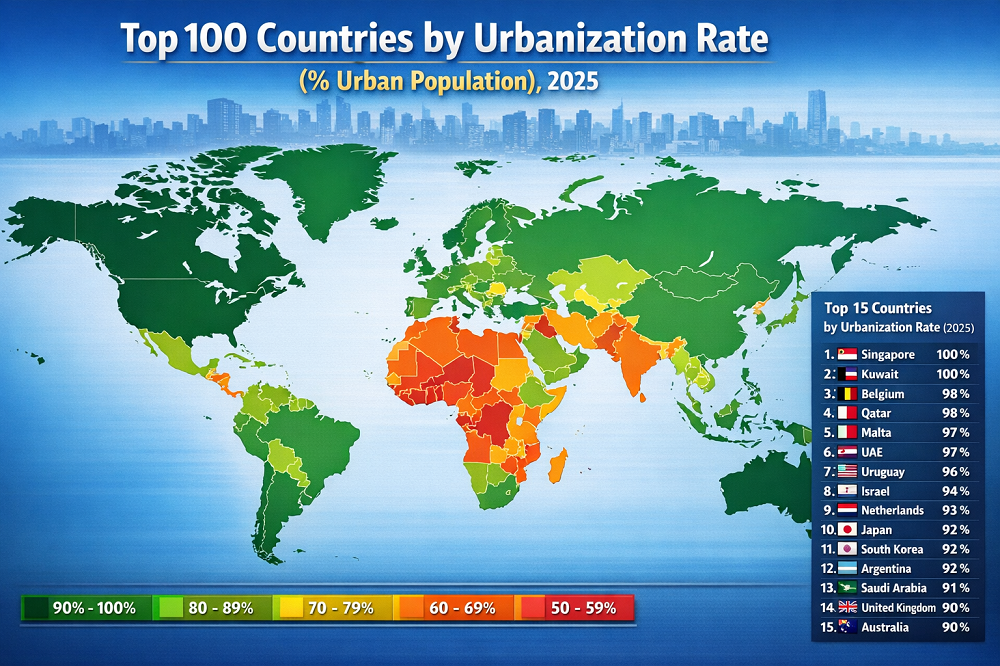
Recent rankings compiled from World Population Review and World Bank / UN data show that in 2025 the top of the table is dominated by small, highly urbanized territories such as Hong Kong, Singapore and Monaco, all with urban shares at or very close to 100%.
Important nuance: the “most urbanized” countries by share of urban population are not necessarily those with the largest cities. Giant metropolitan areas like Tokyo, Delhi or Lagos are located in countries whose overall urban shares are high, but not 100%. The Top 10 list here is about proportion, not absolute size.
The Top 10 most urbanized countries and territories in 2025
Based on the latest 2023–2024 data used in World Population Review’s 2025 rankings and underlying UN/World Bank series, the Top 10 most urbanized countries and territories are:
- Hong Kong (China)
- Singapore
- Kuwait
- Macau (China)
- Cayman Islands
- Bermuda
- Sint Maarten
- Gibraltar
- Monaco
- Anguilla
All of them are reported as having 100% of their population in urban areas. In practice, most are city-states, micro-states or small island territories whose entire territory is built up or functionally integrated into a single metropolitan area.
Urbanization 2025: different paths to a fully urban population
Even within this small group, the underlying urbanization stories are different. Three broad patterns emerge:
1. Dense Asian city-states and special administrative regions
Hong Kong, Singapore and Macau are archetypal highly urbanized economies:
- They combine extreme population density with world-class infrastructure, ports and airports.
- Their economies are dominated by services (finance, logistics, tourism, advanced business services) and high-end manufacturing in regional value chains.
- They anchor much larger cross-border metropolitan systems. Hong Kong and Macau sit inside China’s Greater Bay Area, while Singapore is the core of a broader metropolitan zone that includes parts of Malaysia and Indonesia.
In terms of demographics, natural population growth in these economies is low or negative — fertility is well below replacement — so population change is heavily influenced by migration (temporary workers, expatriates, cross-border commuters). Urbanization 2025 here is less about expanding the urban share and more about intensifying and restructuring existing urban space through redevelopment, vertical density and transport upgrades.
2. Oil-rich Gulf city-states
Kuwait is a classic case of a Gulf city-state with a very high urban share. While the World Bank’s urbanization data show that much of the Gulf is highly urban, Kuwait stands out as essentially fully urban by the standard metric. Its capital and surrounding metropolitan area account for nearly all of the resident population, including a large share of foreign workers in construction, services and hydrocarbons.
Urbanization 2025 in Kuwait and other Gulf cities is driven by:
- Continued in-migration of foreign labour, though policies on nationalization and quotas can alter trends rapidly.
- Investment in large-scale infrastructure, including new towns, metros, highways and coastal developments.
- Climate adaptation challenges, especially related to heat, water and energy, given that these highly urbanized populations live in arid environments.
3. Small islands, overseas territories and micro-states
The remaining group — Cayman Islands, Bermuda, Sint Maarten, Gibraltar, Monaco and Anguilla — includes British Overseas Territories, a European micro-state and Caribbean islands. Several traits are common:
- The total population is small, often below 100,000.
- Most residents live in one or two built-up areas that extend across much of the territory.
- Urban–rural distinctions are thin: even where there are low-density or green areas, they are typically part of a single functional urban region.
- Economic models rely heavily on tourism, offshore finance, specialised logistics or niche services.
In these settings, “urban share” is less about skyscrapers and more about functional dependence on urban services. Housing, jobs and infrastructure are tightly packed, and “metropolitan” often means a compact, coastal strip rather than a multi-million mega-region.
Urban share and mega-cities: why size still matters
Looking only at the Top 10 most urbanized countries can be misleading if we want to understand global metropolitan dynamics and mega-cities. Many of the world’s largest metro areas — such as Tokyo, Delhi, Shanghai, Lagos or São Paulo — are located in countries where the urban share is very high but not 100%.
UN urbanization data show that by 2020:
- Northern America and Latin America & the Caribbean had urban shares above 80%.
- Europe was around the mid-70% mark.
- Asia and Africa were still below 55%, but with enormous absolute numbers of new urban residents each year.
That means the fastest-growing metropolitan areas are often not in the fully urbanized micro-states, but in large emerging economies where the urban share is still increasing. Nevertheless, the Top 10 list is useful because it shows what a fully urban society looks like and how governance, housing and infrastructure challenges change when there is essentially no rural population left.
Urbanization 2025: common challenges among the most urbanized
Despite very different geographies and sizes, the most urbanized economies around 2025 face a surprisingly similar set of issues:
- Housing affordability and space constraints – high land values and limited territory push prices up, leading to intense debates about public housing, height limits and land reclamation.
- Transport and congestion – dense cores require heavy investment in metros, light rail and walkable urban design to avoid gridlock.
- Exposure to climate and environmental risk – many are coastal and low-lying, vulnerable to sea-level rise and storms; others face extreme heat.
- Diversification and resilience – tourism- or finance-dependent economies must manage volatility, as the COVID-19 shock made clear.
- Socio-spatial inequality – even in small territories, sharp divides can emerge between high-end districts and more precarious neighbourhoods.
The sections below summarise basic indicators for each of the Top 10 and then visualise their urban shares compared with the global context of urbanization 2025.
Top 10 most urbanized countries and territories (circa 2025)
This stylised table draws on 2023–2024 urban-population data summarised by World Population Review, which in turn compiles figures from United Nations and World Bank sources. All ten entries report urban population shares at or very close to 100%; the third column summarises the structure of their metropolitan areas and key urbanization 2025 themes.
| Economy / territory | Urban population share (approx. 2024–2025) | Metropolitan and urbanization profile |
|---|---|---|
|
Hong Kong (China) Fully urban, mega-region core |
Reported as 100% urban. Urbanization rate still positive but low because virtually all residents already live in urban areas. | Hyper-dense high-rise city of over 7 million people, integrated into the Greater Bay Area mega-region with Shenzhen, Guangzhou and Macau. Urbanization 2025 is about redevelopment, transit-oriented growth and cross-border integration rather than expanding the urban share. |
|
Singapore City-state & global hub |
Also listed at 100% urban. Entire resident population is functionally urban. | Compact island city-state with a metropolitan population around 6 million. The core of a transnational metro system linking Johor in Malaysia and Batam/Bintan in Indonesia through commuting, logistics and investment flows. |
|
Kuwait Gulf oil city-state |
Reported as 100% urban, reflecting the dominance of Kuwait City and its suburbs. | A largely continuous metropolitan strip along the Gulf coast. Urbanization 2025 is shaped by migration of foreign workers, large infrastructure projects and climate-stress adaptation, rather than rural–urban migration. |
|
Macau (China) Tourism mega-cluster |
Listed with an urban share at or near 100%. | Dense casino and tourism hub connected by bridges and causeways to the Pearl River Delta. Functionally part of the Greater Bay Area, with heavy cross-border flows of visitors and workers. |
|
Cayman Islands Offshore finance & tourism |
Reported as 100% urban, though density varies within the islands. | Main activity clusters around George Town and Seven Mile Beach, forming a coastal metropolitan strip. Urbanization issues centre on coastal vulnerability, housing, and infrastructure for tourism. |
|
Bermuda Atlantic micro-metropolis |
Also listed at 100% urban. | Urban functions organised around Hamilton and surrounding parishes, with most residents living in built-up coastal areas. Urbanization 2025 focuses on storm resilience, heritage conservation and managing tourism/finance-driven development. |
|
Sint Maarten Split island, single urban system |
Listed among the territories with 100% urban population. | Dutch part of a bi-national island shared with Saint-Martin (France). Airport-centred coastal urban strip integrating tourism, logistics and services into a single metropolitan area despite divided sovereignty. |
|
Gibraltar Strategic rock city |
Effectively 100% urban, as almost all land is built up. | High-density town at the mouth of the Mediterranean. Functions as part of a wider cross-border urban area with La Línea and the Campo de Gibraltar in Spain, illustrating how metropolitan areas often cross national borders. |
|
Monaco European micro-state |
Recorded as 100% urban. | A vertical city built into a steep Mediterranean coastline, fully embedded in the French–Italian Riviera metropolitan corridor. Urbanization issues include extreme land scarcity and the use of land reclamation to expand the urban footprint. |
|
Anguilla Caribbean micro-urban territory |
Listed at 100% urban in recent rankings. | Small island whose settlements and tourism infrastructure effectively cover most of the territory. Urban and rural land uses blur into each other; policy debates are about carrying capacity, coastal erosion and sustainable tourism rather than urban expansion. |
For comparison, large economies often discussed in debates on mega-cities, such as Japan, Brazil or China, have urban shares in the range of roughly 60–95%, depending on the country and year. They are highly urban, but not fully urbanized in the strict statistical sense used by the UN and World Bank.
Visualising the “100% urban” club in 2025
The bar chart below shows the reported urban population share for the Top 10 most urbanized countries and territories around 2025. All are effectively at 100% urbanization; the chart also includes a stylised bar for the world average to highlight the gap between these micro-urban economies and the global picture.
What the “100% club” tells us about metropolitan futures
The fact that a growing number of territories report effectively no rural population hints at what many larger countries may experience over the coming decades. Once a country becomes overwhelmingly urban, policy questions shift from managing rural–urban migration to issues such as:
- Metropolitan governance — coordinating housing, transport, climate adaptation and economic development across multiple municipalities within a single functional urban area.
- Infill and vertical growth — redeveloping existing neighbourhoods, increasing density in transit corridors and re-using formerly industrial land.
- Resilience to shocks — designing compact, walkable cities that can withstand pandemics, energy shocks and extreme weather events.
For researchers and analysts, the Top 10 most urbanized countries in 2025 are therefore useful laboratories of full urbanization. They show how societies function when the rural share is effectively zero and how metropolitan areas can extend across national borders, creating cross-jurisdictional regions that challenge traditional notions of the “city”.