
TOP 10 Fastest-Growing Populations (2025)
Population · Demography · Annual growth
Where the fastest demographic expansion is still concentrated in 2025
Global population growth is still slowing overall, but the slowdown is not happening at the same speed everywhere. The countries at the top of this ranking continue to post annual growth rates close to 3% or above, and in one case well above 4%. At those levels, population size can double within roughly 15 to 25 years, which is fast enough to reshape labour markets, school systems, housing demand, food security, and public finance within a single generation.
For ranking purposes, this article keeps the familiar late-2025 comparison logic: the last globally comparable CIA-style 2024 annual population growth estimates are used as the proxy for a 2025 snapshot, while the broader demographic context is refreshed with the latest UN and World Bank material. That matters because one-year calendar changes for 2025 can be distorted by war, displacement, and return migration, whereas this ranking is meant to capture the structural leaders in sustained population growth.
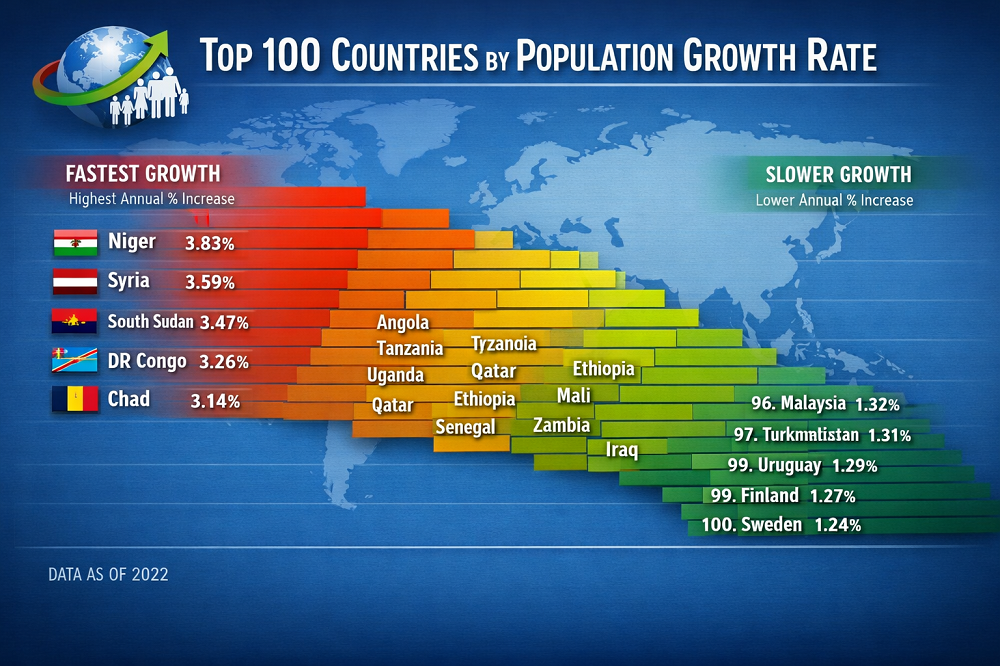
Top 10 fastest-growing populations around 2025
The Top 10 remains overwhelmingly African and overwhelmingly driven by natural increase rather than immigration. In most of these countries, fertility is still high, the median age is extremely low, and a very large cohort of children is already moving toward reproductive age. That combination creates demographic momentum even before any new migration shock is added.
Growth proxy: about 4.6–4.7% a year
South Sudan remains the outlier at the top. Its headline growth rate is exceptionally high, but it is also the most uncertain case in the ranking because conflict, displacement, and migration swings complicate the demographic base. Even so, the country still combines a very young age structure with high fertility and rapid natural increase.
Growth proxy: about 3.6–3.7%
Niger remains the clearest example of fertility-led population growth. Even after gradual decline, fertility remains among the highest in the world, and net migration is too small to change the story. The central issue is the sheer scale of births relative to deaths.
Growth proxy: about 3.3%
Angola combines rapid urbanisation with still-high fertility. Its growth is less about migration and more about strong natural increase feeding the expansion of Luanda and other urban centres.
Growth proxy: about 3.3%
Benin stays near the top because fertility remains high and the population is exceptionally young. The age structure ensures that even a gradual fertility decline still leaves fast headline growth in place.
Growth proxy: about 3.2%
Equatorial Guinea is smaller than the other countries in this group, but it still posts very rapid growth. Natural increase remains important, while migration linked to the resource economy can reinforce the pace in some years.
Growth proxy: about 3.1–3.2%
Uganda is part-way through the demographic transition, yet the transition is not far enough advanced to bring growth down quickly. Fertility has declined from earlier extremes, but the age pyramid remains very broad at the base.
Growth proxy: about 3.1%
The DRC is one of the most important countries in the whole global population story because its growth is happening from a very large base. That means even “just” 3.1% translates into a huge annual increase in the absolute number of people.
Growth proxy: about 3.0%
Chad remains a classic Sahel case: high fertility, a young population, and strong natural increase meeting climate stress, lower state capacity, and infrastructure gaps.
Growth proxy: about 2.9%
Mali’s population still grows rapidly despite insecurity and outward pressure. That is the clearest reminder that emigration or instability does not necessarily offset very high fertility.
Growth proxy: about 2.8–2.9%
Zambia closes the Top 10 in this proxy ranking. Fertility is lower than in Niger or Chad, but it is still high enough to support strong natural increase, especially in a rapidly urbanising economy.
Table 1. Top 10 fastest-growing populations, 2025 snapshot
Growth rate uses the familiar 2024 proxy series for a stable 2025-style ranking. The final column shows approximate doubling time, calculated with the rule of 70.
| Rank | Country | Annual growth rate | Doubling time |
|---|---|---|---|
| 1 | South Sudan | 4.65% | ≈ 15 years |
| 2 | Niger | 3.66% | ≈ 19 years |
| 3 | Angola | 3.33% | ≈ 21 years |
| 4 | Benin | 3.29% | ≈ 21 years |
| 5 | Equatorial Guinea | 3.23% | ≈ 22 years |
| 6 | Uganda | 3.18% | ≈ 22 years |
| 7 | DR Congo | 3.11% | ≈ 23 years |
| 8 | Chad | 3.01% | ≈ 23 years |
| 9 | Mali | 2.90% | ≈ 24 years |
| 10 | Zambia | 2.83% | ≈ 25 years |
Chart 1. Annual population growth rate for the Top 10
A useful rule of thumb is that once annual growth moves beyond 3%, policymakers are dealing not with slow demographic drift but with a structural expansion of school-age and working-age cohorts.
Methodology
This article uses the last broadly comparable CIA-style country comparison for annual population growth, centred on 2024 estimates, as a proxy for the 2025 ranking. That choice is deliberate. For this topic, the search intent is not “which country had a one-year rebound because refugees returned?” but “which countries are structurally growing the fastest?” One-year UN calendar changes can temporarily elevate countries affected by conflict, return migration, or sudden revisions to the demographic base.
To keep the ranking stable and interpretable, the growth leaderboard is anchored to the late-2025 comparison logic already familiar to readers. The surrounding analysis is refreshed with the latest UN and World Bank context on global slowdown, fertility decline, age structure, and demographic transition. Country-level fertility references in the next block are rounded and harmonised to match the latest 2025-style context.
There are limits. Population growth rates are estimates, not direct headcounts. Countries with weak civil registration, conflict, large refugee flows, or irregular census intervals can be revised materially later. South Sudan is the clearest example. Rapid population growth also does not say anything by itself about living standards, income growth, or state capacity. It is a demographic pace indicator, not a welfare score.
Insights and takeaways
Three patterns dominate this ranking. First, the concentration is geographic: the fastest-growing populations are overwhelmingly in Sub-Saharan Africa. Second, the driver is usually internal rather than external: natural increase, not immigration, does most of the work. Third, age structure matters as much as fertility. When a country already has a very large child population, growth can remain rapid even after fertility starts to drift lower.
The gap between countries in this table and ageing economies elsewhere is not just statistical. It implies very different policy calendars. Countries in the Top 10 have to build ahead of demand: classrooms before the cohort arrives, jobs before the labour force expands, and transport, water, and housing before urban congestion locks in. By contrast, slower-growing or shrinking countries are more focused on labour scarcity, pension pressure, and ageing.
The other important insight is that fast growth is not automatically a demographic dividend. It becomes a dividend only if countries convert a youth-heavy age structure into productive employment, better female education, stronger child survival, and declining dependency ratios over time. Without that transition, rapid growth can intensify pressure on land, food systems, and fragile public services.
What this means for readers
For business readers, these countries matter because fast population growth usually means rising long-run demand for housing, low-cost consumer goods, education, mobile connectivity, health services, and urban transport. For labour-market readers, the signal is different: the fastest-growing societies are likely to account for a larger share of future labour-force expansion, but only part of that increase will become a dividend without stronger job creation.
For readers thinking about migration, climate, or food security, the ranking is a reminder that demographic pressure will remain highest where infrastructure and state capacity are often weakest. Rapid growth does not create crisis by definition, but it raises the cost of delay. Every year of underinvestment is multiplied by the speed at which the population base expands.
FAQ
What does “population growth rate” actually measure?
It measures how fast the total population changes over a year after combining births, deaths, immigration, and emigration. In most of the countries in this ranking, births minus deaths are the dominant force.
Why use 2024 as a proxy for a 2025 ranking?
Because the best internationally comparable country-comparison series for this indicator is not updated in the same clean way every calendar year. Using the last stable global comparison avoids mixing structural leaders with temporary rebound cases driven by migration or conflict.
Does fast population growth always mean high fertility?
Usually, but not always. High fertility and a very young age structure explain most cases here. Still, migration and data revisions can amplify or dampen the headline rate in any single year.
How fast is 3% growth in practical terms?
Very fast. Using the rule of 70, a 3% annual growth rate implies population doubling in about 23 years. At 4.65%, the doubling time falls to roughly 15 years.
Why are almost all of the fastest-growing populations in Africa?
Because Sub-Saharan Africa still has the world’s highest fertility rates on average, the youngest age structures, and a later demographic transition than Europe, East Asia, or the Americas.
Is rapid population growth good or bad for the economy?
It is neither automatically good nor automatically bad. It can support a future demographic dividend, but only if health, education, urban planning, and job creation keep pace with the population.