
TOP 10 Countries with Oldest Median Age (2025)
TOP 10 Countries with the Oldest Median Age in the World (2025)
Median age is one of the clearest single-number summaries of a population's age structure. In 2025, a small cluster of states and territories has crossed into a zone of extreme demographic maturity: half their residents are already older than 45–57 years. This reshapes core parts of the economy — from pension systems and labor markets to healthcare spending, political priorities, and long-run growth.
The global median age in 2025 stands at roughly 31 years. The countries in this top 10 exceed that benchmark by a factor of 1.5 to nearly 2, placing them among the most demographically aged populations in the world.
📐 Methodology
- Indicator: Median age of the population — the age that splits the entire population exactly in half (50% younger, 50% older).
- Reference year: 2025. Where precise 2025 estimates are not yet published, 2024 figures are used as a proxy and flagged accordingly.
- Primary sources: UN World Population Prospects 2024, CIA World Factbook 2025, World Bank WDI. Data are harmonized and rounded to one decimal place.
- Processing: UN data take precedence; for small territories and special administrative regions, cross-source verification is applied. All values are analytical estimates, not official national statistics.
- Limitations: For microstates and small territories, median age can be more volatile due to selective migration patterns. Rankings should be interpreted as approximate, not as a formal statistical release.
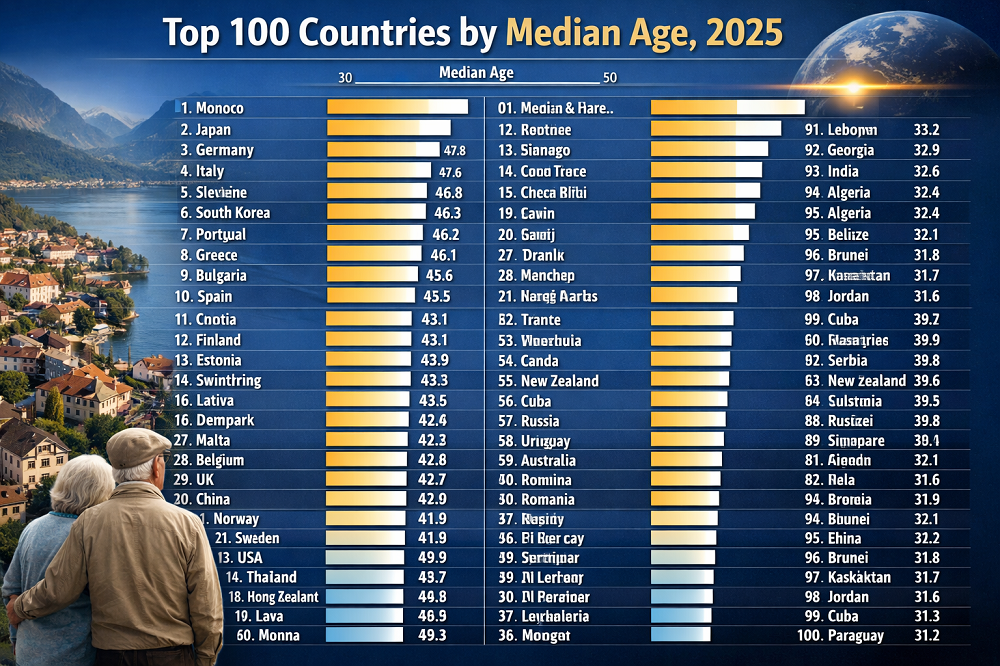
Top 10 countries and territories by median age — 2025 snapshot
The top 10 is dominated by European states with decades of below-replacement fertility, along with several microstates or special territories where migration patterns further skew the age structure upward. Japan stands out as the only large diversified economy in the group.
Monaco's exceptional median age reflects its unique resident structure rather than unusually low fertility alone. Affluent, typically older residents are attracted by the tax environment and lifestyle, while high property prices effectively price out younger cohorts. As a result, measured median age far exceeds that of any sovereign state and is best treated as a structural outlier in comparative analysis.
This small French archipelago off the coast of Canada has no universities and limited local employment, driving persistent youth emigration. The remaining population ages steadily, and births are very few. With a total population of around 6,000, even small demographic shifts produce large movements in median age.
Japan is the largest economy in the top 10 and the most studied case of advanced demographic ageing. A total fertility rate hovering around 1.2 for several decades, combined with one of the world's highest life expectancies, has produced a population where nearly one in three residents is aged 65 or older. Japan is often treated as a leading case study in aging policy: robotics, longer working lives, immigration reform, and natalist incentives are all part of the policy debate.
The small Pyrenean state specialises in tourism and tax-advantaged retail. Like Monaco, it attracts wealthier mature residents, which skews its age structure toward older cohorts. Fertility is low and emigration of young workers to neighbouring Spain and France is common.
Italy is experiencing one of Europe's most acute demographic crises. Fertility has remained below 1.3 for roughly three decades, significant youth emigration to other EU countries has accelerated the process, and longevity is among the highest in the world. The result is mounting pressure on the pension system, a shrinking labour force and declining domestic demand in many regions.
An elite Caribbean island with extremely high real-estate prices and a resident base tilted toward affluent adults. Young workers emigrate for opportunities elsewhere, while mature, well-off residents stay or relocate here — a structural analogue of Monaco, but in the tropics.
Hong Kong records one of the world's lowest total fertility rates (around 0.7–0.8), combined with a life expectancy exceeding 85 years. The extreme cost of living defers or eliminates family formation, while the population ages at an accelerating rate. Projections suggest the trend will intensify significantly through the 2030s.
Spain underwent one of the fastest demographic transitions in the world during the 1990s, with fertility collapsing from around 2.8 to 1.2 within a single generation. This is now manifesting in a steadily rising median age and growing fiscal pressure on the public pension system. Regional disparities within Spain are significant: some inland regions already face severe depopulation.
Germany enters the top 10 despite substantial immigration inflows that partially offset natural ageing. Without net migration, median age would be measurably higher. The ageing of the large post-war baby boom cohort is now the defining fiscal challenge: Germany is reforming its pension system, expanding labour force participation among older workers, and liberalising skilled immigration to address growing labour shortages.
The sovereign debt crisis of the 2010s triggered large-scale emigration among younger Greeks, sharply accelerating demographic aging. Combined with chronically low fertility, the effects will be felt for decades. Economic recovery has partially slowed the outflow, but the demographic legacy of the crisis — a depleted young-adult cohort — cannot be reversed quickly.
* Values are rounded to one decimal place and should be interpreted as analytical estimates. They may differ slightly from official statistics of individual countries.
Table 1. Top 10 countries by median age, 2025 snapshot
| Rank | Country / Territory | Type | Median age, 2025 (years) | YoY change |
|---|---|---|---|---|
| 1 | Monaco | Microstate | 56.9 | +0.3 |
| 2 | Saint Pierre and Miquelon | Territory | 51.2 | +0.4 |
| 3 | Japan | Sovereign state | 49.9 | +0.3 |
| 4 | Andorra | Microstate | 48.8 | +0.3 |
| 5 | Italy | Sovereign state | 48.4 | +0.3 |
| 6 | Saint-Barthélemy | Territory | 47.4 | +0.2 |
| 7 | Hong Kong SAR | SAR | 47.2 | +0.4 |
| 8 | Spain | Sovereign state | 46.8 | +0.3 |
| 9 | Germany | Sovereign state | 46.8 | +0.2 |
| 10 | Greece | Sovereign state | 46.5 | +0.3 |
| Sources: UN WPP 2024, CIA World Factbook 2025. Values are rounded. Data are analytical estimates, not an official statistical release. | ||||
Chart 1. Median age in the top 10 countries, 2025
The global median age of approximately 31 years is shown as a reference baseline (dashed line). Bars shaded red indicate economies that have crossed the 50-year threshold. Data are analytical estimates based on UN and CIA World Factbook sources.
Extended ranking: Top 25 countries by median age, 2025
Beyond the top 10, the picture becomes more diverse. Southern and Eastern European economies — Portugal, Bulgaria, Slovenia, and Croatia — cluster in the 43–46 range, joined by South Korea, which is aging faster than any other large economy. Nordic countries (Finland, Denmark, Sweden) also appear, though their historically moderate fertility and higher immigration have kept median ages somewhat lower than the Mediterranean peers.
Table 2. Top 25 countries by median age, 2025
Median age in years (2025 estimates). YoY = year-on-year change in years. Sources: UN WPP 2024, CIA World Factbook 2025. Values are analytical estimates, rounded to 1 decimal place.
| Rank | Country / Territory | Type | Region | Median age (years) ↕ | YoY change ↕ |
|---|---|---|---|---|---|
| 1 | Monaco | Microstate | Europe | 56.9 | +0.3 |
| 2 | Saint Pierre and Miquelon | Territory | Americas | 51.2 | +0.4 |
| 3 | Japan | Sovereign state | Asia | 49.9 | +0.3 |
| 4 | Andorra | Microstate | Europe | 48.8 | +0.3 |
| 5 | Italy | Sovereign state | Europe | 48.4 | +0.3 |
| 6 | Saint-Barthélemy | Territory | Americas | 47.4 | +0.2 |
| 7 | Hong Kong SAR | SAR | Asia | 47.2 | +0.4 |
| 8 | Spain | Sovereign state | Europe | 46.8 | +0.3 |
| 9 | Germany | Sovereign state | Europe | 46.8 | +0.2 |
| 10 | Greece | Sovereign state | Europe | 46.5 | +0.3 |
| 11 | Portugal | Sovereign state | Europe | 46.2 | +0.3 |
| 12 | South Korea | Sovereign state | Asia | 45.8 | +0.5 |
| 13 | Finland | Sovereign state | Europe | 44.9 | +0.2 |
| 14 | Bulgaria | Sovereign state | Europe | 44.6 | +0.3 |
| 15 | Slovenia | Sovereign state | Europe | 44.5 | +0.3 |
| 16 | Croatia | Sovereign state | Europe | 44.3 | +0.3 |
| 17 | Switzerland | Sovereign state | Europe | 44.0 | +0.2 |
| 18 | Austria | Sovereign state | Europe | 43.8 | +0.2 |
| 19 | Lithuania | Sovereign state | Europe | 43.5 | +0.1 |
| 20 | Czechia | Sovereign state | Europe | 43.3 | +0.3 |
| 21 | Latvia | Sovereign state | Europe | 43.2 | +0.1 |
| 22 | Martinique | Territory | Americas | 43.0 | +0.3 |
| 23 | Belgium | Sovereign state | Europe | 42.8 | +0.2 |
| 24 | Denmark | Sovereign state | Europe | 42.5 | +0.2 |
| 25 | Sweden | Sovereign state | Europe | 41.5 | +0.1 |
Chart 2. Median age trajectory: Japan, Italy, Germany and South Korea (1980–2025)
All four economies follow similar upward paths, but at different speeds and starting points. South Korea is the most dramatic recent mover: its median age has risen by nearly 17 years since 1990 — faster than any other large economy over that period.
Historical values are based on UN World Population Prospects data; 1980–2020 figures are rounded. The dashed reference line indicates the approximate global median age (~31 years in 2025).
📊 Key insights and analytical takeaways
The 2025 data point to several patterns that matter beyond the ranking itself.
1. Europe is the demographic epicentre of global ageing. Seven of the top 10 positions are held by European countries or territories with European ties. This is not coincidental: Europe's post-war baby boom ended earlier than in other regions, and fertility dropped below replacement in many countries as early as the 1970s. The inertia of that demographic transition is now producing record median ages.
2. Asia is accelerating fast. Japan has been in the top 3 for decades, but South Korea is now the fastest-ageing large economy in the world, adding roughly 0.5 years to its median age annually. UN projections suggest South Korea could overtake Italy and Spain before 2040. Hong Kong is already in the top 10 despite being a relatively young society just thirty years ago.
3. Microstates are structural outliers. Monaco and Andorra inflate their median age figures through selective residency: wealthy older residents, high property prices that exclude young people, and limited local economic opportunities. When designing or comparing population policies, microstates should be treated separately from sovereign states.
4. Ageing cannot be reversed quickly. Even if fertility rose sharply today, the new cohorts would not enter the labour market for 20–25 years. Median ages in the top 10 will continue rising through at least the mid-2040s regardless of near-term policy changes.
5. Every country in the top 25 is getting older. Not a single entry shows a decline in median age. The average annual increase across the top 25 is around +0.25–0.3 years. At that pace, Japan will approach 52 years and Germany and Spain will reach close to 49 by 2035.
What the median age ranking tells us — and what it means for you
A median age above 45 years is not just a demographic data point. It is a structural signal that half the adult population has already passed its peak working years and is moving into a phase of rising demand for healthcare and social services. For economies, governments and individuals alike, this has concrete and measurable consequences.
If you live in or plan to move to one of these countries, an ageing society means strong pension systems under growing reform pressure, high-quality geriatric and chronic-disease care, potential labour shortages in care, construction and hospitality, and the political weight of older voters shaping public spending priorities. It also means expanding markets in health technology, financial services for retirees, automation, and what economists call the "silver economy."
Policy context: how the world's oldest societies are responding
Countries with median ages above 45 are already implementing or seriously debating the following measures:
- Pension reform: raising statutory retirement ages, shifting toward actuarially fair defined-contribution elements, and incentivising later exit from the labour market. Japan has progressively raised its pension age, while Germany has already enacted later retirement-age thresholds and continues to debate longer working lives.
- Labour market adaptation: expanding participation among older workers (60+) and women, relaxing skilled immigration rules, and investing in retraining. South Korea and Germany are both reforming immigration frameworks specifically to address emerging workforce gaps.
- Automation and productivity: when the labour force shrinks, growth can still come from productivity gains. Japan leads the world in industrial robots per 10,000 workers — a direct response to its demographic reality.
- Natalist and family policies: childcare subsidies, parental leave, affordable housing for families. Evidence suggests that financial incentives alone are insufficient; comprehensive cultural and structural reforms are needed to move fertility meaningfully.
- Healthcare system restructuring: shifting from acute episodic care toward chronic disease management, long-term care and rehabilitation. Financing these shifts is the central fiscal challenge of the next two decades for most top-10 economies.
The key lesson from the countries that have managed demographic ageing best is that no single measure works in isolation. Sustained progress requires simultaneous reform of labour markets, pension systems and healthcare, backed by long-term investment in education and innovation.
❓ FAQ: questions people actually ask about median age
-
What is the difference between median age and average age?+Average (mean) age sums all ages and divides by the number of people — it can be pulled up by a large cohort of very old survivors. Median age simply identifies the midpoint: 50% of the population is younger, 50% is older. Median is generally a better single-number description of a "typical" resident because it is not distorted by the tails of the age distribution.
-
Why does Monaco rank first if it is so tiny?+Monaco's extreme median age is driven by two structural factors beyond fertility alone: it actively attracts affluent, typically older, residents seeking its favourable tax environment, while its prohibitively high property prices effectively prevent younger, lower-income people from settling there. The result is a resident base skewed heavily toward older cohorts — a pattern distinct from sovereign states and best treated as a separate category in comparative analysis.
-
When will South Korea overtake Japan?+Current UN projections suggest South Korea could draw level with Japan in median age sometime between 2040 and 2045, and may overtake it shortly after — assuming fertility in both countries remains near current levels. South Korea's total fertility rate of approximately 0.72 in 2023–2024 is the lowest ever recorded for any country, and its median age is rising roughly 0.5 years per year, significantly faster than Japan's current pace of about 0.3.
-
Can immigration stop a country from ageing?+Immigration can slow the rise of median age, but not halt it entirely. Young migrants add younger cohorts, but they themselves age over time. Offsetting the natural ageing of a population with fertility rates of 1.2–1.5 through immigration alone would require very large and sustained inflows — politically and logistically challenging. Germany shows that even substantial immigration only modestly dampens the upward trend in median age.
-
What is the "demographic dividend" and why does it end?+The demographic dividend is the period when the working-age share of the population is at its maximum and the number of dependants (children and elderly) is relatively small. All top-10 countries have passed this peak: the growth in elderly dependants is now outpacing the decline in child dependants. The result is a rising old-age dependency ratio and an increasing fiscal burden per worker.
-
Does a high median age automatically mean slower economic growth?+Not necessarily. A shrinking labour force is a headwind for GDP growth, but it does not preclude high living standards. Japan and Germany remain among the world's most productive economies despite being in the top 10 for median age — because they compensate through technology, specialisation and capital deepening. The real risks are fiscal (rising healthcare and pension costs) rather than purely productive.
-
Is there a "critical" median age threshold that triggers policy concern?+There is no single universally agreed threshold, but demographers often use the following informal benchmarks: a median age above 35 indicates a mature society entering a transition phase; above 40, pension and healthcare systems face measurable structural pressure; above 45, labour force contraction and healthcare demand rise sharply; above 50, demographic burdens become extreme and are currently seen only in microstates and, imminently, Japan. Most policy frameworks begin to flag structural risks around the 38–42 range.
📚 Primary data sources and technical notes
All figures in this article are compiled from openly available international datasets. They are harmonized and rounded for comparability and should be treated as analytical estimates rather than official country-specific statistics.
-
United Nations — World Population Prospects 2024 (UN DESA, Population Division)
The primary source for median age estimates, historical time series and long-run demographic projections for all countries and territories. Updated every two years.
https://population.un.org/wpp/ -
CIA World Factbook (2025 edition)
Country profiles including current median age, age structure and total fertility rate. Updated continuously throughout the year. Used for cross-validation and for territories not covered by UN datasets.
https://www.cia.gov/the-world-factbook/field/median-age/country-comparison/ -
World Bank — World Development Indicators (WDI)
Supporting demographic series including life expectancy, total fertility rate and old-age dependency ratios. Used for contextual data and trend verification.
https://data.worldbank.org/ -
UNdata — United Nations Statistics Portal
Aggregated demographic and social indicators in machine-readable format. Used for downloading historical median age series and cross-checking UN WPP figures.
https://data.un.org/ -
Our World in Data — Age Structure & Median Age
Long-run visualisations of median age and related indicators. Useful for historical context and convergence trends across regions.
https://ourworldindata.org/age-structure -
OECD — Demographic and Population Databases
Harmonized demographic indicators for OECD member states: age structure, labor force participation, and family demographics. Used for OECD countries in the top 25.
https://www.oecd.org/en/topics/demographic-change.html
All numerical values in the tables and charts are approximate and rounded for clarity. For formal statistical or policy work, consult the original databases and their methodological documentation.