
Global Population in 2025: A Comprehensive Overview
Top 100 countries by population, 2025
Population size is one of the most “basic” national statistics, but it remains a powerful lens for interpreting economic scale, consumer markets, labor supply, urban pressure, and long-run development paths. A country’s population does not tell you how rich it is, yet it strongly shapes what is possible: the size of domestic demand, the potential tax base, the burden of dependency ratios, and the pace of infrastructure expansion needed to keep living standards stable.
This StatRanker page ranks the Top 100 countries by population using a mid-2025 estimate and presents the result in a format that is easy to scan on desktop and mobile. The first section focuses on the global picture and the Top 10. The next section provides the full Top 100 table and a simple distribution chart. The final section explains how to interpret population rankings responsibly: what they capture, what they miss, and which complementary indicators help turn a headcount into a real-world story.
Values are rounded for readability. Small differences between sources can occur due to differing “mid-year” conventions, migration assumptions, and revision cycles.
What defines the global population landscape in 2025
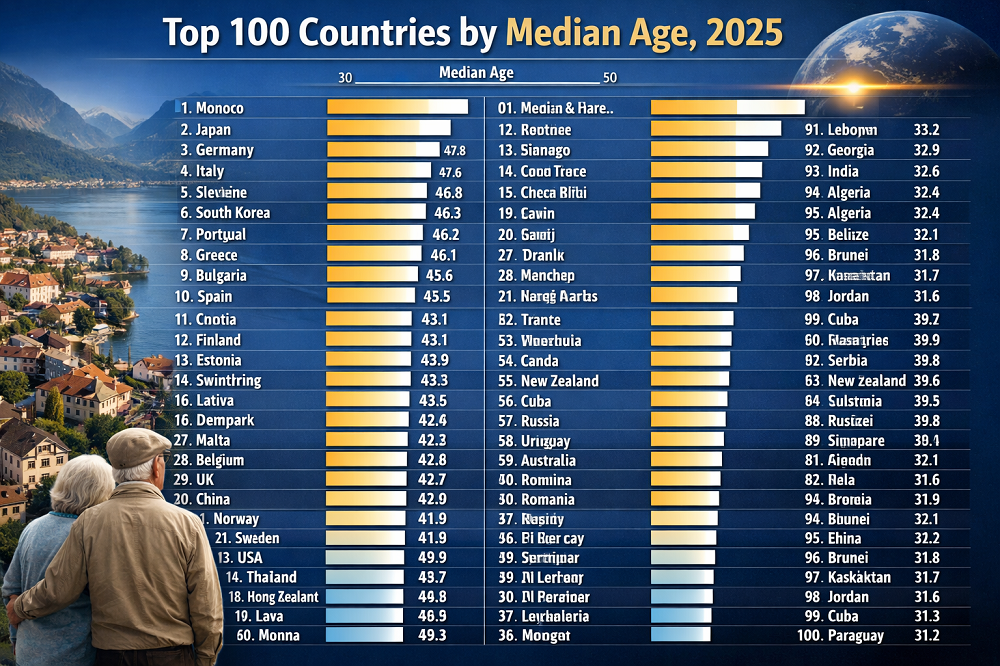
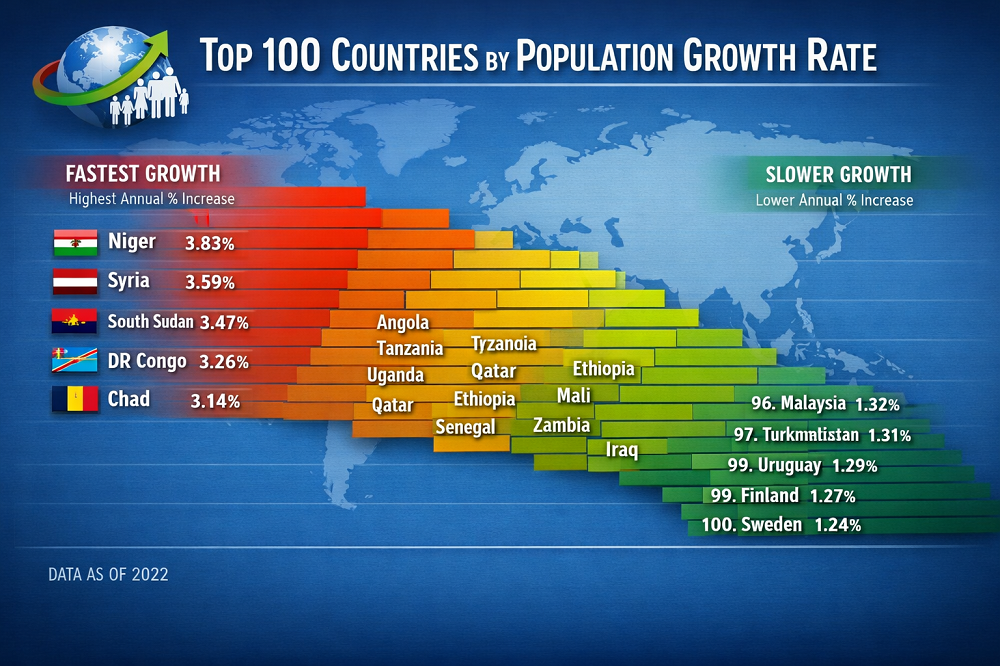
Three structural forces define 2025’s population map. First, the world’s population is now above eight billion, and most net growth is concentrated in countries where median ages are relatively low and fertility remains above replacement. Second, many higher-income economies face slower growth or outright stagnation as fertility rates sit below replacement and populations age. Third, large emerging economies increasingly sit in the “middle” of demographic transition: fertility has fallen substantially compared with the 1990s, but age structures are still young enough to support continued growth for years.
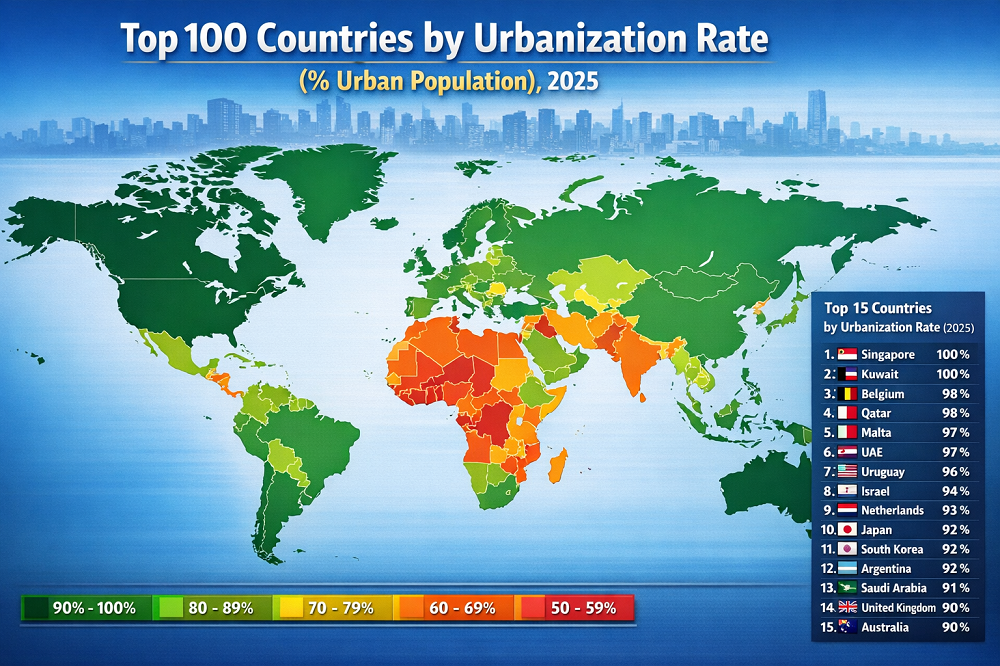
A ranking can look static because many large countries keep their positions year to year. Yet the underlying dynamics are not static. A country can remain in the same rank while its internal structure changes quickly—urbanization rises, working-age shares peak, or migration trends reverse. That is why interpreting population size is less about the headline number and more about context: is the country becoming younger or older, more urban or more dispersed, and is its population growth supported by births, longer life expectancy, or migration?
In 2025, India and China remain the two demographic giants, together representing more than a third of the world’s population. After them, there is a steep drop: the United States is the third-largest country by population, but its population is far smaller than either India or China. From ranks 4 to 10 we see a mix of South and Southeast Asian giants, major African countries with rapid growth, and large economies in the Americas. This pattern is a reminder that population and income are not the same story: some of the world’s biggest populations are still in the process of “catching up” in GDP per capita terms.
Top 10 most populous countries in 2025
The Top 10 alone accounts for a very large share of humanity. For media, business planning, and public policy, the Top 10 is often the “default map” for thinking about global demand—smartphones, food systems, transport, and education. Still, the Top 10 does not explain the full picture. A mid-sized country may have outsized geopolitical influence or a very high income level. Conversely, a very large country can still face major constraints if infrastructure, institutions, or productivity do not keep pace with population needs.
India’s scale comes with a wide internal range: megacities and fast-growing secondary cities alongside rural regions that remain heavily dependent on agriculture. Growth is shaped by continued urbanization, a large working-age cohort, and significant regional differences in fertility and health outcomes.
China remains a demographic superpower, but its age structure is changing quickly. Low fertility and rapid aging imply that long-run growth will depend more on productivity gains, innovation, and improvements in labor-force participation than on population expansion.
The U.S. population is smaller than the Asian giants but remains a key driver of global consumption, innovation, and capital markets. In demographic terms, immigration flows and participation rates are especially important in shaping the future size and composition of the workforce.
Indonesia’s large population is spread across thousands of islands, creating unique infrastructure and logistics challenges. Continued urban growth and productivity improvements are critical for sustaining rising living standards across diverse regions.
Pakistan’s demographic profile remains relatively young. Policy capacity in education, health services, and job creation strongly determines whether population growth becomes an economic advantage or an added strain on public systems.
Nigeria is the largest country in Africa by population and a major driver of the continent’s growth. Urban planning, electricity access, and productivity improvements are core to turning a rapidly expanding population into broad-based gains in prosperity.
Brazil’s size is paired with very high urbanization. The demographic focus is increasingly on aging and on productivity: improving education quality, reducing regional inequality, and upgrading infrastructure in large metropolitan areas.
Bangladesh combines very high population density with rapid structural change. Industrial employment, climate adaptation, and urban services matter disproportionately because pressure on land and housing is intense.
Russia’s population is spread across a vast territory, leading to very different policy challenges than high-density countries. Regional concentration, internal migration, and aging are central to long-term demographic management.
Ethiopia represents a major share of East Africa’s demographic momentum. Improving health outcomes, supporting urban job growth, and building transport networks are key for translating population size into higher productivity and income per person.
Table 1. Top 10 countries by population, 2025 (mid-year estimate)
Population values are shown in millions and rounded. World share is computed using an approximate global total for 2025 to provide an intuitive scale.
| Rank | Country | Population (millions) | World share (%) |
|---|---|---|---|
| 1 | India | 1,463.9 | 17.79 |
| 2 | China | 1,416.1 | 17.21 |
| 3 | United States | 347.3 | 4.22 |
| 4 | Indonesia | 285.7 | 3.47 |
| 5 | Pakistan | 255.2 | 3.10 |
| 6 | Nigeria | 237.5 | 2.89 |
| 7 | Brazil | 213.0 | 2.59 |
| 8 | Bangladesh | 175.7 | 2.13 |
| 9 | Russia | 144.0 | 1.75 |
| 10 | Ethiopia | 136.0 | 1.65 |
Figure 1. Population size for the Top 20 countries (millions), 2025
The bar chart shows why rank “feels uneven”: the first two countries are in a class of their own, while the rest of the Top 20 forms a long tail of large but much smaller populations. For communication, it is often useful to pair this chart with a “share of world population” view (shown in the tables) to keep scale in perspective.
- Most countries in the Top 20 are below 200 million.
- The Top 2 alone exceed 2.8 billion combined.
- Use the full table in Part 2 for the complete Top 100 list.
Full Top 100 population ranking and what it reveals
Once we move beyond the Top 10, the ranking becomes a map of regional demographic weight. South Asia and Southeast Asia contribute many large countries in the upper half of the list, while Africa adds a growing cluster of countries that are moving rapidly up the ranks over time. Europe, by contrast, has relatively few very large populations; its influence is often expressed through income, trade, and institutions rather than scale alone. The Americas sit in between: the United States and Brazil are massive, while other countries range from medium to small but can be economically significant.
The distribution is also “top heavy.” A small number of countries account for a very large share of the world’s population, while most countries are below 50 million. That matters because global shocks—food prices, disease outbreaks, energy scarcity, supply-chain disruptions—hit large populations differently than small ones. In large countries, even a minor change in per-capita outcomes can translate into tens of millions of people affected.
Use the table for fast comparisons (rank, size, and world share), then use the chart below it to understand concentration: how quickly the cumulative share rises as you move down the ranking. A steep curve means the world population is concentrated in the top ranks; a flatter curve would mean a more even distribution.
Table 2. Top 100 countries by population (millions), 2025
The ranking is sorted from highest to lowest. World share is the country’s population as a percentage of an approximate 2025 world total. On mobile, rows automatically turn into stacked cards to avoid horizontal scrolling.
| Rank | Country | Population (millions) | World share (%) |
|---|---|---|---|
| 1 | India | 1,463.9 | 17.79 |
| 2 | China | 1,416.1 | 17.21 |
| 3 | United States | 347.3 | 4.22 |
| 4 | Indonesia | 285.7 | 3.47 |
| 5 | Pakistan | 255.2 | 3.10 |
| 6 | Nigeria | 237.5 | 2.89 |
| 7 | Brazil | 213.0 | 2.59 |
| 8 | Bangladesh | 175.7 | 2.13 |
| 9 | Russia | 144.0 | 1.75 |
| 10 | Ethiopia | 136.0 | 1.65 |
| 11 | Mexico | 132.3 | 1.61 |
| 12 | Japan | 123.3 | 1.50 |
| 13 | Philippines | 118.0 | 1.43 |
| 14 | Egypt | 114.5 | 1.39 |
| 15 | Democratic Republic of the Congo | 111.0 | 1.35 |
| 16 | Vietnam | 101.0 | 1.23 |
| 17 | Iran | 90.6 | 1.10 |
| 18 | Turkey | 88.0 | 1.07 |
| 19 | Germany | 84.4 | 1.03 |
| 20 | Thailand | 71.8 | 0.87 |
| 21 | United Kingdom | 69.0 | 0.84 |
| 22 | Tanzania | 68.4 | 0.83 |
| 23 | France | 65.9 | 0.80 |
| 24 | South Africa | 62.0 | 0.75 |
| 25 | Italy | 59.1 | 0.72 |
| 26 | Kenya | 56.9 | 0.69 |
| 27 | Myanmar | 55.0 | 0.67 |
| 28 | Colombia | 52.7 | 0.64 |
| 29 | South Korea | 51.7 | 0.63 |
| 30 | Uganda | 49.5 | 0.60 |
| 31 | Sudan | 49.0 | 0.60 |
| 32 | Spain | 48.1 | 0.58 |
| 33 | Argentina | 46.2 | 0.56 |
| 34 | Algeria | 46.0 | 0.56 |
| 35 | Iraq | 45.0 | 0.55 |
| 36 | Afghanistan | 43.7 | 0.53 |
| 37 | Canada | 40.2 | 0.49 |
| 38 | Poland | 38.0 | 0.46 |
| 39 | Morocco | 37.8 | 0.46 |
| 40 | Saudi Arabia | 37.5 | 0.46 |
| 41 | Ukraine | 37.2 | 0.45 |
| 42 | Angola | 36.9 | 0.45 |
| 43 | Uzbekistan | 36.0 | 0.44 |
| 44 | Mozambique | 34.7 | 0.42 |
| 45 | Peru | 34.6 | 0.42 |
| 46 | Ghana | 34.4 | 0.42 |
| 47 | Yemen | 34.2 | 0.42 |
| 48 | Malaysia | 34.1 | 0.41 |
| 49 | Madagascar | 31.5 | 0.38 |
| 50 | Nepal | 31.0 | 0.38 |
| 51 | Cameroon | 29.2 | 0.35 |
| 52 | Côte d’Ivoire | 29.1 | 0.35 |
| 53 | Venezuela | 28.4 | 0.35 |
| 54 | Niger | 27.6 | 0.34 |
| 55 | Australia | 27.2 | 0.33 |
| 56 | North Korea | 26.0 | 0.32 |
| 57 | Burkina Faso | 24.6 | 0.30 |
| 58 | Mali | 23.7 | 0.29 |
| 59 | Taiwan | 23.3 | 0.28 |
| 60 | Syria | 23.3 | 0.28 |
| 61 | Sri Lanka | 22.0 | 0.27 |
| 62 | Malawi | 21.0 | 0.26 |
| 63 | Zambia | 20.6 | 0.25 |
| 64 | Kazakhstan | 20.3 | 0.25 |
| 65 | Chile | 19.7 | 0.24 |
| 66 | Romania | 19.0 | 0.23 |
| 67 | Chad | 19.0 | 0.23 |
| 68 | Guatemala | 18.6 | 0.23 |
| 69 | Senegal | 18.2 | 0.22 |
| 70 | Ecuador | 18.1 | 0.22 |
| 71 | Somalia | 18.0 | 0.22 |
| 72 | Netherlands | 17.9 | 0.22 |
| 73 | Cambodia | 17.1 | 0.21 |
| 74 | Zimbabwe | 16.7 | 0.20 |
| 75 | Guinea | 14.7 | 0.18 |
| 76 | Benin | 14.3 | 0.17 |
| 77 | Rwanda | 14.2 | 0.17 |
| 78 | Burundi | 13.5 | 0.16 |
| 79 | Bolivia | 12.4 | 0.15 |
| 80 | Tunisia | 12.4 | 0.15 |
| 81 | Belgium | 11.8 | 0.14 |
| 82 | Haiti | 11.6 | 0.14 |
| 83 | Jordan | 11.6 | 0.14 |
| 84 | South Sudan | 11.6 | 0.14 |
| 85 | Dominican Republic | 11.3 | 0.14 |
| 86 | Cuba | 11.2 | 0.14 |
| 87 | Czechia | 10.9 | 0.13 |
| 88 | Honduras | 10.7 | 0.13 |
| 89 | Sweden | 10.6 | 0.13 |
| 90 | Azerbaijan | 10.5 | 0.13 |
| 91 | Papua New Guinea | 10.5 | 0.13 |
| 92 | Tajikistan | 10.4 | 0.13 |
| 93 | Portugal | 10.3 | 0.13 |
| 94 | Greece | 10.3 | 0.13 |
| 95 | United Arab Emirates | 10.2 | 0.12 |
| 96 | Israel | 9.9 | 0.12 |
| 97 | Hungary | 9.6 | 0.12 |
| 98 | Belarus | 9.2 | 0.11 |
| 99 | Austria | 9.1 | 0.11 |
| 100 | Switzerland | 8.9 | 0.11 |
Figure 2. Cumulative world population share captured by rank (Top 100)
This chart answers a practical question: if you cover the top N countries, what fraction of the world’s population do you cover? It is a compact way to see concentration. If the curve rises quickly at the beginning, it means that the highest-ranked countries account for a disproportionate share of humanity.
The cumulative share rises quickly in the first ranks: the Top 2 already exceed one third of the world’s population, and the Top 10 represents a very large global share. By the Top 100, the coverage is close to the total world population because most people live in countries above the cutoff.
How to interpret population rankings in 2025
A Top 100 population ranking is easy to read but easy to misinterpret. The most common mistake is to treat population as a proxy for “power” or “success.” Population size primarily measures how many people live inside a national boundary, not how productive they are, how healthy they are, or how well institutions function. A country with 20 million people can have a higher GDP than a country with 100 million if it has much higher productivity per person. Likewise, a large population can be an advantage only if education, health, infrastructure, and labor markets can absorb and support it.
The ranking is still extremely useful because it anchors scale. When you compare emissions totals, number of internet users, healthcare capacity, or vehicle fleets, population is often the denominator that turns totals into rates. That is why demographic scale sits at the base of many policy dashboards: it tells you what a country must manage in education cohorts, housing needs, and future pension burdens.
Key takeaways
Population rankings are most informative when paired with “structure” indicators—age composition, urbanization, and migration—because these determine how population size translates into real-world capacity and demand.
- Scale is concentrated: the first few ranks represent a large share of humanity.
- Growth drivers differ: some countries grow mainly via births, others via migration.
- Aging matters: a stable population can still face rising dependency burdens.
- Urban pressure is key: city systems often determine lived outcomes more than totals.
- Use rates for comparisons: pair totals with per-capita metrics to avoid false conclusions.
A helpful mental model is to treat population as a “capacity requirement.” A country of 200 million must run education systems, public health, transport, and food logistics at a scale that is fundamentally different from a country of 5 million. Whether it succeeds depends on institutions, policy choices, and productivity—not on population alone.
Why the regional pattern matters
The world’s demographic center of gravity continues to tilt toward regions with younger age structures. Many African countries have rapidly expanding cohorts of children and young adults. That creates both opportunity and risk. The opportunity is a future workforce that can support growth if jobs and skills investments keep pace. The risk is a mismatch: if education quality and labor absorption lag behind, pressure builds in cities, public services, and political systems.
Asia, still the largest regional population hub, shows a more mixed profile. Several countries remain large and continue to grow, but many have already moved into low-fertility patterns. This shifts the policy focus from “managing growth” toward “managing aging,” including healthcare capacity, pension financing, and maintaining productivity as the labor force stops expanding.
Europe’s demographic story is heavily shaped by low fertility and aging. As a result, population ranking positions change slowly, but the internal composition changes significantly. In many European countries, migration and participation rates can matter more than births in determining the future workforce size. The Americas present a mixed picture: the U.S. remains very large and relatively dynamic, while many Latin American countries have moved quickly through demographic transition and now face the early stages of aging.
Methodology notes
“Population” can differ across datasets due to definitions and timing. Some sources use mid-year estimates, some use end-year estimates, and some revise historical values after new census results. For a ranking page, the key is consistency: the same definition should be applied across countries, and rounding should be transparent.
- Reference period: mid-2025 estimate used as a practical snapshot for 2025.
- Units: populations are shown in millions to keep tables readable and avoid overflow.
- Rounding: values are rounded; this can cause small rank differences when countries are close.
- Revisions: rankings can shift slightly when new censuses or updated demographic models are released.
For formal work, always use the original dataset and its documentation. This StatRanker ranking is designed for analytical navigation and educational comparisons.
Sources
Primary datasets commonly used to compile population estimates and projections.
-
United Nations — World Population Prospects (WPP)Core global population estimates and projections by country, with methodological notes and revision history.
https://population.un.org/wpp/ -
World Bank — World Development Indicators (WDI), Population seriesHarmonised population totals and related demographic indicators across countries.
https://data.worldbank.org/indicator/SP.POP.TOTL -
U.S. Census Bureau — International Database / International ProgramsCountry population estimates and demographic components; useful for cross-checking assumptions and trends.
https://www.census.gov/programs-surveys/international-programs.html