
Aging Populations: Challenges and Opportunities in Developed Countries
Aging Populations in Developed Countries: challenges you can measure, opportunities you can build
Population ageing is no longer an abstract “future risk.” In most high-income economies, the share of residents aged 65+ is already large enough to reshape budgets, labor markets, healthcare demand, and even how cities are designed. Japan, Germany, the United States, Canada, and the United Kingdom are all moving toward a demographic structure where there are fewer working-age adults per retiree, while the 80+ cohort expands fastest.
This 2026 refresh is written for decision-makers and curious readers alike: it explains what is changing, where the pressure shows up first (pensions, care, staffing, housing), and how developed countries can turn longevity into an economic advantage through productivity, prevention, and age-friendly innovation.
The scale of ageing: what “65+” tells you (and what it does not)
“Population ageing constitutes one of the most significant demographic transformations of the 21st century.”
The simplest headline metric is the share of the population aged 65+. It is powerful because it links directly to retirement systems, health utilization patterns, and long-term care demand. In 2024, the global 65+ share was about 10.2%, while OECD members were already far higher. Japan is the clearest “lead indicator” for developed countries because it reached a 65+ share close to 30% and continues to rise.
Three definitions you’ll see everywhere
- 65+ share: how large the older population is as a fraction of everyone.
- Old-age dependency ratio (OADR): older adults relative to working-age people (often 65+ per 100 people ages 15–64). This is closer to “how many potential contributors support how many retirees.”
- 80+ growth: the fastest-growing and highest-needs segment in most projections; it drives care staffing, dementia services, and housing adaptation urgency.
Why developed countries are ageing
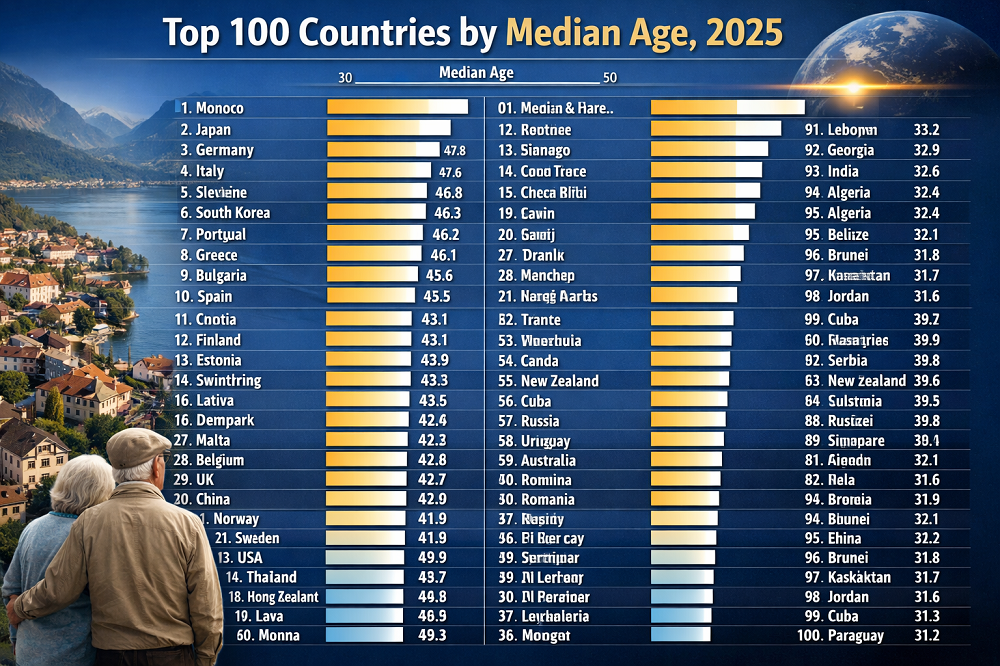
In rich economies, ageing is mostly a story of low fertility + longer life. Even when migration raises total population growth, it rarely offsets the structural shift created by decades of below-replacement births. The result is a steady rise in median age, a larger retiree population, and a workforce that must “do more with fewer” through productivity and better skills matching.
Why 2026 matters as a policy moment
Ageing is gradual, but governments experience it as a sequence of threshold events: when large cohorts cross 65 (retirement eligibility), then 75 (higher health utilization), and later 85 (intensive care and support needs). Many developed countries are now in the phase where post-war cohorts are moving from employment into retirement at scale, compressing the timeline for reforms in pensions, health financing, and workforce planning.
The big four challenges: labor, pensions, care, and age-ready cities
1) Labor markets: fewer workers, tighter competition for skills
In an ageing society, workforce constraints show up before anything else. Employers face a smaller pool of prime-age workers, higher replacement needs, and a stronger role for migration and reskilling. For governments, the key risk is that slower labor-force growth means slower trend GDP growth unless productivity rises.
Europe is feeling this especially acutely: recent policy debates increasingly frame the issue as a shift from “growth by headcount” to “growth by productivity,” because demographic trends reduce the contribution of a growing workforce.
2) Pension systems: sustainability and intergenerational fairness
Ageing increases pension outlays mechanically: more beneficiaries for longer periods. That pressure is manageable when retirement ages, contribution bases, and labor participation evolve with longevity — and destabilizing when they do not. The fiscal stress is most visible in countries where public pension expenditure already represents a very large share of GDP.
3) Healthcare and long-term care: “more years” must become “more healthy years”
Health spending is not driven only by age, but ageing raises demand for chronic disease management, multi-morbidity care, home support, and long-term care capacity. In the United States, the scale is visible in the Medicare budget within national health spending. In Japan and parts of Europe, the immediate constraint is often not money first, but staffing (nurses, carers, home-visit capacity) and the availability of adapted housing.
4) Cities and housing: accessibility becomes core infrastructure
When the 65+ and 80+ shares rise, “age-friendly” design becomes mainstream: step-free access, safer sidewalks, proximity to services, and housing that supports independent living. Without those adaptations, a larger older population translates into more falls, faster functional decline, avoidable hospitalizations, and higher care costs — even when medical quality is high.
Fiscal pressure snapshots (recent official reporting)
| Indicator | Latest reported value | Why it matters for ageing |
|---|---|---|
| United States: Medicare spending | $1,118.0B (2024) | A growing older population increases demand for insured care; the financing trajectory matters as the 65+ share rises. |
| Italy: public pension expenditure | ~16% of GDP (latest available year in OECD reporting) | High pension share limits fiscal space; ageing amplifies the need for retirement-age, contribution, and indexation design. |
| Germany: retirement-age population | ~1 in 4 aged 67+ projected by 2035 | A near-term demographic “wave” increases urgency for labor supply, productivity, and care workforce planning. |
Opportunities: longevity as an economic engine
The “silver economy” framing is useful because it forces a balanced view: ageing can raise fiscal pressure, but it also creates new markets, new productivity incentives, and a larger base of experienced talent.
1) The silver economy: a demand shift you can plan for
Ageing changes what households buy and what public systems must provide. In practice, this expands markets for: home renovation and accessible housing; preventive health and chronic disease management; mobility and safe transport; financial products; travel designed for older adults; and care services that help people remain independent.
In Europe, official analysis of the “silver economy” has treated it as a macro-level growth pathway — not a niche. The implication for developed countries is straightforward: the winner is the economy that treats longevity as a design constraint and an innovation opportunity (services, product standards, and workforce organization).
2) Longer working lives: from “retire early” to “work differently”
In many developed countries, the policy goal is not simply to “raise retirement age,” but to make later-life work more realistic: flexible schedules, ergonomics, updated skills, and pathways to shift from physically demanding tasks to mentoring, quality control, training, or customer-facing roles where experience is an advantage. The business case improves when employers quantify how much know-how and productivity is lost in mass retirements.
3) Health innovation: prevention, remote monitoring, and smarter care pathways
Health systems can bend the cost curve when they shift from late-stage treatment to earlier prevention, and from hospital-centric care to home-centric care supported by digital tools. Ageing increases the payoff from telemedicine, medication management, fall prevention, and coordination for multi-morbidity patients.
4) Care technology and robotics: scaling capacity where staffing is tight
Japan has become the most watched “test case” for care innovation. The lesson is not that machines replace human carers; it is that assistive technology can reduce physical burden, improve safety, and stretch scarce staff. Policy in Japan has explicitly prioritized caregiving technology domains, showing how governments can accelerate adoption via standards, procurement, and targeted programs.
5) A more realistic narrative: older does not automatically mean less capable
A key 2025 message in international policy debate is that healthier ageing can increase labor participation and productivity longer than older models assumed. If people live longer with better function, the effective “dependency” burden can be lower than implied by a fixed age threshold. That is why reforms that improve healthy life expectancy and reduce disability matter economically, not only socially.
65+ share in key developed countries (latest data) and where it may go by 2050
The table uses the latest widely referenced 65+ shares (World Bank WDI via FRED, 2024) and a comparable set of 2050 projections used in cross-country summaries. Projections vary by scenario (fertility, migration, life expectancy), but the direction is consistent: more older residents in every major developed economy.
Table: % of population aged 65+ (2024) vs. projected (2050)
| Country | 65+ share (2024) | Projected 65+ share (2050) | Notes |
|---|---|---|---|
| Japan | 29.78% | 37.7% | Japan remains the lead indicator. National projections also show a mid-century share in the mid-to-high 30s (scenario-dependent). |
| Germany | 23.20% | 28.1% | A rapid near-term retirement wave elevates labor and care planning urgency. |
| United States | 17.93% | 22.0% | Ageing is slower than in Japan/Europe, but the absolute number of older adults is large and rising. |
| Canada | 19.80% | 24.1% | Migration can change the short-run age profile, but long-run ageing remains a central planning constraint. |
| United Kingdom | 19.50% | 24.8% | UK projections commonly describe the shift as “about one in four” aged 65+ by 2050. |
Diagram: 2024 vs. 2050 (bar comparison)
A practical playbook for developed countries
The most effective responses treat ageing as a multi-sector systems problem: budgets, labor markets, health pathways, housing stock, and technology adoption reinforce each other. The winning strategy is not “one reform,” but a portfolio that keeps societies productive while improving healthy life expectancy.
What tends to work (and why)
- 1) Build growth on productivity, not headcount. When labor-force growth slows, policy must raise output per worker: better skills matching, capital investment, diffusion of technology, and reduction of administrative friction for businesses.
- 2) Make longer working lives realistic. Gradual retirement, flexible work, training, and age-friendly workplaces reduce “cliff-edge” exits and preserve expertise.
- 3) Invest in prevention and healthy ageing. Global health guidance emphasizes that countries must prepare health and social systems for this demographic shift. Prevention is the most scalable cost-control tool because it reduces disability and care intensity later.
- 4) Expand long-term care capacity — and adopt caregiving technology. Staffing is often the binding constraint. Assistive devices, better workflow, and technology standards can reduce burden and improve safety without promising unrealistic “robot replacement.”
- 5) Treat housing and the built environment as part of health policy. Accessible homes and safer streets reduce falls and premature loss of independence, which is both a quality-of-life and cost issue.
- 6) Use migration and reskilling as targeted tools. Migration can stabilize working-age shares in the short run; reskilling raises effective labor supply and helps sectors facing chronic shortages (health, care, construction, and tech).
FAQ (for search and AI results)
Why do ageing populations matter economically if many older adults are healthy?
Because ageing changes the ratio between workers and retirees and shifts demand toward healthcare and long-term support. Even with healthier ageing, countries must finance retirement systems and care pathways for a larger older cohort.
Is immigration enough to “fix” ageing in developed countries?
Immigration can slow population decline and support labor supply, but it rarely reverses decades of low fertility on its own. Most developed countries still need productivity growth, later-life work options, and prevention-focused health policy.
What is the “silver economy” in practical terms?
It is the set of products, services, and jobs created by longevity and the needs of older consumers: accessible housing, health and wellness services, mobility solutions, financial services, travel, and care.
Which country is the best “early warning” example?
Japan is often used as the lead indicator: it reached close to 30% aged 65+ and now tests the limits and innovations of pensions, care staffing, and technology adoption under real pressure.
Does ageing automatically increase healthcare costs?
Not automatically. Costs depend on disease burden, care pathways, pricing, and prevention. But ageing increases the potential demand for chronic care and long-term support, making system design and healthy ageing policies more important.
What is the single best “first move” for policymakers?
Treat ageing as a productivity agenda: combine prevention, workforce participation, and care capacity planning. Countries that protect healthy years and keep people economically active longer can reduce fiscal stress without sacrificing quality of life.
Sources (official and widely cited)
- World Bank (WDI) via FRED (St. Louis Fed): Population ages 65 and above (% of total) — country series (2024 latest).
- Japan IPSS: Population Projections for Japan (2023 revision) — age structure tables and projections to 2070.
- OECD: Pensions at a Glance 2025 — country notes and public pension expenditure context.
- Centers for Medicare & Medicaid Services (CMS): National Health Expenditure (NHE) fact sheet — Medicare spending totals.
- World Health Organization (WHO): Ageing and health fact sheet — global ageing milestones and system readiness framing.
- Statistics Canada: Age and gender population estimates — ageing dynamics and cohort effects.
- German Federal Statistical Office (Destatis): Coordinated population projection releases — near-term retirement-age population shift.
- European Commission: Silver Economy study — GDP and employment contribution estimates.