
Top 10 Countries in Cement and Concrete Product Production 2025
2025 snapshot: cement output as the backbone of concrete
Cement is the key binder in concrete, while concrete products (blocks, slabs, precast elements, and reinforced structures) translate cement into buildable components. Because comparable “concrete products” output is not consistently reported country-by-country, cement production is the most practical global proxy for the scale of concrete supply chains.
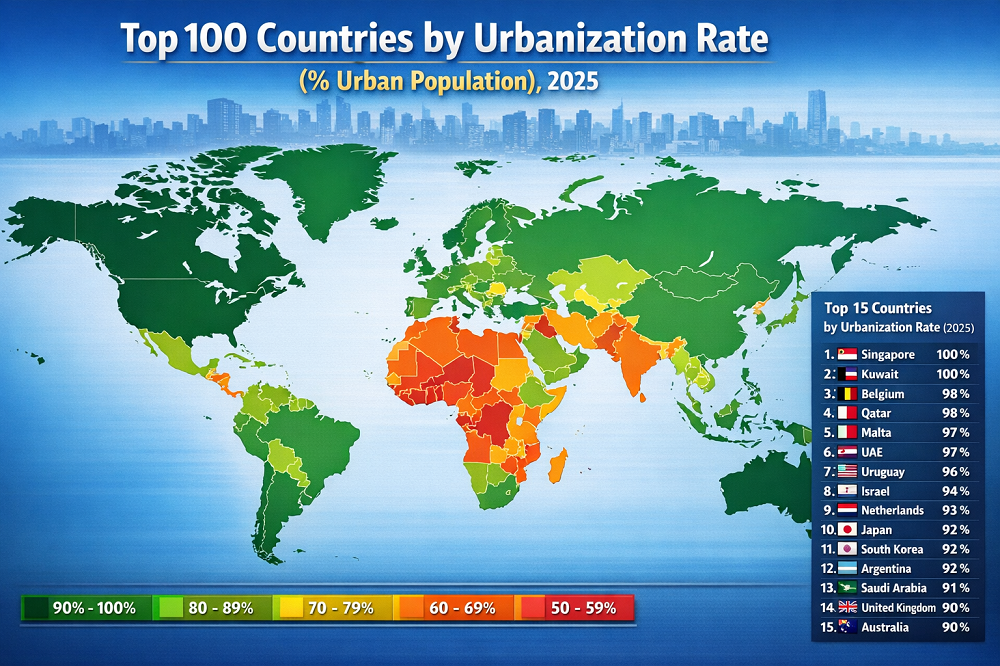
The latest USGS estimates put world cement production at 3.8 billion metric tons in 2025 (rounded), reflecting softer demand in some large markets and uneven construction cycles. At the same time, long-run urbanization pressure remains strong: the UN projects roughly two-thirds of the global population will live in urban areas by 2050.
Top 10 cement-producing countries (2025)
Production in million metric tons (Mt). Shares are of world total (3,800 Mt, rounded).
Top 10 table (2025)
| Rank | Country | Cement production (Mt) | Share of world (%) |
|---|---|---|---|
| 1 | China | 1,700 | 44.74 |
| 2 | India | 470 | 12.37 |
| 3 | Vietnam | 100 | 2.63 |
| 4 | Turkey | 89 | 2.34 |
| 5 | United States | 84 | 2.21 |
| 6 | Iran | 68 | 1.79 |
| 7 | Brazil | 67 | 1.76 |
| 8 | Egypt | 64 | 1.68 |
| 9 | Indonesia | 64 | 1.68 |
| 10 | Russia | 59 | 1.55 |
Notes: figures are USGS estimates (rounded). “Concrete products output” can diverge from cement output due to imports, exports, clinker trade, and the mix of ready-mix vs precast production.
Production chart (2025): major producers
Chart covers the set of countries with both production and clinker capacity figures published in the same USGS snapshot (plus scale context).
| Country | Cement production (Mt) |
|---|---|
| China | 1,700 |
| India | 470 |
| Vietnam | 100 |
| Turkey | 89 |
| United States | 84 |
| Iran | 68 |
| Brazil | 67 |
| Egypt | 64 |
| Indonesia | 64 |
| Russia | 59 |
| Saudi Arabia | 54 |
| Japan | 44 |
| Mexico | 42 |
| Korea, Rep. | 37 |
Methodology (what this ranking measures)
This 2025 snapshot ranks countries by estimated cement production (million metric tons, Mt). Cement is used as a global, comparable indicator for the scale of concrete and cement-product supply chains because consistent country-level reporting for downstream “concrete products” (blocks, slabs, precast elements) is limited. Values come from the USGS Mineral Commodity Summaries cement chapter, which publishes rounded estimates and a matching clinker capacity table for key producers.
Practical limitations: (1) cement output does not equal domestic concrete output when trade is large (imports/exports, clinker trade), (2) capacity figures are approximate and may not align with imported clinker and grinding-only setups, and (3) the “Other countries (rounded)” bucket is a reminder that global production is broader than the named producers.
Insights you can take away
- Concentration is extreme: China and India together account for well over half of world cement output.
- Demand cycles show up fast: China’s 2025 estimate is lower than 2024, consistent with a softer construction cycle, while India and Vietnam expand.
- Capacity utilization matters: the same production number can imply tight supply (high utilization) or slack capacity (low utilization), affecting pricing power and lead times.
- Decarbonization is shifting from pilots to procurement: blended cements, alternative fuels, and performance-based standards are increasingly tied to public tenders and large developers’ specs.
What it means for readers (builders, investors, and planners)
- Construction costs: when utilization rises in a region, cement and ready-mix pricing tends to respond quickly—especially where import terminals are limited.
- Project risk: infrastructure schedules are sensitive to supply-chain bottlenecks (clinker, gypsum, slag, fly ash) and to permitting constraints around kilns and quarries.
- Material choices: if low-carbon concrete is a requirement (or a differentiator), focus on mix design options (SCMs, optimized binder content, performance specs) rather than chasing one “miracle” product.
FAQ
Why is China still so far ahead?
Scale and legacy capacity. China built a huge kiln base over decades of rapid urban build-out. Even with slower demand, the installed system remains the world’s largest.
Is “cement production” the same as “concrete products production”?
No. Concrete products depend on downstream manufacturing (ready-mix and precast), local standards, and trade flows. Cement is used here because it’s the most consistently comparable global metric.
Why do some countries show very high utilization?
Capacity is a rounded estimate and “production” can include cement made from imported clinker in grinding operations. These factors can push implied utilization above 100% in the simplified snapshot.
What’s driving the biggest shifts in 2025?
Construction cycles (housing and infrastructure), credit conditions, and the timing of large projects. Policy pressure on emissions is also affecting investment decisions in kilns and alternative binders.
How big is cement’s climate footprint?
Estimates commonly place cement and concrete-related cement manufacturing at roughly 7–8% of global CO₂ emissions, combining process emissions (calcination) and fuel combustion.
What changes fastest: supply or demand?
Demand can swing quickly with construction and financing conditions. Supply (new kilns) moves slowly due to permitting, capex, and long lead times, which is why utilization is a useful near-term signal.
Major producers with published clinker capacity (2025)
This section uses a consistent subset where production and clinker capacity are published together in the same snapshot. Use the controls to quickly filter, sort, and switch units (Mt vs share of world).
| Rank | Country | Value | YoY (vs 2024) |
|---|---|---|---|
| 1 | China | 1,700 44.74% | −5.6% |
| 2 | India | 470 12.37% | +6.8% |
| 3 | Vietnam | 100 2.63% | +9.9% |
| 4 | Turkey | 89 2.34% | +4.7% |
| 5 | United States | 84 2.21% | −1.2% |
| 6 | Iran | 68 1.79% | −4.2% |
| 7 | Brazil | 67 1.76% | +3.1% |
| 8 | Egypt | 64 1.68% | +20.8% |
| 9 | Indonesia | 64 1.68% | −5.9% |
| 10 | Russia | 59 1.55% | −11.9% |
| 11 | Saudi Arabia | 54 1.42% | +5.9% |
| 12 | Japan | 44 1.16% | −4.3% |
| 13 | Mexico | 42 1.11% | −4.5% |
| 14 | Korea, Republic of | 37 0.97% | −15.9% |
| — | Other countries (rounded) | 860 22.63% | 0.0% |
Source: USGS estimates (rounded). “Other countries” keeps the global total consistent in share calculations.
Clinker capacity and implied utilization (2025)
Utilization is computed as production ÷ clinker capacity, using the same snapshot.
| Country | Clinker capacity (Mt) | Implied utilization (%) |
|---|---|---|
| China | 1,800 | 94.4 |
| India | 400 | 117.5 |
| Vietnam | 110 | 90.9 |
| Turkey | 100 | 89.0 |
| United States | 100 | 84.0 |
| Iran | 85 | 80.0 |
| Brazil | 61 | 109.8 |
| Egypt | 75 | 85.3 |
| Indonesia | 83 | 77.1 |
| Russia | 80 | 73.8 |
| Saudi Arabia | 75 | 72.0 |
| Japan | 50 | 88.0 |
| Mexico | 42 | 100.0 |
| Korea, Republic of | 62 | 59.7 |
Scatter chart: production vs clinker capacity (2025)
Each point is a country. The diagonal (conceptually) represents 100% utilization.
Interpretation: what the 2025 cement map is telling you
The top end of the cement ranking is still shaped by one structural fact: cement is heavy, low-value per ton, and expensive to ship far. That makes production highly regional, tied to domestic construction cycles, quarry access, and kiln permitting. The 2025 snapshot shows a world where the biggest producer remains dominant, but growth is more visible in fast-urbanizing markets and in countries scaling exports or large infrastructure programs.
For concrete products (blocks, slabs, precast), the key constraint is not only cement tonnage, but reliable upstream inputs (clinker, gypsum, SCMs like slag/fly ash/calcined clay), downstream logistics (ready-mix fleets, precast yards), and standards that allow performance-based low-carbon mixes.
Policy and industry takeaways
- Move standards from “recipe” to “performance”: allowing more blended cement and optimized mixes can cut emissions without waiting for entirely new kiln fleets.
- Procurement sets the market: public infrastructure specs can accelerate low-carbon concrete adoption if they reward verified performance (strength, durability, embodied carbon).
- SCM supply is the new bottleneck: slag and fly ash availability is uneven; scaling calcined clays and alternative SCM logistics becomes strategically important.
- Capacity utilization is a near-term signal: tight utilization can mean faster price response and longer lead times, while slack capacity can cap pricing even when demand improves.
- Decarbonization is a portfolio, not one lever: clinker substitution, alternative fuels, energy efficiency, and (in some regions) CCUS all matter, but timelines differ.
How to read “green concrete” claims
- Ask what changed: lower clinker factor, different SCM blend, cleaner energy, or carbon capture?
- Check functional performance: durability and lifecycle performance often matter more than headline “percent reduced.”
- Prefer transparent accounting: product EPDs, third-party verification, and comparable system boundaries.
Sources
-
USGS — Mineral Commodity Summaries 2026: Cement (PDF)
Primary reference for 2024–2025 estimated cement production and clinker capacity figures used in this snapshot.
-
USGS — Cement statistics and information
Background on cement supply, demand, and USGS reporting coverage.
-
International Energy Agency — Cement (sector overview)
Context on the cement sector’s emissions intensity and decarbonization pathways.
-
United Nations — World Urbanization Prospects (urban share projections)
Urbanization projections used for long-run demand context.
-
UN Population Division — World Urbanization Prospects portal
Access point for the latest revision datasets and methodological notes.
-
IEA — Global Energy Review 2025: CO₂ emissions
Broader macro context on industrial process emissions and cement-cycle signals in recent years.