Top 100 Countries by Military Expenditure (% of GDP), 2025
How military expenditure as a share of GDP shows defense burden in 2025
Military expenditure as a share of GDP is one of the clearest ways to compare how heavily countries lean into defense relative to the size of their economies. Total military spending in dollars tells you who can buy the most, but the GDP ratio tells you how demanding that effort is for national output, fiscal priorities and long-term resource allocation. In a year shaped by the war in Ukraine, higher NATO spending targets, Middle East insecurity and rapid rearmament in parts of Asia, the burden indicator is often more revealing than raw headline totals.
For a 2025 ranking page, the most practical base year is 2024, because that is the latest full year currently available in the SIPRI data stack. The world average military burden is about 2.20% of GDP in the latest broadly comparable country set, but the leaders sit far above that level and reflect very different stories: open war, elevated regional threat, legacy security doctrine, or structurally defense-heavy state budgets.
Top 10 countries by military expenditure as a share of GDP, latest available picture
The current top of the ranking is not dominated by the largest military powers in dollar terms. Instead, it is led by countries facing acute security pressure or maintaining unusually defense-intensive state structures. Ukraine is in a class of its own because wartime mobilization has pushed military effort to a level that no peacetime NATO economy approaches. The next cluster contains countries where regional rivalry, border insecurity, internal conflict or long-standing military centrality keep defense burdens persistently high.
Ukraine’s ratio is extraordinary because the country is financing national survival under full-scale war. The number says less about “normal” defense policy and more about total wartime mobilization, emergency procurement and a fiscal system reorganized around national defense.
Israel’s burden jumped sharply as the regional security environment worsened. It remains one of the clearest examples of a high-income economy that still allocates a very large share of output to military readiness and operations.
Algeria combines a large hydrocarbon base with a traditionally high-security posture. The ratio highlights how resource exporters can sustain a heavy defense burden without needing top-tier absolute spending levels.
Saudi Arabia remains a structurally defense-intensive state, even though the burden is well below earlier peaks. It reflects regional deterrence logic, high-end procurement and a long-running preference for a heavily funded security sector.
Russia’s ratio rose as the war drove large-scale procurement, replenishment and personnel spending. The burden figure captures the macroeconomic weight of prolonged conflict more directly than nominal military-spending headlines alone.
Myanmar’s latest value underlines how internal conflict and military dominance can push defense to a very large share of national output, even in an economy far smaller than the top global spenders in dollar terms.
Qatar remains high in the long-run ranking because the country has historically maintained a large defense burden relative to its economic size. In the latest indexed country page, the available terminal year is 2022 rather than 2024.
Oman has long sat near the top of global military-burden tables. Even after falling far below historical peaks, it still allocates a very large share of economic output to defense by international standards.
Libya’s position reflects both security fragmentation and the difficulty of interpreting ratios in a volatile state. When GDP fluctuates and the political environment is unstable, the burden number can move sharply from one year to the next.
Kuwait rounds out the top 10 in the latest country-level picture. Like other Gulf states, it pairs a relatively small population with sustained defense spending and a security strategy built around regional deterrence.
Table 1. Top 10 snapshot
| Rank | Country | Military expenditure (% of GDP) | Source year |
|---|---|---|---|
| 1 | Ukraine | 34.48% | 2024 |
| 2 | Israel | 8.78% | 2024 |
| 3 | Algeria | 7.97% | 2024 |
| 4 | Saudi Arabia | 7.30% | 2024 |
| 5 | Russia | 7.05% | 2024 |
| 6 | Burma (Myanmar) | 6.79% | 2024 |
| 7 | Qatar | 6.50% | 2022 |
| 8 | Oman | 5.59% | 2024 |
| 9 | Libya | 5.29% | 2023 |
| 10 | Kuwait | 4.84% | 2024 |
The full long table in Part 2 is embedded directly in HTML for indexability. Because cross-country availability is uneven, the overview above prioritizes the freshest country-level values, while the long list preserves the largest clean Top 100 snapshot that can be rendered without fetches or hidden data calls.
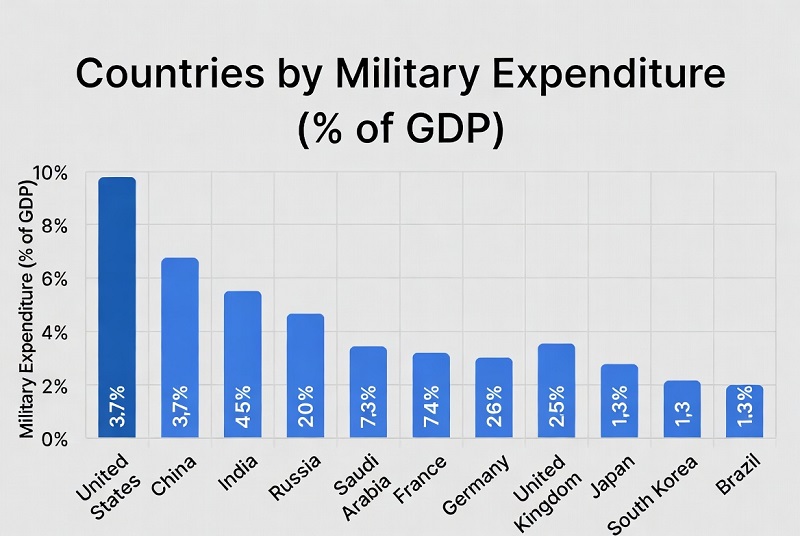
Chart 1. Top 20 countries by military expenditure as a share of GDP
This chart emphasizes burden rather than firepower in absolute dollars. High positions typically signal war, acute threat perception, or a state structure that keeps defense near the center of public spending.
Methodology
This page uses military expenditure as a percentage of GDP, the classic “military burden” indicator. The core source is the SIPRI Military Expenditure Database, which currently extends through 2024 for the main annual series. World Bank metadata for the same indicator also identifies SIPRI as the underlying source, which helps with series definition and cross-country comparability.
For the 2025 framing, 2024 is used as the latest full-year proxy wherever country-level values are available. Some country pages terminate earlier, so a few rows still reflect 2023 or 2022. Values are lightly rounded for publication. The indicator includes spending on armed forces, defense ministries, military aid, operations and maintenance, procurement, research and development, and certain paramilitary forces where judged to be trained and equipped for military operations. It does not equal total security spending in the broad sense.
Readers should keep four limits in mind. First, open-source military-spending estimates are inherently harder to compare than standard national accounts. Second, wartime economies can move sharply year to year, so ranking changes may reflect both spending surges and GDP swings. Third, foreign military support, off-budget channels or classification choices can complicate clean international comparisons. Fourth, for ratio indicators, a high number does not always mean a powerful military in absolute terms; sometimes it means the economy is small, under stress, or both.
Insights and takeaways
The first big pattern is concentration around conflict and threat. Ukraine’s figure is fundamentally different from everyone else’s because it reflects wartime mobilization. Russia and Israel also sit far above peacetime norms, while several Middle Eastern states continue to sustain high structural defense burdens because regional deterrence remains central to state strategy.
The second pattern is that burden and scale are not the same thing. The United States and China dominate total spending in dollars, but neither leads this ranking. That is why the ratio matters for fiscal interpretation: it shows how much of the economic base is being committed to defense, not just how large a military budget looks in cash terms.
The third pattern is Europe’s rearmament. NATO’s 2% benchmark no longer looks ambitious for the eastern flank. Poland, Greece, the Baltic states and several Nordic countries now sit near or above levels that would once have looked exceptional inside Europe. What used to be a compliance discussion is increasingly a long-cycle industrial and budgetary shift.
What this means for the reader
For investors and business readers, a high military-burden ratio can signal elevated geopolitical risk, pressure on public budgets, and stronger demand for defense, logistics, cybersecurity and reconstruction capacity. It can also point to harder trade-offs in health, infrastructure and civilian capital spending if defense claims a growing slice of national output.
For migration, education and location decisions, the indicator gives context rather than a full answer. A country spending 5% to 8% of GDP on defense is not automatically unstable, but it often operates in a tougher security environment. For policy watchers, the ranking is useful because it shows who is moving from symbolic defense commitment toward genuine macroeconomic prioritization.
FAQ
Why is Ukraine so far above everyone else?
Because the country is financing a full-scale war. The ratio captures both very high military outlays and the strain war places on economic output.
Why use % of GDP instead of military spending in dollars?
Dollars show scale. The GDP ratio shows burden. A country can spend less in absolute terms than the United States yet devote a much larger share of its economy to defense.
Does a high burden always mean a stronger military?
No. It can also mean the economy is smaller, the state is under security stress, or GDP has weakened while defense spending remained high.
Why does Qatar still appear near the top with an older year?
Because the latest indexed country page available in the accessible source chain ends in 2022. It still belongs in the high-burden group, but the terminal year should be read carefully.
Is NATO’s 2% target “high” in this ranking?
It is above the world average, but not close to the global top. In today’s environment, 2% is more of a baseline than a frontier value for exposed European members.
Why are the United States and China not near the top?
Because this ranking is about burden, not absolute size. The United States spends more in dollars than any other country, but its defense effort is spread over a very large economy.
Full long table and distribution view
The long table below is fully embedded in HTML, so every visible row exists in source code without waiting for JavaScript. Interactive controls only sort and hide already rendered rows. Because fully indexed cross-country ranking pages lag country-level updates, this long list preserves the largest clean Top 100 snapshot available in the accessible SIPRI-derived ranking chain, while Part 1 highlights fresher country-level leaders where 2024 or 2023 values are directly exposed.
Table 2. Top 100 countries by military expenditure (% of GDP) — maximum fully indexed long table
Mode note: because this indicator is already a ratio, the “share” toggle below shows each country’s share of the cumulative Top 100 burden index. It is a descriptive UI view, not a country’s share of world military spending.
Cumulative Top 100 burden index: 248.97 percentage points in this embedded long-table snapshot.
| Rank | Country | Value | YoY |
|---|---|---|---|
| 1 | UkraineEurope · lower-middle income | 25.64%Snapshot year: 2022 | n/a |
| 2 | QatarMENA · high income | 6.50%Snapshot year: 2022 | n/a |
| 3 | Saudi ArabiaMENA · high income | 6.40%Snapshot year: 2022 | n/a |
| 4 | OmanMENA · high income | 5.26%Snapshot year: 2022 | n/a |
| 5 | JordanMENA · upper-middle income | 4.80%Snapshot year: 2022 | n/a |
| 6 | RussiaEurope · upper-middle income | 4.61%Snapshot year: 2022 | n/a |
| 7 | KuwaitMENA · high income | 4.51%Snapshot year: 2022 | n/a |
| 8 | IsraelMENA · high income | 4.43%Snapshot year: 2022 | n/a |
| 9 | LibyaMENA · upper-middle income | 4.35%Snapshot year: 2022 | n/a |
| 10 | Burma (Myanmar)Asia · lower-middle income | 4.17%Snapshot year: 2022 | n/a |
| 11 | TogoAfrica · low income | 4.14%Snapshot year: 2022 | n/a |
| 12 | ArmeniaAsia · upper-middle income | 4.08%Snapshot year: 2022 | n/a |
| 13 | AlgeriaMENA · upper-middle income | 4.06%Snapshot year: 2022 | n/a |
| 14 | GreeceEurope · high income | 4.00%Snapshot year: 2022 | n/a |
| 15 | MoroccoMENA · lower-middle income | 3.81%Snapshot year: 2022 | n/a |
| 16 | AzerbaijanAsia · upper-middle income | 3.80%Snapshot year: 2022 | n/a |
| 17 | BahrainMENA · high income | 3.42%Snapshot year: 2022 | n/a |
| 18 | USAAmericas · high income | 3.31%Snapshot year: 2022 | n/a |
| 19 | PakistanAsia · lower-middle income | 3.18%Snapshot year: 2022 | n/a |
| 20 | MaliAfrica · low income | 3.09%Snapshot year: 2022 | n/a |
| 21 | Burkina FasoAfrica · low income | 2.98%Snapshot year: 2022 | n/a |
| 22 | NamibiaAfrica · upper-middle income | 2.91%Snapshot year: 2022 | n/a |
| 23 | KyrgyzstanAsia · lower-middle income | 2.90%Snapshot year: 2022 | n/a |
| 24 | ColombiaAmericas · upper-middle income | 2.80%Snapshot year: 2022 | n/a |
| 25 | BruneiAsia · high income | 2.61%Snapshot year: 2022 | n/a |
| 26 | BurundiAfrica · low income | 2.60%Snapshot year: 2022 | n/a |
| 27 | South KoreaAsia · high income | 2.58%Snapshot year: 2022 | n/a |
| 28 | TunisiaMENA · lower-middle income | 2.57%Snapshot year: 2022 | n/a |
| 29 | BotswanaAfrica · upper-middle income | 2.52%Snapshot year: 2022 | n/a |
| 30 | LithuaniaEurope · high income | 2.44%Snapshot year: 2022 | n/a |
| 31 | SingaporeAsia · high income | 2.41%Snapshot year: 2022 | n/a |
| 32 | IndiaAsia · lower-middle income | 2.38%Snapshot year: 2022 | n/a |
| 33 | LatviaEurope · high income | 2.25%Snapshot year: 2022 | n/a |
| 34 | EcuadorAmericas · upper-middle income | 2.22%Snapshot year: 2022 | n/a |
| 35 | MozambiqueAfrica · low income | 2.21%Snapshot year: 2022 | n/a |
| 36 | PolandEurope · high income | 2.20%Snapshot year: 2022 | n/a |
| 37 | GuineaAfrica · low income | 2.19%Snapshot year: 2022 | n/a |
| 38 | SerbiaEurope · upper-middle income | 2.17%Snapshot year: 2022 | n/a |
| 39 | EstoniaEurope · high income | 2.13%Snapshot year: 2022 | n/a |
| 40 | IranMENA · lower-middle income | 2.11%Snapshot year: 2022 | n/a |
| 41 | MauritaniaAfrica · lower-middle income | 2.06%Snapshot year: 2022 | n/a |
| 42 | United KingdomEurope · high income | 2.06%Snapshot year: 2022 | n/a |
| 43 | ChadAfrica · low income | 2.04%Snapshot year: 2022 | n/a |
| 44 | UruguayAmericas · high income | 2.04%Snapshot year: 2022 | n/a |
| 45 | FranceEurope · high income | 1.96%Snapshot year: 2022 | n/a |
| 46 | TajikistanAsia · lower-middle income | 1.93%Snapshot year: 2022 | n/a |
| 47 | Republic of the CongoAfrica · lower-middle income | 1.91%Snapshot year: 2022 | n/a |
| 48 | AustraliaOceania · high income | 1.88%Snapshot year: 2022 | n/a |
| 49 | UgandaAfrica · low income | 1.85%Snapshot year: 2022 | n/a |
| 50 | HungaryEurope · high income | 1.83%Snapshot year: 2022 | n/a |
| 51 | CroatiaEurope · high income | 1.80%Snapshot year: 2022 | n/a |
| 52 | SlovakiaEurope · high income | 1.80%Snapshot year: 2022 | n/a |
| 53 | RomaniaEurope · high income | 1.75%Snapshot year: 2022 | n/a |
| 54 | CyprusEurope · high income | 1.72%Snapshot year: 2022 | n/a |
| 55 | Central African RepublicAfrica · low income | 1.71%Snapshot year: 2022 | n/a |
| 56 | TurkeyEurope · upper-middle income | 1.66%Snapshot year: 2022 | n/a |
| 57 | BelarusEurope · upper-middle income | 1.65%Snapshot year: 2022 | n/a |
| 58 | ItalyEurope · high income | 1.65%Snapshot year: 2022 | n/a |
| 59 | EswatiniAfrica · lower-middle income | 1.65%Snapshot year: 2022 | n/a |
| 60 | IraqMENA · upper-middle income | 1.64%Snapshot year: 2022 | n/a |
| 61 | ChinaAsia · upper-middle income | 1.63%Snapshot year: 2022 | n/a |
| 62 | GeorgiaEurope · upper-middle income | 1.61%Snapshot year: 2022 | n/a |
| 63 | BulgariaEurope · high income | 1.59%Snapshot year: 2022 | n/a |
| 64 | FinlandEurope · high income | 1.59%Snapshot year: 2022 | n/a |
| 65 | North MacedoniaEurope · upper-middle income | 1.58%Snapshot year: 2022 | n/a |
| 66 | MontenegroEurope · upper-middle income | 1.57%Snapshot year: 2022 | n/a |
| 67 | NigerAfrica · low income | 1.57%Snapshot year: 2022 | n/a |
| 68 | CambodiaAsia · lower-middle income | 1.54%Snapshot year: 2022 | n/a |
| 69 | ChileAmericas · high income | 1.54%Snapshot year: 2022 | n/a |
| 70 | SenegalAfrica · lower-middle income | 1.52%Snapshot year: 2022 | n/a |
| 71 | EthiopiaAfrica · low income | 1.51%Snapshot year: 2022 | n/a |
| 72 | HondurasAmericas · lower-middle income | 1.47%Snapshot year: 2022 | n/a |
| 73 | LesothoAfrica · lower-middle income | 1.47%Snapshot year: 2022 | n/a |
| 74 | NorwayEurope · high income | 1.46%Snapshot year: 2022 | n/a |
| 75 | El SalvadorAmericas · lower-middle income | 1.43%Snapshot year: 2022 | n/a |
| 76 | AngolaAfrica · lower-middle income | 1.41%Snapshot year: 2022 | n/a |
| 77 | SpainEurope · high income | 1.41%Snapshot year: 2022 | n/a |
| 78 | Guinea-BissauAfrica · low income | 1.40%Snapshot year: 2022 | n/a |
| 79 | LebanonMENA · lower-middle income | 1.40%Snapshot year: 2022 | n/a |
| 80 | PortugalEurope · high income | 1.39%Snapshot year: 2022 | n/a |
| 81 | DenmarkEurope · high income | 1.36%Snapshot year: 2022 | n/a |
| 82 | FijiOceania · upper-middle income | 1.36%Snapshot year: 2022 | n/a |
| 83 | GabonAfrica · upper-middle income | 1.36%Snapshot year: 2022 | n/a |
| 84 | GermanyEurope · high income | 1.35%Snapshot year: 2022 | n/a |
| 85 | Sri LankaAsia · lower-middle income | 1.34%Snapshot year: 2022 | n/a |
| 86 | CzechiaEurope · high income | 1.33%Snapshot year: 2022 | n/a |
| 87 | RwandaAfrica · low income | 1.33%Snapshot year: 2022 | n/a |
| 88 | SwedenEurope · high income | 1.33%Snapshot year: 2022 | n/a |
| 89 | PhilippinesAsia · lower-middle income | 1.32%Snapshot year: 2022 | n/a |
| 90 | LiberiaAfrica · low income | 1.31%Snapshot year: 2022 | n/a |
| 91 | Equatorial GuineaAfrica · upper-middle income | 1.30%Snapshot year: 2022 | n/a |
| 92 | NetherlandsEurope · high income | 1.30%Snapshot year: 2022 | n/a |
| 93 | SloveniaEurope · high income | 1.30%Snapshot year: 2022 | n/a |
| 94 | JamaicaAmericas · upper-middle income | 1.29%Snapshot year: 2022 | n/a |
| 95 | ThailandAsia · upper-middle income | 1.24%Snapshot year: 2022 | n/a |
| 96 | AlbaniaEurope · upper-middle income | 1.21%Snapshot year: 2022 | n/a |
| 97 | TanzaniaAfrica · lower-middle income | 1.19%Snapshot year: 2022 | n/a |
| 98 | CanadaAmericas · high income | 1.17%Snapshot year: 2022 | n/a |
| 99 | New ZealandOceania · high income | 1.17%Snapshot year: 2022 | n/a |
| 100 | BelgiumEurope · high income | 1.16%Snapshot year: 2022 | n/a |
Source chain: SIPRI-based country ranking pages rendered in clean HTML, preserved here as a fully embedded long table for indexing and on-page filtering. Latest leader updates are discussed in Part 1 and in the scatter below. Updated for publication as a 2025 reference page using the latest fully accessible snapshot plus current country-level cross-checks.
Chart 2. Military burden vs military share of government spending, selected economies
This second chart helps separate “high because of war or acute threat” from “high because defense occupies an unusually large place inside the public budget.” Countries in the upper-right corner combine a heavy burden on GDP with a large claim on government spending. Countries further right but lower on the vertical axis may still spend a lot relative to GDP while allocating a somewhat smaller slice of the budget than the most militarized states.
How to interpret a high military burden in the real world
The main lesson from this ranking is that military burden is a stress-and-priority indicator, not a simple proxy for military power. A country can rank high because it is fighting a war, because it faces a severe regional threat, because the security sector occupies an unusually large place in the state, or because GDP is weak while defense commitments remain elevated. That is why countries such as Ukraine, Israel, Algeria, Saudi Arabia and Oman appear much closer to one another in burden terms than they do in absolute spending terms.
The second lesson is that the 2020s have broken the old assumption that advanced economies would steadily drift toward lower defense shares. Europe’s rearmament cycle, NATO burden-sharing pressure and the normalization of 2%–3% debates mean that military-spending ratios are again central to fiscal politics. In practical terms, that changes industrial policy, debt choices, procurement pipelines, energy-security planning and the room governments have for non-defense expansion.
The third lesson is regional divergence. In the Gulf and broader Middle East, high defense ratios often look structural rather than temporary. In Eastern Europe, the burden is increasingly tied to deterrence against Russia and to rebuilding depleted inventories. In parts of Africa and Asia, the indicator can reflect internal conflict, border insecurity or a military establishment that remains unusually central to the political order. Those are not interchangeable stories, even when the percentages are numerically similar.
Policy takeaways
A high share of GDP devoted to defense usually signals a state making a hard allocation choice. It may be a necessary choice, but it is rarely free.
- For wartime and frontline states, the first priority is sustainability: procurement, ammunition depth, repair capacity, external financing and domestic industrial resilience matter more than symbolic headline targets.
- For NATO and EU members, the central question is shifting from “Will you hit 2%?” to “Can you hold a higher level for years without hollowing out the rest of the budget?”
- For hydrocarbon exporters and MENA security states, high military burden remains manageable only while revenue capacity stays strong. Energy volatility can quickly turn a comfortable burden into a fiscal stress point.
- For lower-income states, high military burden often comes with sharper opportunity costs. Defense can absorb resources that might otherwise support infrastructure, health systems, food resilience and human capital.
- For investors and businesses, the indicator is useful as an early-warning context variable. It does not predict crisis on its own, but it often accompanies riskier political, fiscal and regional-security environments.
Why this ranking stays evergreen
Search interest in military expenditure as a share of GDP tends to remain durable because the query sits at the intersection of defense policy, NATO targets, war coverage, comparative geopolitics and fiscal analysis. It is also a ranking that stays understandable to non-specialists. A reader does not need to know weapons systems or budget accounting to grasp the difference between a country spending 1.2% of GDP and one spending 7% or 34%.
The topic also ages well because each annual update changes the story without changing the core analytical frame. Some years the page is about war shocks. In others it is about rearmament, deterrence, alliance targets, oil-funded procurement or the strain of prolonged insecurity. That makes the page useful both as a current-reference ranking and as a durable explainer.
Sources
-
SIPRI Military Expenditure Database
Core annual military-expenditure series, including military spending as a share of GDP and total spending levels.
https://www.sipri.org/databases/milex -
SIPRI Fact Sheet: Trends in World Military Expenditure, 2024
Annual global update with world totals, burden context and regional trends.
https://www.sipri.org/publications/2025/sipri-fact-sheets/trends-world-military-expenditure-2024 -
World Bank indicator metadata — Military expenditure (% of GDP)
World Bank documentation for indicator code MS.MIL.XPND.GD.ZS, including definition, coverage and SIPRI source attribution.
World Bank metadata help pages -
World Development Indicators / DataBank
Country tables used to cross-check long-run country values and recent annual observations.
https://databank.worldbank.org/source/world-development-indicators/Series/MS.MIL.XPND.GD.ZS -
Our World in Data — military spending as a share of GDP
Useful for historical visualization and quick cross-country perspective built from SIPRI-based data.
https://ourworldindata.org/grapher/military-expenditure-as-share-of-gdp-sipri -
Secondary country-page cross-checks
Country pages that expose latest values in crawlable HTML while citing SIPRI as source were used to update leader narratives and the selected-economy scatter where official bulk pages were less convenient for direct on-page extraction.
https://www.theglobaleconomy.com/rankings/mil_spend_gdp/
All values in the article are rounded for readability. Because military-spending data can be revised and some country endpoints update later than others, the most accurate way to use this page is to read it as a high-quality comparative reference and then confirm any country-specific policy work in the primary source databases.