Top 100 Countries by Human Development Index (HDI) — Latest UNDP Ranking
Human Development Index (HDI): a composite ranking of health, education, and living standards
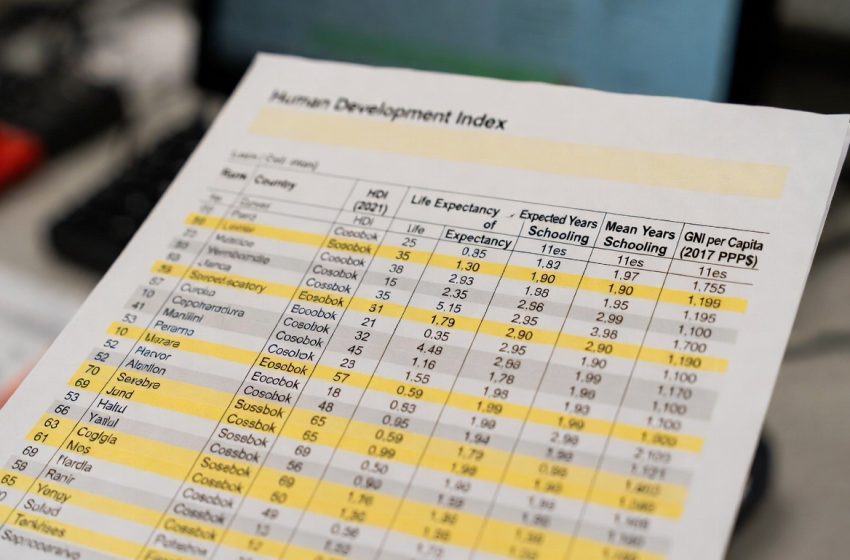
The Human Development Index (HDI) is the most widely used global scorecard for comparing “how well people can live” across countries. Unlike GDP per capita or PPP-income rankings, HDI is a composite: it combines life expectancy (health), years of schooling (education), and gross national income per person (standard of living) into one index between 0 and 1.
This page uses the latest UNDP Human Development Report (HDR 2025) release, with 2023 HDI values and ranks. Where available, the table also shows a simple rank change versus 2022 to highlight who moved up or down in the most recent update.
Top 10 countries by HDI in the latest edition
At the frontier, the ranking is dominated by countries that deliver long lives, maintain high learning outcomes, and sustain high incomes at the same time. In other words: this is not a “richest countries” list—it’s a scoreboard for balanced human development.
Consistently strong outcomes in life expectancy, schooling, and income produce one of the world’s highest composite development scores.
A high-income, high-trust model with strong health outcomes and broad access to education keeps Norway at the very top of HDI.
High productivity and long life expectancy combine with strong education outcomes, placing Switzerland among the global leaders.
High living standards, robust public services, and consistently strong education results lift Denmark’s HDI to the global frontier.
A large advanced economy that pairs high incomes with broad educational attainment and long life expectancy.
High schooling, strong health outcomes, and stable prosperity keep Sweden in the top tier of human development.
High life expectancy and strong education outcomes underpin Australia’s position among the top HDI performers.
Exceptional longevity and strong educational attainment support a very high HDI in one of Asia’s leading hubs.
A long-run leader in education and health with high incomes, maintaining a top-10 place in the composite ranking.
High education and health outcomes, alongside strong income levels, keep Belgium firmly in the very-high HDI group.
Table 1. Top 10 countries by HDI (2023)
| Rank | Country | HDI (index) |
|---|---|---|
| 1 | Iceland | 0.972 |
| 2 | Norway | 0.970 |
| 2 | Switzerland | 0.970 |
| 4 | Denmark | 0.962 |
| 5 | Germany | 0.959 |
| 5 | Sweden | 0.959 |
| 7 | Australia | 0.958 |
| 8 | Hong Kong, China (SAR) | 0.955 |
| 8 | Netherlands | 0.955 |
| 10 | Belgium | 0.951 |
Ranks can repeat when countries have the same HDI value at the reported precision. Full Top 100 appears in Part 2.
Chart 1. HDI values for the Top 20 countries (2023)
Top 20 by HDI (fallback list)
- Iceland0.972
- Norway0.970
- Switzerland0.970
- Denmark0.962
- Germany0.959
- Sweden0.959
- Australia0.958
- Hong Kong, China (SAR)0.955
- Netherlands0.955
- Belgium0.951
- Ireland0.949
- Finland0.948
- Singapore0.946
- United Kingdom0.946
- United Arab Emirates0.940
- Canada0.939
- Liechtenstein0.938
- New Zealand0.938
- United States0.938
- Korea (Republic of)0.938
HDI is shown on a 0–1 scale. The differences near the top are small in absolute terms, so ranking changes can occur with modest shifts in health, schooling, or income.
Methodology (what is being ranked, and what it is not)
The HDI is produced by UNDP as a geometric mean of three normalized dimension indices: (1) health measured by life expectancy at birth, (2) education measured by expected years of schooling (children) and mean years of schooling (adults), and (3) standard of living measured by gross national income (GNI) per capita in PPP terms (with income logged to reflect diminishing returns). Because the index is geometric, weak performance in one dimension is harder to “compensate” with extreme strength in another.
This ranking uses the latest HDR statistical annex (HDR 2025) as the authoritative release for 2023 values. The “Δ rank” column compares the reported 2023 rank to the reported 2022 rank where both are available. Values are shown at the precision provided in the statistical annex.
Key limitations to keep in mind: HDI is a national average and does not show inequality or within-country gaps; it does not capture dimensions such as safety, political freedoms, or environmental sustainability; and some inputs are subject to reporting lags and periodic revisions (including PPP-related income revisions). For distribution-sensitive comparisons, UNDP provides complementary indices such as the IHDI (inequality-adjusted HDI) and the PHDI (planetary pressures–adjusted HDI).
Key insights from the latest HDI league table
- Europe’s institutional advantage still shows up: many top positions combine longevity, educational attainment, and high incomes at once.
- Asia’s leading hubs are present, but the composite matters: strong income alone is not enough—education and health systems are the difference-makers.
- Convergence is visible in Central and Eastern Europe: a growing share of countries sit in the “very high” group, reflecting decades of progress in schooling and life expectancy.
- Resource-rich does not automatically mean top-tier HDI: high income can raise the index, but gaps in education/health (or uneven access) can limit the composite score.
- Small differences can move ranks: at the frontier, HDI values are clustered, so minor revisions or marginal changes can shift placements.
What this means for readers
Use HDI when you need a balanced snapshot—not just a money metric. For relocation or study decisions, it helps you compare “people outcomes” across countries (education and health alongside incomes). For investors and analysts, it is a quick way to understand human-capital environments that often correlate with productivity, institutional capacity, and long-run demand.
If your question is primarily about purchasing power and consumption capacity, a PPP-income ranking is more direct. If your question is about human capability—how long people live, how much they learn, and what living standards support that—HDI is the better starting point.
FAQ: Human Development Index (HDI)
Is HDI the same as “richest countries” or GDP per capita?
No. HDI includes income, but it also requires strong health and education outcomes. A country can be very rich and still rank below the top tier if education or longevity is weaker, or if progress is uneven.
Why can two countries with similar income have very different HDI ranks?
Because the non-income dimensions matter. Differences in life expectancy, schooling years, and education outcomes can shift the composite score even when income is similar.
Why do some ranks repeat?
UNDP reports HDI values at a defined precision. If two countries share the same value at that precision, they can share a rank.
What does “Δ rank” mean in the tables?
It is a simple comparison of the reported 2023 rank to the reported 2022 rank. A positive number means a country moved up the table (better rank); a negative number means it moved down.
Can HDI go down even when GDP grows?
Yes. GDP growth does not guarantee better outcomes in life expectancy or education, and income gains can be uneven. HDI reflects the balance of the three dimensions.
What should I use if I care about inequality or sustainability?
Use UNDP’s complementary indices such as the Inequality-adjusted HDI (IHDI) and the Planetary pressures–adjusted HDI (PHDI), which adjust the headline score for distribution and environmental pressures.
Full ranking: Top 100 countries by HDI (latest UNDP edition)
The table below lists the Top 100 countries by the Human Development Index (HDI) using the latest HDR release (HDI values for 2023). Use the controls to search, filter by region and development group, sort by value or rank change, and switch the value display between the HDI index and % of the 1.000 frontier.
Table 2. Top 100 countries by HDI (2023)
| Rank | Country | Value | Δ rank |
|---|---|---|---|
| 1 | Iceland | 0.972 97.20% | +2 |
| 2 | Norway | 0.970 97.00% | −1 |
| 2 | Switzerland | 0.970 97.00% | 0 |
| 4 | Denmark | 0.962 96.20% | 0 |
| 5 | Germany | 0.959 95.90% | +1 |
| 5 | Sweden | 0.959 95.90% | −1 |
| 7 | Australia | 0.958 95.80% | +1 |
| 8 | Hong Kong, China (SAR) | 0.955 95.50% | +1 |
| 8 | Netherlands | 0.955 95.50% | −1 |
| 10 | Belgium | 0.951 95.10% | +3 |
| 11 | Ireland | 0.949 94.90% | +1 |
| 12 | Finland | 0.948 94.80% | 0 |
| 13 | Singapore | 0.946 94.60% | 0 |
| 13 | United Kingdom | 0.946 94.60% | 0 |
| 15 | United Arab Emirates | 0.940 94.00% | +2 |
| 16 | Canada | 0.939 93.90% | −1 |
| 17 | Liechtenstein | 0.938 93.80% | +1 |
| 17 | New Zealand | 0.938 93.80% | 0 |
| 17 | United States | 0.938 93.80% | −1 |
| 17 | Korea (Republic of) | 0.938 93.80% | +1 |
| 21 | Slovenia | 0.937 93.70% | +1 |
| 22 | Austria | 0.935 93.50% | 0 |
| 23 | Japan | 0.925 92.50% | 0 |
| 24 | Malta | 0.924 92.40% | +2 |
| 25 | Luxembourg | 0.922 92.20% | 0 |
| 26 | France | 0.910 91.00% | 0 |
| 27 | Israel | 0.909 90.90% | 0 |
| 28 | Spain | 0.905 90.50% | −1 |
| 29 | Czechia | 0.900 90.00% | 0 |
| 30 | Italy | 0.899 89.90% | −1 |
| 31 | San Marino | 0.898 89.80% | 0 |
| 32 | Andorra | 0.897 89.70% | 0 |
| 33 | Cyprus | 0.896 89.60% | 0 |
| 34 | Greece | 0.895 89.50% | −1 |
| 35 | Poland | 0.894 89.40% | +1 |
| 35 | Estonia | 0.894 89.40% | +1 |
| 37 | Saudi Arabia | 0.890 89.00% | −1 |
| 38 | Bahrain | 0.889 88.90% | 0 |
| 39 | Lithuania | 0.887 88.70% | 0 |
| 39 | Portugal | 0.887 88.70% | −1 |
| 39 | Croatia | 0.887 88.70% | +1 |
| 39 | Latvia | 0.887 88.70% | 0 |
| 43 | Qatar | 0.886 88.60% | 0 |
| 44 | Slovakia | 0.883 88.30% | +2 |
| 45 | Chile | 0.879 87.90% | +1 |
| 46 | Hungary | 0.876 87.60% | −1 |
| 47 | Argentina | 0.865 86.50% | −1 |
| 48 | Montenegro | 0.862 86.20% | −1 |
| 48 | Uruguay | 0.862 86.20% | −1 |
| 50 | Oman | 0.861 86.10% | −1 |
| 51 | Türkiye | 0.860 86.00% | −1 |
| 52 | Kuwait | 0.859 85.90% | 0 |
| 53 | Antigua and Barbuda | 0.858 85.80% | +2 |
| 54 | Seychelles | 0.857 85.70% | 0 |
| 55 | Bulgaria | 0.845 84.50% | +1 |
| 55 | Romania | 0.845 84.50% | +1 |
| 57 | Georgia | 0.844 84.40% | +1 |
| 57 | Saint Kitts and Nevis | 0.844 84.40% | +2 |
| 59 | Panama | 0.843 84.30% | 0 |
| 59 | Brunei Darussalam | 0.843 84.30% | 0 |
| 60 | Kazakhstan | 0.837 83.70% | 0 |
| 62 | Costa Rica | 0.833 83.30% | 0 |
| 62 | Serbia | 0.833 83.30% | +1 |
| 64 | Russian Federation | 0.832 83.20% | −3 |
| 65 | Belarus | 0.824 82.40% | 0 |
| 66 | Bahamas | 0.820 82.00% | 0 |
| 67 | Malaysia | 0.819 81.90% | +1 |
| 68 | North Macedonia | 0.815 81.50% | −1 |
| 69 | Armenia | 0.811 81.10% | +3 |
| 69 | Barbados | 0.811 81.10% | 0 |
| 71 | Albania | 0.810 81.00% | −1 |
| 71 | Trinidad and Tobago | 0.810 81.00% | −1 |
| 73 | Mauritius | 0.805 80.50% | +1 |
| 74 | Bosnia and Herzegovina | 0.804 80.40% | 0 |
| 75 | Iran (Islamic Republic of) | 0.799 79.90% | +1 |
| 76 | Saint Vincent and the Grenadines | 0.798 79.80% | 0 |
| 76 | Thailand | 0.798 79.80% | 0 |
| 78 | China | 0.797 79.70% | 0 |
| 78 | Peru | 0.797 79.70% | +1 |
| 80 | Grenada | 0.796 79.60% | 0 |
| 81 | Azerbaijan | 0.792 79.20% | 0 |
| 81 | Mexico | 0.792 79.20% | +1 |
| 83 | Colombia | 0.789 78.90% | 0 |
| 84 | Brazil | 0.786 78.60% | 0 |
| 84 | Palau | 0.786 78.60% | 0 |
| 86 | Moldova (Republic of) | 0.784 78.40% | −1 |
| 87 | Ukraine | 0.779 77.90% | 0 |
| 88 | Ecuador | 0.775 77.50% | −1 |
| 89 | Dominican Republic | 0.774 77.40% | +1 |
| 89 | Guyana | 0.774 77.40% | 0 |
| 91 | Sri Lanka | 0.773 77.30% | 0 |
| 92 | Tonga | 0.771 77.10% | +1 |
| 93 | Maldives | 0.770 77.00% | −1 |
| 93 | Viet Nam | 0.770 77.00% | 0 |
| 95 | Turkmenistan | 0.768 76.80% | 0 |
| 96 | Algeria | 0.767 76.70% | +1 |
| 97 | Cuba | 0.764 76.40% | 0 |
| 97 | Dominica | 0.764 76.40% | +1 |
| 99 | Paraguay | 0.763 76.30% | 0 |
| 100 | Egypt | 0.762 76.20% | −1 |
“Δ rank” compares reported 2023 rank to reported 2022 rank. Positive = moved up (better rank). Source: UNDP Human Development Report 2025 statistical annex (HDI table). Values shown as reported.
Figure 2. HDI vs income (GNI per capita, PPP) among the Top 100
HDI is correlated with income, but it is not an income ranking: countries with similar GNI per person can differ in HDI because education attainment and longevity vary. The scatter plot uses GNI per capita from the HDI table (PPP) on the x-axis and HDI on the y-axis.
Sample points (fallback)
| Country | GNI per capita (PPP) | HDI |
|---|---|---|
| Iceland | 69.1k | 0.972 |
| Norway | 112.7k | 0.970 |
| Switzerland | 81.9k | 0.970 |
| Denmark | 76.0k | 0.962 |
| Germany | 64.1k | 0.959 |
| Sweden | 66.1k | 0.959 |
| Australia | 58.3k | 0.958 |
| Hong Kong, China (SAR) | 69.4k | 0.955 |
| Netherlands | 68.3k | 0.955 |
| Belgium | 63.6k | 0.951 |
X-axis is GNI per capita in thousands of 2021 PPP dollars; Y-axis is HDI (0–1). This is an illustrative “level vs outcome” view, not a causal model.
How to interpret the HDI ranking without confusing it with “wealth rankings”
The HDI ranking is best read as a three-dimensional scoreboard. Income matters, but it is only one leg of the stool. Countries rise to the top when they achieve a long, healthy life, build a strong education base, and sustain a decent standard of living at the same time.
This is why HDI is a useful “anti-cannibalization” companion to GDP-per-capita pages: two countries can look similar in PPP income, yet differ in HDI because one delivers longer lives and more schooling. Conversely, a country can rank very high in HDI without being the absolute top in PPP income if it performs exceptionally in health and education.
Reading guide: what to look at first
Step 1: Start with the HDI value (0–1). In the top tier, even a 0.01 difference is meaningful because scores are clustered.
- Step 2: Check whether the country’s position is driven mainly by income or by health/education strength.
- Step 3: Use “Δ rank” as a direction signal, not a verdict—small updates can move ranks near the frontier.
- Step 4: If you care about distribution, look at complementary indices (IHDI, GDI, GII, MPI, PHDI).
A frequent misread is to treat HDI as “proof” of one policy model. The index is descriptive, not prescriptive: it tells you where outcomes are strong and where they lag, but it does not identify which reforms caused the change. Treat it as a starting point for deeper country analysis.
Policy takeaways (why the composite structure matters)
- Health and education are growth infrastructure: they raise productivity and make income gains more durable.
- Income can lift HDI, but only to a point: with logged income and geometric averaging, progress requires balanced gains.
- Near the top, marginal improvements are hard: frontier countries compete on longevity, quality of schooling, and inclusion.
- For “high” HDI countries, the next step is resilience: reducing internal disparities and protecting progress during shocks.
- For “medium/low” HDI countries outside the Top 100: the priority is foundational health access and schooling completion, alongside basic income growth.
If you are using HDI for investment or relocation screening, a robust workflow is to pair HDI with indicators for safety, governance, labour markets, and cost of living. HDI tells you about the capabilities baseline; it does not fully describe day-to-day conditions.
Official sources and downloads
These are the primary sources for the data used in this page (latest UNDP release). For any formal work, rely on the originals and their technical notes.
-
UNDP Human Development Data Center — Human Development Index (HDI)https://hdr.undp.org/data-center/human-development-index
-
Human Development Report 2025 — report pagehttps://hdr.undp.org/content/human-development-report-2025
-
HDR 2025 Statistical Annex — Table 1 (HDI and components), XLSXhttps://hdr.undp.org/sites/default/files/2025_HDR/HDR25_Statistical_Annex_HDI_Table.xlsx
-
HDR 2025 Statistical Annex — Table 1 (PDF)https://hdr.undp.org/sites/default/files/2025_HDR/HDR25_Statistical_Annex_HDI_Table.pdf
-
Documentation & downloads (all HDR tables, metadata, and technical notes)https://hdr.undp.org/data-center/documentation-and-downloads