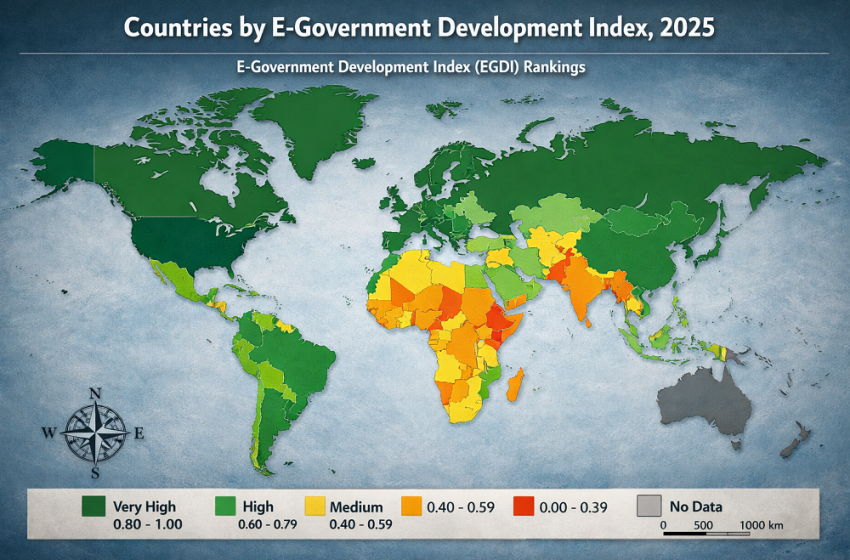
Top 100 Countries by E-Government Development Index, 2025
What the latest United Nations EGDI ranking says about digital-state maturity in 2025
The E-Government Development Index is one of the few global rankings that tries to measure the state itself as a digital service platform. It does not reward good marketing pages or isolated apps. It reflects the harder combination of usable online services, supportive telecom infrastructure, and the human-capital base needed to make digital government work at national scale.
For a 2025 ranking page, the latest complete official benchmark is the 2024 United Nations E-Government Survey. That is why this block uses the 2024 release as the working 2025 snapshot. The global average EGDI reached 0.6382, up from 0.6102 in 2022, while 76 countries entered the very high tier.
Top 10 countries at the digital-government frontier
The pattern at the top of the ranking is not random. It reflects a repeatable formula: strong service design, trusted digital identity, interoperable registries, and consistent investment in infrastructure and skills. Europe dominates the upper tier, Asia supplies major frontrunners, and the Gulf shows that rapid state-led acceleration is possible when digital delivery becomes a strategic priority rather than a side project.
Denmark remains the reference case for integrated public-service delivery: a mature digital identity ecosystem, routine online transactions, and strong institutional continuity. The key lesson is not speed alone, but consistency across welfare, tax, and business services.
Estonia still stands out for registry interoperability and the practical “once-only” logic that reduces repeat paperwork. Its strength is that digital government is not bolted on top of the state; it is built into how the state operates.
Singapore pairs high administrative capacity with disciplined service architecture. Citizens and firms face a low-friction state because identity, payments, notifications and portal access work as one system instead of separate digital islands.
South Korea has been a long-term benchmark for online service completeness. Its score reflects both deep transaction coverage and a society already comfortable with high-frequency digital interaction between citizens, firms and the state.
Iceland shows that a smaller country can still operate near the global frontier when digital trust is high and public systems are well coordinated. Its placement also highlights the role of inclusion, not only raw portal availability.
Saudi Arabia is the strongest signal that fast upward movement is possible at scale. The ranking shows what happens when public-sector digitization, service bundling and execution capacity are treated as national strategy rather than isolated reforms.
The United Kingdom remains a strong performer because it has built transactional depth over time. Its ranking is less about flashy interfaces and more about the routine reliability of high-demand government workflows.
Australia anchors Oceania at the global frontier. Its placement reflects the value of sustained federal digital-service investment, especially where large geography and dispersed users make strong remote access essential rather than optional.
Finland’s score reflects a balanced model: strong infrastructure, high trust, capable institutions and broad digital literacy. It is a reminder that durable digital government depends on social capacity as much as software.
The Netherlands closes the top 10 with a system built on strong administrative coordination and high user adoption. Its ranking reflects an environment where digital public services are expected to be routine, not experimental.
Top 10 table
| Rank | Country | EGDI 2024 |
|---|---|---|
| 1 | Denmark | 0.98474 |
| 2 | Estonia | 0.97274 |
| 3 | Singapore | 0.96912 |
| 4 | South Korea | 0.96789 |
| 5 | Iceland | 0.96707 |
| 6 | Saudi Arabia | 0.96022 |
| 7 | United Kingdom | 0.95773 |
| 8 | Australia | 0.95770 |
| 9 | Finland | 0.95746 |
| 10 | Netherlands | 0.95384 |
Top 20 bar chart
The top 20 chart shows how compressed the frontier has become. Denmark leads, but many countries within the first twenty sit in a narrow band above 0.91. In other words, the top of the table is increasingly a race about service depth, inclusion and execution quality rather than basic digitization.
Source basis: UN DESA E-Government Survey 2024, plotted here as the working 2025 benchmark.
Methodology
This page uses the 2024 United Nations E-Government Survey as the reference point for a 2025 ranking page because that is the latest complete official UN survey cycle available. EGDI is a composite index built from three equally weighted pillars: the Online Service Index, the Telecommunications Infrastructure Index and the Human Capital Index. The ranking therefore captures much more than a country’s main government portal. It combines what citizens can do online, the connectivity environment that supports those services, and the educational base required for effective use.
Scores in this article are taken from the machine-readable UN-linked dataset mirrored by the World Bank Data360 platform and ranked strictly by the official 2024 EGDI value. The “change” references used later compare 2024 with the previous full UN cycle in 2022. Group labels follow the UN thresholds: very high (0.75–1.00), high (0.50–0.75), middle (0.25–0.50) and low (0.00–0.25).
The main limitation is interpretive rather than statistical. EGDI is excellent for comparing national digital-government readiness and maturity, but it is not a full audit of everyday user experience. A country can score well while still having friction in specific services, regional gaps in access, or weaker outcomes for vulnerable groups. It is also not a democracy index, a cybersecurity rating, or a measure of how fast every single agency processes requests.
Insights and takeaways from the 2025 snapshot
The first clear pattern is the depth of Europe’s bench. Europe does not just produce the number-one country; it places a large share of countries across the top tiers. That matters because it points to institutional diffusion. Digital identity, interoperable registries, trusted public data flows and online service standardization are no longer niche advantages inside the region; they are becoming baseline expectations.
The second pattern is the rise of strategic accelerators in MENA. Saudi Arabia, Bahrain and the United Arab Emirates show that strong state direction, budget support and execution discipline can push countries sharply upward in a short period. These cases are important because they widen the global map of digital-state leadership beyond the older OECD-heavy narrative.
The third pattern is Asia’s dual story. At the top, Singapore and South Korea remain world-class. Below them, countries such as China, the Philippines, India, Bangladesh and Vietnam show how large systems can continue improving even when scale, uneven capacity and legacy administration make reform harder. That is why the most interesting part of the ranking is often not the podium, but the group of countries moving from “good portals” to genuinely integrated digital government.
The fourth pattern is the continuing global inclusion gap. The world average improved, and the share of people living in countries below the global average fell sharply, yet the gap is still real. Africa’s leading cases remain exceptions rather than the norm, while small states and lower-capacity systems still face infrastructure, skills and financing bottlenecks. The ranking is therefore a progress story, but not a convergence story finished.
What this means for readers
For ordinary readers, a high EGDI usually means less time lost to paperwork, more reliable remote access to public services, and a better chance that identity, tax, health, licensing or business workflows can be completed online. In practical terms, it is a proxy for administrative convenience.
For people considering relocation, study, or cross-border business, the ranking helps answer a very practical question: how much friction does the state add to daily life? A country near the top is more likely to support digital onboarding, predictable portals, faster document handling and smoother interactions with agencies.
For B2B readers, EGDI is not a direct market-size indicator, but it is a useful signal of state execution capacity. Vendors, consultants and investors can use it as a first-pass screen for where digital public infrastructure, service integration, cloud migration, digital ID, regtech and workflow automation are more likely to find a capable public-sector counterpart.
FAQ
What does EGDI actually measure?
It measures digital-government development at the national level through a composite of online services, telecom infrastructure and human capital. It is broader than a portal review and narrower than a full governance audit.
Why is this called a 2025 ranking if the data release is 2024?
Because the UN survey is not published every year. For a 2025 page, the 2024 release is the latest complete official benchmark and therefore the correct working reference.
Why is Denmark first?
Because high-ranking digital states combine usable services with trusted identity systems, infrastructure, citizen adoption and long-run administrative continuity. Denmark scores strongly across the full stack rather than in only one visible layer.
Does a high EGDI mean people never have problems with bureaucracy?
No. A high score means the national digital-government architecture is strong. It does not guarantee that every agency, municipality or user journey is frictionless in every case.
Is EGDI the same as cybersecurity quality?
No. Secure systems matter, but EGDI is not a dedicated cyber-resilience index. It tells you more about digital-government readiness and service maturity than about breach exposure or incident response.
Why did some Gulf countries move up so quickly?
Because large-scale digitization can move fast when political priority, funding, institutional coordination and service bundling align. The ranking suggests that execution discipline can materially compress catch-up time.
Why should businesses care about this ranking?
Because digital government affects onboarding, licensing, tax workflows, procurement, compliance and cross-border paperwork. High-EGDI countries tend to reduce state friction, which matters for both cost and speed.
The full Top 100: where the digital-state frontier ends and the next tier begins
The Top 100 cut-off for this page is 0.65696, which means the table captures all 76 countries in the United Nations very high EGDI tier and the first 24 countries in the high tier. That makes this list useful for two audiences at once: readers looking for the global leaders and analysts looking for relevant near-frontier countries that are still climbing.
Unlike output or trade rankings, EGDI is an index rather than a total. That is why this table focuses on score level and change versus 2022 instead of any artificial “share of global” view.
Showing 20 countries.
Top 100 countries by E-Government Development Index
| Rank | Country | EGDI 2024 | Change vs 2022 |
|---|---|---|---|
| 1 | Denmark | 0.9847498.47/100 | +0.01304 |
| 2 | Estonia | 0.9727497.27/100 | +0.03344 |
| 3 | Singapore | 0.9691296.91/100 | +0.05582 |
| 4 | South Korea | 0.9678996.79/100 | +0.01499 |
| 5 | Iceland | 0.9670796.71/100 | +0.02607 |
| 6 | Saudi Arabia | 0.9602296.02/100 | +0.10632 |
| 7 | United Kingdom | 0.9577395.77/100 | +0.04393 |
| 8 | Australia | 0.9577095.77/100 | +0.01720 |
| 9 | Finland | 0.9574695.75/100 | +0.00416 |
| 10 | Netherlands | 0.9538495.38/100 | +0.01544 |
| 11 | United Arab Emirates | 0.9532895.33/100 | +0.05228 |
| 12 | Germany | 0.9382193.82/100 | +0.06121 |
| 13 | Japan | 0.9351093.51/100 | +0.03490 |
| 14 | Sweden | 0.9326293.26/100 | −0.00838 |
| 15 | Norway | 0.9315393.15/100 | +0.04363 |
| 16 | New Zealand | 0.9265492.65/100 | −0.01666 |
| 17 | Spain | 0.9206092.06/100 | +0.03640 |
| 18 | Bahrain | 0.9195891.96/100 | +0.14888 |
| 19 | United States | 0.9194591.94/100 | +0.00435 |
| 20 | Ireland | 0.9137791.38/100 | +0.05707 |
| 21 | Lithuania | 0.9110491.10/100 | +0.03654 |
| 22 | Austria | 0.9065390.65/100 | +0.02643 |
| 23 | Israel | 0.9014390.14/100 | +0.01293 |
| 24 | Kazakhstan | 0.9009390.09/100 | +0.03813 |
| 25 | Uruguay | 0.9005990.06/100 | +0.06179 |
| 26 | Switzerland | 0.9003590.03/100 | +0.02515 |
| 27 | Turkey | 0.8913189.13/100 | +0.09301 |
| 28 | Malta | 0.8886088.86/100 | −0.00570 |
| 29 | Latvia | 0.8852288.52/100 | +0.02532 |
| 30 | Ukraine | 0.8840788.41/100 | +0.08117 |
| 31 | Chile | 0.8826688.27/100 | +0.04496 |
| 32 | Croatia | 0.8817588.17/100 | +0.07115 |
| 33 | Slovenia | 0.8758987.59/100 | −0.00221 |
| 34 | France | 0.8744287.44/100 | −0.00878 |
| 35 | China | 0.8718487.18/100 | +0.05994 |
| 36 | Greece | 0.8673786.74/100 | +0.02187 |
| 37 | Poland | 0.8648086.48/100 | +0.02110 |
| 38 | Cyprus | 0.8618786.19/100 | −0.00413 |
| 39 | Serbia | 0.8618486.18/100 | +0.03814 |
| 40 | South Africa | 0.8616286.16/100 | +0.12592 |
| 41 | Oman | 0.8575985.76/100 | +0.07419 |
| 42 | Argentina | 0.8573385.73/100 | +0.03753 |
| 43 | Russia | 0.8532585.32/100 | +0.03705 |
| 44 | Liechtenstein | 0.8528485.28/100 | −0.01566 |
| 45 | Luxembourg | 0.8465884.66/100 | −0.02092 |
| 46 | Mongolia | 0.8456984.57/100 | +0.12479 |
| 47 | Canada | 0.8451684.52/100 | −0.00594 |
| 48 | Armenia | 0.8421784.22/100 | +0.10577 |
| 49 | Portugal | 0.8415384.15/100 | +0.01423 |
| 50 | Brazil | 0.8402684.03/100 | +0.04926 |
| 51 | Italy | 0.8355783.56/100 | −0.00193 |
| 52 | Thailand | 0.8351083.51/100 | +0.06910 |
| 53 | Qatar | 0.8243882.44/100 | +0.10948 |
| 54 | Czech Republic | 0.8239482.39/100 | +0.01514 |
| 55 | Bulgaria | 0.8145381.45/100 | +0.03793 |
| 56 | Belgium | 0.8121281.21/100 | −0.01478 |
| 57 | Malaysia | 0.8111481.11/100 | +0.03714 |
| 58 | Peru | 0.8070080.70/100 | +0.05460 |
| 59 | Hungary | 0.8043080.43/100 | +0.02160 |
| 60 | Slovakia | 0.8021480.21/100 | +0.00134 |
| 61 | Costa Rica | 0.8008980.09/100 | +0.03499 |
| 62 | Albania | 0.8000080.00/100 | +0.05870 |
| 63 | Uzbekistan | 0.7999079.99/100 | +0.07340 |
| 64 | Indonesia | 0.7991179.91/100 | +0.08311 |
| 65 | Mexico | 0.7849978.50/100 | +0.03769 |
| 66 | Kuwait | 0.7812078.12/100 | +0.03280 |
| 67 | Ecuador | 0.7799778.00/100 | +0.09107 |
| 68 | Colombia | 0.7793077.93/100 | +0.05320 |
| 69 | Georgia | 0.7792377.92/100 | +0.02913 |
| 70 | Moldova | 0.7719577.20/100 | +0.04685 |
| 71 | Vietnam | 0.7709277.09/100 | +0.09222 |
| 72 | Romania | 0.7636476.36/100 | +0.00174 |
| 73 | Philippines | 0.7621276.21/100 | +0.10982 |
| 74 | Azerbaijan | 0.7607376.07/100 | +0.06703 |
| 75 | Brunei | 0.7553675.54/100 | +0.02836 |
| 76 | Mauritius | 0.7506175.06/100 | +0.03051 |
| 77 | Belarus | 0.7444974.45/100 | −0.01351 |
| 78 | Kyrgyzstan | 0.7316073.16/100 | +0.03390 |
| 79 | Panama | 0.7298172.98/100 | +0.03421 |
| 80 | Paraguay | 0.7250772.51/100 | +0.09187 |
| 81 | Montenegro | 0.7211172.11/100 | −0.00489 |
| 82 | Monaco | 0.7174771.75/100 | −0.00533 |
| 83 | The Bahamas | 0.7143471.43/100 | −0.01336 |
| 84 | North Macedonia | 0.7070470.70/100 | +0.00704 |
| 85 | Dominican Republic | 0.7012770.13/100 | +0.05837 |
| 86 | Trinidad and Tobago | 0.6972669.73/100 | +0.06336 |
| 87 | Tunisia | 0.6934869.35/100 | +0.04048 |
| 88 | Andorra | 0.6893168.93/100 | −0.02839 |
| 89 | Jordan | 0.6849368.49/100 | +0.07683 |
| 90 | Morocco | 0.6841168.41/100 | +0.09261 |
| 91 | Barbados | 0.6815068.15/100 | −0.03020 |
| 92 | Seychelles | 0.6773367.73/100 | −0.00197 |
| 93 | Fiji | 0.6754467.54/100 | +0.05194 |
| 94 | Maldives | 0.6745367.45/100 | +0.08603 |
| 95 | Egypt | 0.6699466.99/100 | +0.08044 |
| 96 | Jamaica | 0.6677766.78/100 | +0.07717 |
| 97 | India | 0.6677666.78/100 | +0.07946 |
| 98 | Sri Lanka | 0.6666866.67/100 | +0.03818 |
| 99 | Bolivia | 0.6650866.51/100 | +0.04858 |
| 100 | Bangladesh | 0.6569665.70/100 | +0.09396 |
Source: UN DESA E-Government Survey 2024 / World Bank Data360 mirror. Update basis: latest full UN release, used as the working benchmark for a 2025 ranking page.
Score level versus two-year change
This scatter chart helps separate two different stories. Countries on the far right are already operating near the digital-government frontier. Countries higher on the vertical axis are the ones that improved fastest between the 2022 and 2024 UN survey cycles. Bahrain, Saudi Arabia, South Africa, the Philippines and Bangladesh stand out as strong movers, while Denmark, Estonia and Singapore show what near-ceiling performance looks like.
Horizontal axis: EGDI 2024. Vertical axis: change from 2022 to 2024. Values use the official UN survey cycle, not annual interpolation.
How to interpret this ranking without overreading it
High EGDI countries are usually the places where the state behaves more like a coherent digital platform and less like a collection of disconnected offices. That matters, but the ranking should not be read as a moral scoreboard. A country can be digitally capable and still have weak outcomes in areas such as trust, political accountability, affordability, or inclusion for harder-to-serve populations. EGDI is best used as a serious signal of state digitization capacity, not as a one-number answer to every governance question.
The most useful reading of the table is comparative. If two countries have similar income levels but one has a much stronger EGDI score, the gap often points to differences in administrative execution, interoperability, digital identity adoption, procurement discipline or public-sector reform sequencing. For policymakers, that makes EGDI a diagnostic tool. For firms and institutions, it makes EGDI a practical proxy for how much transaction friction the public sector is likely to add.
Policy takeaways
- Digital identity and trust infrastructure remain the backbone of high-performing systems. Without secure identification and reliable data exchange, service digitization stays shallow.
- Service depth matters more than homepage polish. Countries rise when tax, licensing, health, benefits, procurement and business workflows actually become transactional online services.
- Fast climbers usually combine political priority with administrative follow-through. The strongest movers are rarely the countries with the best slogans; they are the ones that keep redesigning workflows and integrating back-end systems.
- Infrastructure and skills still constrain convergence. Countries with weaker broadband, device access, public IT capacity or digital literacy can improve, but they face slower and more uneven gains.
- Inclusion remains the unfinished part of the story. A state can move services online and still leave behind rural users, older citizens, low-income households or people who need assisted digital access.
One reason the ranking is useful for 2025 is that it captures the state of systems after a period in which many governments moved from emergency digitization to structural digitization. The frontier is no longer defined by simply having e-services. It is defined by whether services are integrated, trusted, routinely used, and institutionally durable.
What separates leaders from the rest
The leaders do not simply publish more forms online. They reduce the number of steps, cut duplication, connect registries, standardize authentication, and treat the user journey as a system-design problem. That is why the same countries tend to appear repeatedly near the top across survey cycles: they built operating models, not one-off projects.
Countries just outside the top tier often have respectable online-service coverage but weaker integration or less even national capacity. Their opportunity is real. The jump from “good digital government” to “frontier digital government” usually comes from fewer but deeper reforms: common identity, data-sharing rules, service design standards, cloud modernization, stronger agency coordination and better assisted-access models.
For commercial readers, the practical implication is straightforward. High-EGDI environments are more likely to support digital onboarding, electronic documentation, online payments, interoperable records and predictable administrative touchpoints. That does not remove regulatory complexity, but it often reduces avoidable operational friction.
Official sources
These are the core primary or institutional sources behind the article and the ranking logic.
The main report and methodological anchor for the latest full UN survey cycle, including the official EGDI framework, regional analysis and country benchmarking.
https://desapublications.un.org/publications/un-e-government-survey-2024
The full publication in PDF form, useful for methodology, regional discussion and interpretation beyond the raw table.
The official UN country database for ranks, scores, group labels and country information pages. The public interface may occasionally be under maintenance, but it remains one of the main source systems behind the ranking.
https://publicadministration.un.org/egovkb/en-us/data-center
The machine-readable dataset used here to rank countries and build the table. It mirrors UN DESA data in a structured format suitable for reproducible analysis.
https://data360.worldbank.org/en/dataset/UN_EGDI
The downloadable country-by-year CSV used for the Top 100 table and the 2022-to-2024 change calculations.
https://data360files.worldbank.org/data360-data/data/UN_EGDI/UN_EGDI_EGDI_WIDEF.csv
An official companion dataset for readers who want to inspect one of the three pillars behind the headline EGDI score.
https://data360files.worldbank.org/data360-data/data/UN_EGDI/UN_EGDI_OSI_WIDEF.csv