

Top 10 Countries by International Tourist Arrivals: 2026 Snapshot Based on World Bank 2020 Data
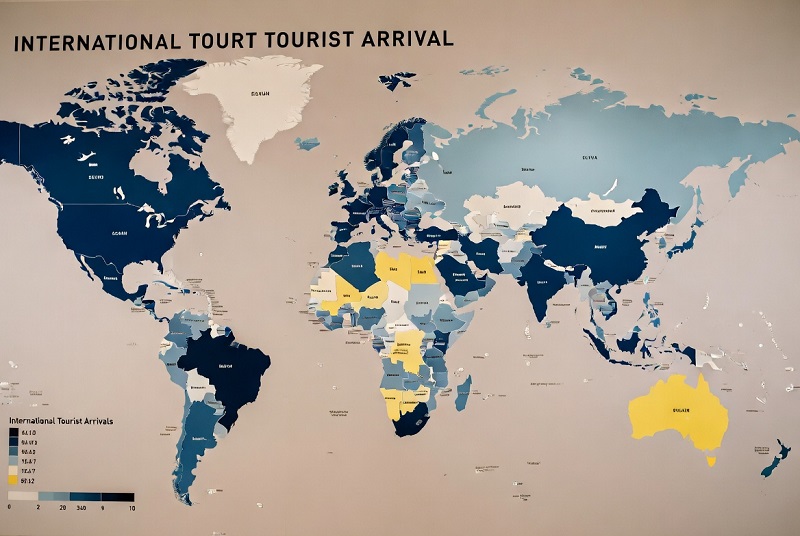
World Bank International Arrivals in 2020: What the Figures Measure
France leads the World Bank's 2020 ST.INT.ARVL series with 117,109,000 reported international arrivals, followed by Mexico (51,128,000) and the United States (45,037,000). These are arrival events, not a harmonized count of overnight tourists; the series can include same-day visitors.
The metric is international tourism, number of arrivals, measured in counts for calendar year 2020 and ranked from highest to lowest. This historical 2026 snapshot covers ten confirmed countries, not projected 2026 visits. Data status: 10 official_value, 0 calculated_value, 0 official_forecast, 0 modeled_projection and 0 industry_observed_value.
The table is a compiled research dataset based on 7 sources, with row-level source and method notes shown in the ranking table. World Bank WDI supplies every numeric ranking value; six other official references document definitions, country differences, regional labels and the exceptional 2020 context.
World Bank 2020 arrivals; includes same-day visitors in the corresponding OECD breakdown.
Tenth-ranked observation, not the global minimum.
2020 values only · arrival events · higher values rank higher.
10 published official values; zero calculated results, forecasts, modeled projections or industry observations.
Overview: Total visitors and overnight tourists are different
World Bank metadata allows a broader visitor count when tourist-only data are unavailable. For example, OECD reports 41.684 million overnight tourists and 75.424 million same-day visitors for France in 2020, alongside its 117.109 million total-arrivals figure. The ranking below preserves the published WDI series without treating these categories as interchangeable.
Top 10 Countries by Reported International Arrivals, 2020
These are the ten highest non-missing 2020 country values in the World Bank ST.INT.ARVL series after excluding regional aggregates and non-sovereign territorial entries. Each row uses the same year and unit. The notes identify the source and any material interpretation limit.
Showing 10 of 10 confirmed countries.
Main ranking — World Bank WDI ST.INT.ARVL · 2020 · arrival events · descending original rank
| Rank | Country | Arrivals | Source / Method Note |
|---|---|---|---|
| 1 | France | 117,109,000 | Europe & Central Asia · WDI / UN Tourism, 2020 · official_value. Total arrivals include same-day visitors; OECD reports 41.684M overnight tourists. |
| 2 | Mexico | 51,128,000 | Latin America & Caribbean · WDI / UN Tourism, 2020 · official_value. Total includes same-day visitors; OECD reports 24.284M overnight tourists. |
| 3 | United States | 45,037,000 | North America · WDI / UN Tourism, 2020 · official_value. Published arrival count; national reporting practices limit direct comparison. |
| 4 | Italy | 38,419,000 | Europe & Central Asia · WDI / UN Tourism, 2020 · official_value. Published arrivals, not necessarily a harmonized overnight-only measure. |
| 5 | Spain | 36,410,000 | Europe & Central Asia · WDI / UN Tourism, 2020 · official_value. OECD separates 18.933M overnight and 17.477M same-day visitors. |
| 6 | Hungary | 31,641,000 | Europe & Central Asia · WDI / UN Tourism, 2020 · official_value. No national-definition adjustment. |
| 7 | China | 30,402,000 | East Asia & Pacific · WDI / UN Tourism, 2020 · official_value. No national-definition adjustment. |
| 8 | Croatia | 21,608,000 | Europe & Central Asia · WDI / UN Tourism, 2020 · official_value. No national-definition adjustment. |
| 9 | Türkiye | 15,971,000 | Europe & Central Asia · WDI / UN Tourism, 2020 · official_value. No national-definition adjustment. |
| 10 | Denmark | 15,595,000 | Europe & Central Asia · WDI / UN Tourism, 2020 · official_value. Lowest value within this confirmed Top 10, not globally. |
No countries match the current filters. Clear the search or choose another region.
Compiled research dataset based on seven sources; all ten raw numeric values and 2020 observation years originate in World Bank WDI. No older-year substitutes, forecasts, modeled projections or source averaging. Original ranks remain fixed if the display order changes.
Chart: Reported International Arrivals, Top 10
The bars reproduce the ten raw ranking values. France's value sets the 100% reference scale; labels display arrivals in millions.
Chart calculations are display conversions, not new tourist-arrivals observations: millions = published count / 1,000,000; bar width = country count / 117,109,000 × 100, rounded to two decimal places. National reporting definitions may differ.
Methodology: Ranking Rules and Statistical Limits
Source and status
World Bank WDI ST.INT.ARVL, sourced to UN Tourism. All ranking rows are directly published official_value observations for 2020, not calculated estimates or forecasts.
Coverage and ordering
Countries with a non-missing 2020 observation are eligible. Regional aggregates and non-sovereign territories are excluded. The ten largest raw values are ranked descending; no 2019 values fill gaps.
Conflicts and adjustments
The same WDI indicator supplies every rank. OECD is used only to interpret visitor categories; differences between measures are not averaged or merged. No modeling assumptions are applied.
Units and limitations
Reported arrival events, not distinct people, tourism receipts, hotel nights, spending per trip or current tourism demand. Counts may depend on border, survey or accommodation reporting practices.
2020 Comparison: Total Arrivals Versus Overnight Tourists
OECD country profiles distinguish total international arrivals, overnight visitors and same-day visitors. The following figures are published 2020 observations shown in millions; they explain the WDI totals but do not replace their ranking values.
Official observed 2020 figures, million arrival events — OECD Tourism Trends and Policies 2022
| Country | WDI total | OECD overnight | OECD same-day | Method Note |
|---|---|---|---|---|
| France | 117.109M | 41.684M | 75.424M | World Bank and OECD, 2020; source data presented in thousands, here shown in millions. |
| Mexico | 51.128M | 24.284M | 26.845M | World Bank and OECD, 2020; source data presented in thousands, here shown in millions. |
| Spain | 36.410M | 18.933M | 17.477M | World Bank and OECD, 2020; source data presented in thousands, here shown in millions. |
For France and Mexico, the separately published overnight and same-day categories differ from the published overall total by 0.001 million (1,000 arrivals), consistent with values being independently displayed in thousands. These are source display differences, not adjustments to WDI.
World Bank metadata notes that when overnight-tourist figures are unavailable, the visitor count can include same-day travelers, cruise passengers and crew. Its national collection methods also vary. A separate overnight-only ranking would require a consistently defined country dataset and fresh ranking calculations.
UN Tourism's January 2022 assessment estimated that global international overnight-tourist arrivals fell by approximately 73% in 2020 relative to 2019. That historical finding gives context to an exceptional year; it is not used to calculate or modify these country values.
Insights From the 2020 Reported Arrivals
Key insight: France leads the reported series
At 117.109M, France's WDI total is about 2.29 times Mexico's 51.128M. This compares published counts, not identical overnight-tourist definitions.
Notable pattern: Four countries in a narrow band
Italy, Spain, Hungary and China range from 30.402M to 38.419M arrivals, occupying ranks four through seven.
Regional concentration: Seven European-region entries
Seven countries are in the World Bank's Europe & Central Asia region; Mexico, the United States and China are the other three.
Outlier: Hungary ranks above China
Hungary reports 31.641M versus China's 30.402M in this WDI series. The figures alone do not establish causes or relative tourist spending.
How to Interpret This Historical Ranking
This table is useful for identifying the largest published 2020 WDI arrivals counts among eligible countries. It does not establish which countries attracted the most unique overnight tourists under a single common definition, nor which earned the most tourism revenue. One traveler can generate multiple arrival events.
All ranked observations are official published 2020 values, not 2026 forecasts. For current tourism performance or an overnight-tourist-only comparison, a more recent, consistently defined series is needed. Differences in national reporting and the pandemic's exceptional effect on 2020 travel make unqualified cross-country claims risky.
Frequently Asked Questions
Which country leads the World Bank 2020 international arrivals ranking?
France is first with 117,109,000 reported arrivals in WDI ST.INT.ARVL. This includes a broader visitor count rather than only tourists who stayed overnight.
Are these actual 2026 tourism figures?
No. The data are observed 2020 values; 2026 is the publication snapshot. No 2026 projection appears in the ranking.
Are the ten figures directly published official values?
Yes. Every ranked number is an official_value published in World Bank WDI for 2020. OECD figures appear only in the separate definition comparison; there are no calculated or forecast ranking entries.
Why is France's total higher than its overnight-tourist count?
OECD reports 117.109M total international arrivals, including 41.684M overnight tourists and 75.424M same-day visitors in France in 2020. The total should not be described as 117.109M overnight tourists.
Why are some major destinations absent from the Top 10?
This ranking requires a published observation specifically for 2020 and excludes regional aggregates and non-sovereign territories. Older 2019 counts are not substituted for missing 2020 values.
Do arrival figures represent individual visitors or tourism income?
Neither. Repeated trips can produce multiple arrivals by the same individual, while tourism receipts are a different indicator of spending by international visitors.
Sources
Seven sources support this compiled research dataset. Only World Bank WDI ST.INT.ARVL provides the ten ranking values. OECD, World Bank documentation and UN Tourism provide methodological and historical context.
1. World Bank — International Tourism, Number of Arrivals
Primary numeric source: WDI ST.INT.ARVL, 2020 country counts, sourced to UN Tourism. Purpose: all ten ranking rows.
2. World Bank DataBank — Indicator Metadata
Purpose: reporting definitions, visitor types, source years and warnings about national comparability.
https://databank.worldbank.org/metadataglossary/world-development-indicators/series/ST.INT.ARVL
3. OECD Tourism Trends and Policies 2022 — France
Purpose: France's 2020 total, overnight-tourist and same-day-visitor breakdown.
4. OECD Tourism Trends and Policies 2022 — Mexico
Purpose: Mexico's 2020 total, overnight-tourist and same-day-visitor breakdown.
5. OECD Tourism Trends and Policies 2022 — Spain
Purpose: Spain's 2020 total, overnight-tourist and same-day-visitor breakdown.
6. World Bank — Country and Lending Groups
Purpose: region labels used in the ranking and filter. Regional categories do not influence ranks.
7. UN Tourism — Tourism Grows 4% in 2021
Purpose: January 2022 historical assessment of the decline in global international tourism during 2020; not a ranking-value source.
https://www.untourism.int/news/tourism-grows-4-in-2021-but-remains-far-below-pre-pandemic-levels
Related research, different metric: International Tourism Receipts by Country ranks international tourism revenue rather than arrival events.
Observed year: 2020. Research snapshot: October 22, 2026. All source URLs are provided here for verification.
Download the Top 10 Countries by International Tourist Arrivals: 2026 Snapshot Based on World Bank 2020 Data dataset
Top 10 Countries by International Tourist Arrivals: 2026 Snapshot Based on World Bank 2020 Data
10 ranked entries · Excel + CSV + methodology + sources + chart · Snapshot: 2020 · Version 1.0
The archive includes machine-readable data, methodology and source documentation. Quick human verification is required before the ZIP is delivered. Full Data Pack downloads require a free account. Free accounts can download 1 different Data Pack every 30 days; re-downloading the same pack does not use another slot. Annual Data Access provides unlimited manual downloads while annual access is active.
Download Excel + CSV Data Pack