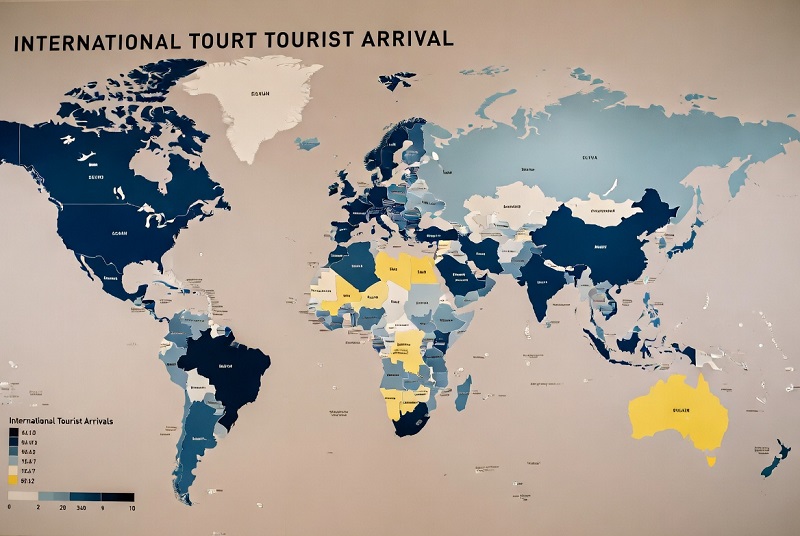
Top 100 Countries by International Tourist Arrivals, 2025
Why international tourist arrivals still matter
International tourist arrivals are one of the clearest scale indicators in travel data. They show which destination systems process the largest number of inbound overnight trips, not which places earn the most per visitor and not which countries offer the best travel experience. For a 2025 article, that distinction matters. UN Tourism reports that global international tourist arrivals reached about 1.52 billion in 2025, up 4% from 2024 and above pre-pandemic levels, but the full comparable cross-country ranking available in the referenced World Bank WDI series is still anchored to an earlier benchmark year. This article therefore uses the latest broad country ranking view that can be reconstructed consistently across many countries and economies, while also explaining the 2025 recovery context.
The result is useful for search intent and for analysis, but it should be read carefully: arrivals count trips, not unique people, and the World Bank metadata notes that national measurement methods differ across countries.
Top 10 snapshot
France dominates the comparable ranking because it combines huge leisure demand, dense European short-haul flows, repeat city breaks, mature rail and air access, and a deep tourism product mix that works across seasons.
Mexico shows how powerful proximity can be. Large U.S. source-market demand, land-border traffic, resort corridors, and short-haul air connectivity keep arrivals extremely high even when long-haul travel is uneven.
The United States remains one of the world’s biggest inbound travel systems because it combines business travel, visiting friends and relatives, major gateway cities, leisure flows, and broad regional and intercontinental access.
Italy’s scale reflects a familiar formula: iconic cities, strong cultural travel, coastal demand, repeat European tourism, and a destination network that is larger than any single city or season.
Spain remains a tourism giant because it serves beach demand, urban tourism, islands, second-home travel, and short-haul European access at the same time. Few countries have that combination at comparable scale.
Hungary looks unusually high at first glance, but arrivals count trips rather than unique tourists or travel spending. In Europe, frequent cross-border trips can push some countries much higher than casual readers expect.
China illustrates another route to scale: very large destination systems, many entry points, and an economy that generates business, urban, and multi-purpose travel even when the global travel cycle is uneven.
Croatia is a good example of tourism intensity. A country does not need a huge population to rank high if it has strong nearby feeder markets, a clear leisure brand, and concentrated seasonal demand.
Turkey combines beach tourism, city tourism, transit relevance, regional access, and long-haul appeal. That makes it structurally important in almost any global arrivals comparison.
Denmark rounds out the Top 10 because compact geography, efficient access, strong neighboring markets, and frequent short-break travel can produce surprisingly large inbound totals.
Table 1. Top 10 countries by international tourist arrivals
| Rank | Country | Arrivals | Share of comparable total |
|---|---|---|---|
| 1 | France | 117,109,000 | 19.29% |
| 2 | Mexico | 51,128,000 | 8.42% |
| 3 | United States | 45,037,000 | 7.42% |
| 4 | Italy | 38,419,000 | 6.33% |
| 5 | Spain | 36,410,000 | 6.00% |
| 6 | Hungary | 31,641,000 | 5.21% |
| 7 | China | 30,402,000 | 5.01% |
| 8 | Croatia | 21,608,000 | 3.56% |
| 9 | Turkey | 15,971,000 | 2.63% |
| 10 | Denmark | 15,595,000 | 2.57% |
Chart 1. Top 20 countries by arrivals
The chart should load automatically. If it does not, the shape of the ranking is still clear: France is far ahead, Mexico and the United States form the next tier, and the rest of the Top 20 drops away quickly after the first few positions.
- France — 117.1 million
- Mexico — 51.1 million
- United States — 45.0 million
- Italy — 38.4 million
- Spain — 36.4 million
Chart labels use millions of arrivals for readability. The underlying table values remain in full counts.
Methodology
The indicator used here is International tourism, number of arrivals, World Bank code ST.INT.ARVL, sourced to UN Tourism. In the official metadata, the measure refers to international inbound tourists or overnight visitors traveling to a country other than the one of usual residence for a period not exceeding 12 months and for a purpose other than remuneration from within the country visited. That definition makes the series highly useful, but it does not eliminate comparability issues. The same metadata warns that source systems differ across countries and may rely on border records, accommodation records, surveys, or mixed methods.
For the country ranking in this article, the full Top 100 is reconstructed from the latest broad public cross-country ranking view available for this indicator in the comparable dataset used here. In practice, that view is the 2020 snapshot. This is why the article is framed as a 2025 edition but does not pretend that a single official and fully comparable 2025 country league table already exists on the same basis. The 2025 layer in this piece comes from UN Tourism’s global update, while the cross-country ladder remains the comparable benchmark table.
Readers should keep three limits in mind. First, arrivals count trips, not unique people. Second, a high-arrivals country is not automatically a high-spend country. Third, arrivals are sensitive to geography, border openness, neighboring source markets, and the balance between short-haul and long-haul travel. In other words, this ranking is best interpreted as a measure of inbound scale, not as a final score for tourism quality, profitability, or destination prestige.
Insights
The first insight is concentration. France alone accounts for roughly one-fifth of the comparable 123-entry ranking total used in this article, which is an enormous share for a single destination system. The second insight is that Europe remains heavily overrepresented at the top because short-haul mobility, cross-border travel, and repeated multi-trip behavior amplify arrivals. The third is that proximity can compete with global brand power: Mexico’s position near the top is a direct reminder that access to a huge adjacent source market can matter as much as iconic destination marketing.
Another important pattern is that arrivals and value are not the same thing. Countries such as Croatia, Hungary, Andorra, or Denmark can rank very high in arrivals relative to their size, but that does not automatically mean they generate the same tourism receipts or per-visitor spending as the largest long-haul destinations. For researchers, marketers, airlines, hotel groups, and route planners, arrivals are the opening lens, not the final answer.
What this means for the reader. If you are choosing destinations for investment research, travel business planning, content strategy, relocation analysis, or route expansion, arrivals tell you where people actually go at scale. But use them together with receipts, average stay, seasonality, visa openness, air seat capacity, hotel pipeline, and safety indicators before you draw a commercial conclusion.
FAQ
Is this ranking based on 2025 country data?
No. The article is a 2025 edition, but the full country ladder uses the latest broad comparable ranking snapshot reconstructed for the World Bank WDI arrivals indicator used here. That comparable country snapshot is 2020, while 2025 is used for global recovery context from UN Tourism.
Why is France so far ahead?
France combines urban tourism, leisure tourism, strong repeat travel, dense regional mobility, and excellent transport access. In arrivals data, that combination is unusually powerful.
Why does Hungary rank above countries that feel more famous for tourism?
Because arrivals count trips, not reputation. In Europe, frequent cross-border and short-haul travel can lift some countries very high even if their international image feels smaller to casual readers.
Does one arrival mean one unique tourist?
No. A single person can be counted multiple times if they enter a country more than once during the measurement period.
Are all countries measured the same way?
Not perfectly. The World Bank metadata notes differences in national data collection systems, which is why arrivals should be read as a strong scale signal, not a flawless like-for-like score.
Is arrivals the same as tourism revenue?
No. A country can receive many tourists but earn less per visitor than a country with fewer arrivals and higher average spending. Arrivals and receipts answer different questions.
Why keep a 2025 article if the full ranking year is older?
Because users search the topic in the current year, while the data landscape updates at different speeds. A useful 2025 article can still explain the latest global context and present the most comparable full-country ranking available.
Full Top 100 table
The table below is fully written in HTML so every row is visible in source and remains readable even without JavaScript. Search, sort, and row-limit controls only improve usability. Shares are calculated against the full 123-entry comparable ranking total used in this article, not against a live world-total estimate.
| Rank | Country | Arrivals | Share of comparable total |
|---|---|---|---|
| 1 | France | 117,109,000 | 19.29% |
| 2 | Mexico | 51,128,000 | 8.42% |
| 3 | United States | 45,037,000 | 7.42% |
| 4 | Italy | 38,419,000 | 6.33% |
| 5 | Spain | 36,410,000 | 6.00% |
| 6 | Hungary | 31,641,000 | 5.21% |
| 7 | China | 30,402,000 | 5.01% |
| 8 | Croatia | 21,608,000 | 3.56% |
| 9 | Turkey | 15,971,000 | 2.63% |
| 10 | Denmark | 15,595,000 | 2.57% |
| 11 | Austria | 15,091,000 | 2.49% |
| 12 | Germany | 12,449,000 | 2.05% |
| 13 | United Kingdom | 11,101,000 | 1.83% |
| 14 | United Arab Emirates | 8,084,000 | 1.33% |
| 15 | Greece | 7,406,000 | 1.22% |
| 16 | Netherlands | 7,265,000 | 1.20% |
| 17 | Russia | 6,359,000 | 1.05% |
| 18 | Macao SAR (China) | 5,897,000 | 0.97% |
| 19 | Andorra | 5,207,000 | 0.86% |
| 20 | Romania | 5,023,000 | 0.83% |
| 21 | Bulgaria | 4,973,000 | 0.82% |
| 22 | Malaysia | 4,333,000 | 0.71% |
| 23 | Portugal | 4,208,000 | 0.69% |
| 24 | Japan | 4,116,000 | 0.68% |
| 25 | Indonesia | 4,053,000 | 0.67% |
| 26 | South Africa | 3,887,000 | 0.64% |
| 27 | Puerto Rico | 3,882,000 | 0.64% |
| 28 | Vietnam | 3,837,000 | 0.63% |
| 29 | Belarus | 3,598,000 | 0.59% |
| 30 | Hong Kong SAR (China) | 3,569,000 | 0.59% |
| 31 | Ukraine | 3,382,000 | 0.56% |
| 32 | Latvia | 3,204,000 | 0.53% |
| 33 | Morocco | 2,802,000 | 0.46% |
| 34 | Dominican Republic | 2,748,000 | 0.45% |
| 35 | Singapore | 2,742,000 | 0.45% |
| 36 | Albania | 2,658,000 | 0.44% |
| 37 | Belgium | 2,584,000 | 0.43% |
| 38 | South Korea | 2,519,000 | 0.42% |
| 39 | Lithuania | 2,284,000 | 0.38% |
| 40 | Kuwait | 2,161,000 | 0.36% |
| 41 | Kazakhstan | 2,035,000 | 0.34% |
| 42 | Tunisia | 2,012,000 | 0.33% |
| 43 | Sweden | 1,957,000 | 0.32% |
| 44 | Bahrain | 1,909,000 | 0.31% |
| 45 | Australia | 1,828,000 | 0.30% |
| 46 | Bahamas | 1,795,000 | 0.30% |
| 47 | Estonia | 1,695,000 | 0.28% |
| 48 | Iran | 1,550,000 | 0.26% |
| 49 | Georgia | 1,513,000 | 0.25% |
| 50 | Philippines | 1,483,000 | 0.24% |
| 51 | Norway | 1,397,000 | 0.23% |
| 52 | Colombia | 1,396,000 | 0.23% |
| 53 | Jamaica | 1,330,000 | 0.22% |
| 54 | Cambodia | 1,306,000 | 0.22% |
| 55 | Jordan | 1,240,000 | 0.20% |
| 56 | Slovenia | 1,216,000 | 0.20% |
| 57 | Costa Rica | 1,147,000 | 0.19% |
| 58 | Peru | 1,119,000 | 0.18% |
| 59 | Paraguay | 1,077,000 | 0.18% |
| 60 | Brunei | 1,071,000 | 0.18% |
| 61 | New Zealand | 996,000 | 0.16% |
| 62 | Myanmar | 903,000 | 0.15% |
| 63 | Finland | 896,000 | 0.15% |
| 64 | Laos | 886,000 | 0.15% |
| 65 | Oman | 869,000 | 0.14% |
| 66 | Azerbaijan | 796,000 | 0.13% |
| 67 | Malta | 718,000 | 0.12% |
| 68 | El Salvador | 707,000 | 0.12% |
| 69 | Honduras | 669,000 | 0.11% |
| 70 | Côte d’Ivoire | 668,000 | 0.11% |
| 71 | Panama | 647,000 | 0.11% |
| 72 | Zimbabwe | 639,000 | 0.11% |
| 73 | Guatemala | 594,000 | 0.10% |
| 74 | Algeria | 591,000 | 0.10% |
| 75 | Qatar | 582,000 | 0.10% |
| 76 | Maldives | 555,000 | 0.09% |
| 77 | Sri Lanka | 540,000 | 0.09% |
| 78 | Luxembourg | 525,000 | 0.09% |
| 79 | Ethiopia | 518,000 | 0.09% |
| 80 | Zambia | 502,000 | 0.08% |
| 81 | Iceland | 488,000 | 0.08% |
| 82 | Belize | 487,000 | 0.08% |
| 83 | Togo | 482,000 | 0.08% |
| 84 | Nicaragua | 474,000 | 0.08% |
| 85 | Uganda | 473,000 | 0.08% |
| 86 | Serbia | 446,000 | 0.07% |
| 87 | Saint Lucia | 433,000 | 0.07% |
| 88 | Antigua and Barbuda | 385,000 | 0.06% |
| 89 | Armenia | 375,000 | 0.06% |
| 90 | Montenegro | 351,000 | 0.06% |
| 91 | Eswatini | 345,000 | 0.06% |
| 92 | Bolivia | 323,000 | 0.05% |
| 93 | Mauritius | 316,000 | 0.05% |
| 94 | Gambia | 246,000 | 0.04% |
| 95 | Nepal | 230,000 | 0.04% |
| 96 | Grenada | 217,000 | 0.04% |
| 97 | Bosnia and Herzegovina | 197,000 | 0.03% |
| 98 | Namibia | 187,000 | 0.03% |
| 99 | Cabo Verde | 180,000 | 0.03% |
| 100 | Fiji | 168,000 | 0.03% |
All rows remain in the HTML source. Without JavaScript, the table simply stays in its original ranking order. With JavaScript enabled, users can search, sort, and switch between Top 10, Top 20, Top 50, and all 100 rows.
Chart 2. Rank versus arrivals
This chart is a simple way to see the shape of the distribution. The first few positions tower over the rest, then the curve falls sharply and gradually flattens. In practical terms, global inbound tourism is concentrated in a relatively small set of destination systems, while the lower half of the Top 100 contains many countries where arrivals are meaningful but not globally dominant.
If the chart does not render, the main message remains the same: the ranking has a very steep head and a long tail. France alone is above 117 million arrivals in the comparable table, while rank 100 is below 200 thousand.
This plot uses millions of arrivals on the vertical axis and ranking position on the horizontal axis.
How to interpret the ranking correctly
The most important reading rule is that this is a ranking of inbound trip volume, not of destination quality. High-arrivals countries can achieve their position for very different reasons: some are iconic long-haul destinations, some are dense regional hubs, some sit next to huge source markets, and some benefit from frequent cross-border mobility that creates many recorded entries. That is why France, Mexico, Italy, Spain, Hungary, and Croatia all appear near the top for different structural reasons.
The second rule is that the ranking is much more useful when paired with a second lens. If your purpose is economic analysis, add tourism receipts and receipts per arrival. If your purpose is infrastructure or airline strategy, add seat capacity, airport throughput, and seasonality. If your purpose is destination marketing, add average stay, repeat visitation, and source-market composition. Arrivals alone are powerful, but they are not self-explanatory.
The third rule is temporal honesty. A 2025 search query naturally asks for 2025, yet not every international dataset updates into a neat country league table at the same speed. For that reason, this article uses 2025 for context and user intent, but keeps the full country ranking tied to the most broadly comparable cross-country snapshot available in the referenced WDI/UN Tourism series used here.
Policy and business takeaways
- Accessibility beats slogans. Countries with strong air links, easy regional access, and low friction at the border often outperform places with strong branding but weaker connectivity.
- Neighbor effects matter. Mexico and many European countries benefit from large nearby source markets. Geography can create durable demand that marketing alone cannot replicate.
- Short-haul travel changes rankings. In regions with frequent border crossings, arrival totals can be boosted by repeated trips and mobility patterns that do not necessarily imply high per-trip spending.
- Tourism intensity can be more revealing than absolute scale. Countries such as Croatia or Andorra show how smaller destinations can become globally visible when travel intensity is high relative to population or territory size.
- Use arrivals as an early filter, not the final verdict. For hotel investment, aviation, tourism boards, and travel content planning, arrivals identify scale. The next step is always to test value, resilience, and seasonality.
Bottom line. The ranking is best understood as a map of where inbound travel is processed at scale. It is not a trophy list, and it should not be read as a clean scoreboard of “best tourism countries.” The value of the article lies in combining the latest official global context with the most broadly comparable country ladder that can still be reconstructed from the underlying series.
Sources
- World Bank metadata PDF for ST.INT.ARVL — International tourism, number of arrivals
- World Bank metadata glossary entry for ST.INT.ARVL
- UN Tourism World Tourism Barometer data page
- UN Tourism update: international tourist arrivals up 4% in 2025
- UN Tourism dashboard
- World Bank blog explainer on international tourism data
- Comparable public country ranking view used to reconstruct the full Top 100 table
Transparency note: the ranking table in this article follows the World Bank WDI / UN Tourism arrivals series, but the complete Top 100 ordering shown here was reconstructed from a public comparable ranking view because the official metadata pages do not present the same country list as a single ready-made table. The official 2025 context, definitions, and series provenance are linked above.