
Top 10 Countries for Global Window and Door Production in 2025
Where window and door production is strongest in 2025
Window and door production in 2025 is being shaped by three forces at the same time: urban expansion, building-envelope efficiency standards, and a worldwide shift toward renovation and retrofit rather than pure greenfield construction. That combination changes how countries rise in the ranking. The leaders are not just the places that pour the most concrete; they are the places that combine factory depth, supplier ecosystems, steady replacement demand, and the ability to manufacture higher-performance systems in wood, aluminium, steel, PVC, and composites.
This page is deliberately built as a production ranking, not a random list of market-report numbers copied country by country. There is no single public official dataset that gives a clean, global, comparable “window and door output by country” table for one year. The industry is split across different materials, customs codes, and manufacturing classifications. That is why this article uses a composite production signal for 2025, anchored in the latest 2024–2025 information on manufacturing scale, construction demand, replacement cycles, export presence, and regulatory pull for higher-performance products.
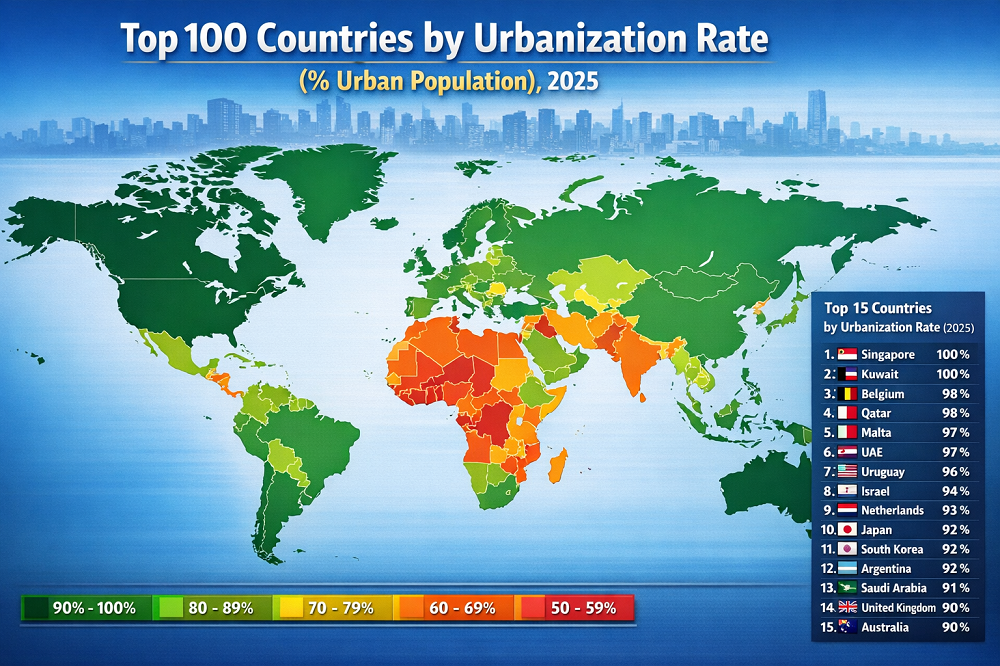
Private market forecasts cluster the global windows-and-doors market at roughly the low- to mid-USD-200-billion range in 2025, while official sources confirm the structural drivers underneath that demand: rising urbanization, tougher building-efficiency rules, and ongoing replacement of inefficient stock.
Top 10 countries at a glance
#1 China
Production signal: 100/100. 2025 outlook: +6.4%.
Dominates scale manufacturing and urban construction demand. China combines scale, supplier depth, domestic demand and export reach, which is why it remains the reference point for the whole industry.
#2 United States
Production signal: 88/100. 2025 outlook: +4.1%.
Large replacement market, strong branded manufacturing, strict efficiency pull. The U.S. stands out because replacement demand and energy-efficiency upgrades create a steadier base than pure new-build cycles.
#3 India
Production signal: 82/100. 2025 outlook: +7.2%.
Fast urban build-out and housing pipeline support rapid capacity growth. India rises because future volume is driven not only by exports but by the country’s own urban expansion and housing backlog.
#4 Germany
Production signal: 74/100. 2025 outlook: +3.6%.
High-value engineering, export strength, retrofit and energy standards. Germany stays high thanks to premium engineering, code-driven retrofit demand and a reputation for high-spec products across Europe.
#5 Japan
Production signal: 71/100. 2025 outlook: +3.2%.
Premium systems, seismic performance, advanced glazing and automation. Japan remains influential because demanding performance standards push higher-value systems, not just large-volume commodity output.
#6 Italy
Production signal: 67/100. 2025 outlook: +3.8%.
Strong design-led fabrication, premium joinery, export orientation. Italy matters because design, bespoke fabrication and premium joinery keep it stronger than raw market size alone would suggest.
#7 Turkey
Production signal: 65/100. 2025 outlook: +5.4%.
Large regional supplier in PVC and aluminium systems. Turkey is one of the clearest examples of a country that combines domestic demand with regional export reach into Europe, MENA and nearby markets.
#8 Poland
Production signal: 63/100. 2025 outlook: +4.9%.
Major EU production base with strong window export footprint. Poland’s role is bigger than many readers expect: it has become a serious European manufacturing base, especially for export-oriented window systems.
#9 Mexico
Production signal: 61/100. 2025 outlook: +4.7%.
North American supply-chain position and cost-competitive manufacturing. Mexico benefits from North American supply chains, cost competitiveness and proximity to a large replacement-heavy U.S. market.
#10 South Korea
Production signal: 59/100. 2025 outlook: +3.7%.
Advanced materials, dense urban market, strong industrial base. South Korea closes the top 10 because it pairs a sophisticated urban construction market with strong industrial and materials capabilities.
Top 10 table
| Rank | Country | Production signal | Why it ranks |
|---|---|---|---|
| 1 | China | 100/100 | Dominates scale manufacturing and urban construction demand. |
| 2 | United States | 88/100 | Large replacement market, strong branded manufacturing, strict efficiency pull. |
| 3 | India | 82/100 | Fast urban build-out and housing pipeline support rapid capacity growth. |
| 4 | Germany | 74/100 | High-value engineering, export strength, retrofit and energy standards. |
| 5 | Japan | 71/100 | Premium systems, seismic performance, advanced glazing and automation. |
| 6 | Italy | 67/100 | Strong design-led fabrication, premium joinery, export orientation. |
| 7 | Turkey | 65/100 | Large regional supplier in PVC and aluminium systems. |
| 8 | Poland | 63/100 | Major EU production base with strong window export footprint. |
| 9 | Mexico | 61/100 | North American supply-chain position and cost-competitive manufacturing. |
| 10 | South Korea | 59/100 | Advanced materials, dense urban market, strong industrial base. |
Production signal is a relative score, not an official national output ledger. It is used here because the category is fragmented across materials and product classes.
Bar chart: top 15 production leaders
Chart fallback: chart library did not load, so the ranking is shown as a text list.
- China — 100/100
- United States — 88/100
- India — 82/100
- Germany — 74/100
- Japan — 71/100
- Italy — 67/100
- Turkey — 65/100
- Poland — 63/100
- Mexico — 61/100
- South Korea — 59/100
- Canada — 56/100
- United Kingdom — 54/100
- France — 52/100
- Spain — 50/100
- Brazil — 49/100
Methodology
The methodology follows a practical rule: use the latest full-year evidence available in 2024 and early 2025 as a proxy for the 2025 production landscape. That means the ranking blends several signal groups instead of pretending there is one official spreadsheet with perfect country coverage. First, it considers manufacturing structure: countries with established window, door, millwork, or metal-frame industries get a stronger base. Second, it considers demand-side support: urbanization, housing build-out, non-residential construction, and above all the replacement/retrofit cycle, which matters enormously in mature markets.
Third, it accounts for product sophistication. Countries that manufacture high-spec insulated systems, curtain-wall-compatible aluminium frames, premium joinery, or code-compliant high-performance products tend to generate more value even when their physical volume is lower than mass-market producers. Fourth, the ranking looks at export relevance and regional supply-chain reach. A country that serves neighboring markets can rank above a country with a similar domestic market but weaker manufacturing depth.
Sources include official and quasi-official references such as U.S. Census industry classifications, World Bank work on building energy efficiency and regulations, UN urbanization projections, and market-structure reports from major research houses used only as directional inputs. Limitations are clear. This is not a customs-only ranking, not a revenue-only ranking, and not a raw unit-output ranking. Profit margins, product mix, informal production, and exchange-rate effects can all change the picture. That is exactly why the article uses a composite production signal instead of fake precision.
What stands out in the 2025 map
The first big pattern is that scale and sophistication are no longer the same thing. China is still the obvious leader because it combines domestic construction, supplier depth, export capability, and the ability to manufacture across almost every price point. But below China, the ranking splits into different models. The United States wins on replacement demand, branded distribution, and energy-upgrade pull. Germany, Italy, and Japan win more on technical specification, premium systems, engineering, and higher value per unit.
The second pattern is the rise of regional manufacturing platforms. Turkey, Poland, and Mexico are not just “big local markets.” They matter because they are efficient supply positions inside larger regional demand systems. Turkey links Europe and the Middle East. Poland feeds a large share of European demand. Mexico gains from proximity to North America and a manufacturing ecosystem that can scale faster than many mature markets.
The third pattern is that growth is shifting toward Asia and selected emerging markets even when the highest-value retrofit work remains concentrated in rich countries. India, Vietnam, Indonesia, Saudi Arabia, Egypt, and Brazil are not yet the highest-value leaders per unit, but they matter because housing growth, infrastructure, and modernization keep pulling more fabrication capacity into the market.
What this means for readers
For a homeowner, developer, importer, or distributor, this ranking matters because it helps explain where price, lead times, and product quality tend to come from. A country near the top usually has one of two advantages: either it can produce huge volumes at competitive cost, or it has a mature high-spec segment with better thermal, acoustic, and durability performance. If you are sourcing products, that difference matters more than the headline “top producer” label.
For investors and market watchers, the ranking shows which countries benefit from retrofit economics. In mature economies, a weak new-build cycle does not automatically crush window and door manufacturing because replacement windows, patio doors, façade upgrades, and code-driven renovations can keep factories busy. In faster-growing economies, the opportunity is different: more volume, more dealer expansion, and more room for low- to mid-price products to move upscale over time.
For readers comparing countries as places to work, produce, or source from, the most useful lesson is simple: the industry follows buildings, energy rules, and logistics. The country with the cheapest nominal labor does not automatically become a production leader. It needs suppliers, installers, distributors, certification habits, and stable demand from housing or commercial construction.
FAQ
Why is China still number one?
Because it combines volume, broad supplier depth, domestic demand, and export capability better than any other country in the field.
Why is the United States so high if its labor costs are higher?
Because the U.S. has a giant replacement market, strong brands, code-driven efficiency upgrades, and a large installed base of homes that need new windows and doors over time.
Why use a composite score instead of dollar output by country?
Because there is no single clean official table for the whole world. The category is split across materials and classifications, so a composite approach is more honest than invented precision.
Does a higher rank mean better quality?
Not automatically. Higher rank usually means stronger overall production position. Quality depends on product segment, specification, certification, and manufacturer capability.
Why are countries like Poland and Turkey so important?
Because they serve larger regional markets and have efficient manufacturing ecosystems, not just domestic demand.
What is driving demand in 2025 the most?
Urbanization, energy-efficiency upgrades, hotter and colder climate stresses, and renovation cycles in mature housing markets.
Is this ranking about windows only?
No. It covers the broader window-and-door manufacturing ecosystem, including residential and commercial products across major frame materials.
Extended country table
Because the industry has no single clean official world ranking, the extended table below keeps the logic simple: a relative production signal, a 2025 outlook rate, and a region tag that lets you compare where capacity is dense, where growth is fastest, and where value is concentrated in retrofit and premium systems rather than raw volume.
| Rank | Country | Production signal | 2025 outlook |
|---|---|---|---|
| 1 | China | 100/100 | +6.4% |
| 2 | United States | 88/100 | +4.1% |
| 3 | India | 82/100 | +7.2% |
| 4 | Germany | 74/100 | +3.6% |
| 5 | Japan | 71/100 | +3.2% |
| 6 | Italy | 67/100 | +3.8% |
| 7 | Turkey | 65/100 | +5.4% |
| 8 | Poland | 63/100 | +4.9% |
| 9 | Mexico | 61/100 | +4.7% |
| 10 | South Korea | 59/100 | +3.7% |
| 11 | Canada | 56/100 | +3.9% |
| 12 | United Kingdom | 54/100 | +2.8% |
| 13 | France | 52/100 | +2.9% |
| 14 | Spain | 50/100 | +3.3% |
| 15 | Brazil | 49/100 | +4.8% |
| 16 | Vietnam | 47/100 | +6.1% |
| 17 | Indonesia | 45/100 | +5.8% |
| 18 | Saudi Arabia | 44/100 | +5.5% |
| 19 | United Arab Emirates | 43/100 | +4.6% |
| 20 | Thailand | 41/100 | +4.2% |
| 21 | Czechia | 39/100 | +3.4% |
| 22 | Romania | 37/100 | +4.5% |
| 23 | Netherlands | 36/100 | +2.7% |
| 24 | Belgium | 35/100 | +2.6% |
| 25 | Austria | 34/100 | +2.8% |
| 26 | Egypt | 33/100 | +5.1% |
| 27 | South Africa | 31/100 | +3.1% |
| 28 | Australia | 30/100 | +2.9% |
| 29 | Malaysia | 29/100 | +4.0% |
| 30 | Singapore | 27/100 | +2.5% |
Showing all 30 countries.
The table is fully written in HTML for indexability. JavaScript is used only for filtering, search, sorting, and chart rendering.
Scatter chart: growth versus production strength
Chart fallback: the plot is replaced with text highlights.
- China sits in the top-right leadership zone: highest scale with solid forward growth.
- India, Vietnam, and Indonesia stand out for faster growth relative to current production position.
- Germany, Italy, Japan, and the UK sit in the mature-value zone: lower growth, high specification, strong installed-base replacement demand.
How to read the extended table
A country with a high production signal but modest growth is usually a mature market: lots of installed stock, strong technical standards, and stable demand from replacements, retrofits, and premium construction. A country with a mid-table production signal but stronger outlook is often earlier in the industrialization or urbanization cycle. That does not make it “better” or “worse”; it tells you what kind of opportunity dominates.
This distinction matters. Mature leaders often deliver tighter tolerances, certified energy performance, and stronger premium branding. Faster-growth challengers often offer more capacity expansion, lower labor cost, newer dealer networks, and wider upside if local building demand keeps rising. In practice, many large buyers split sourcing between the two groups: one set of countries for volume and one set for higher-spec systems.
The table also shows why there is no simple one-size-fits-all answer to the question “who produces the most?” By value, premium fabricators can punch above their physical volume. By units, large domestic markets can lead even when average selling prices are lower. By regional influence, export platforms such as Turkey, Poland, and Mexico can outrank countries with similar home demand but weaker supply-chain positions.
Interpretation, policy signals, and sourcing logic
The 2025 landscape shows that window and door production is no longer a simple function of “who builds the most.” The winning countries combine building demand with regulation, technology, installers, distribution, and material ecosystems. That is why mature economies with slower headline growth still rank highly: they generate stable demand for replacement, thermal upgrades, better glazing packages, air-tightness improvements, acoustic performance, and façade modernization. They may not look explosive on a construction-growth chart, but they remain structurally important to the industry.
How to interpret the ranking correctly
China remains the benchmark because the whole stack is present at scale: upstream materials, machinery, domestic construction, export capacity, and product breadth from entry-level systems to higher-performance lines. The United States is a different kind of leader. Its strength is not only factory scale; it is the economics of replacement. A large installed housing stock and recurring retrofit cycles mean producers can stay relevant even when new housing slows.
Europe is more fragmented but still powerful. Germany, Italy, Poland, Turkey, France, and Spain each occupy different positions in the value chain. Germany and Italy have strong premium, engineering, and performance reputations. Poland is an export platform inside Europe. Turkey is both a domestic market and a bridge supplier into nearby regions. The lesson is that “Europe” should not be read as one market. It is a mix of mature retrofit demand and specialized manufacturing niches.
The fastest strategic upside still sits in parts of Asia, the Middle East, and selected emerging markets. India, Vietnam, Indonesia, Saudi Arabia, Egypt, and Brazil matter because urban growth and modernization continue to pull fabrication capacity higher. These countries may not yet dominate the premium end, but they are central to the next wave of scale expansion.
Policy takeaways
The clearest policy takeaway is that building-energy rules indirectly shape industrial geography. When governments tighten building-envelope standards, support labels and certification, and finance retrofits, they do not only reduce energy use. They also create domestic demand for higher-quality windows and doors. That demand encourages local assembly, fabrication skills, supplier networks, and machinery upgrades. Countries that want to strengthen this industry do not need to start with export slogans. They need predictable building regulation, stable retrofit economics, and installer capability.
A second takeaway is that industrial policy works better when it respects the fragmented nature of the category. Windows and doors are not one simple product. Wood joinery, aluminium systems, PVC profiles, glass packages, hardware, automation, and installation standards each matter. Countries that build industrial capability only in one slice of the chain can still become important regional producers, but the deepest leaders usually control more of the stack.
A third takeaway is resilience. The industry is exposed to construction cycles, materials pricing, freight costs, and labor shortages. Policy stability helps smooth those shocks. Where energy retrofits, public-building upgrades, and code enforcement continue even in weak private cycles, manufacturers have a better chance of keeping lines running and preserving skilled labor.
What buyers, manufacturers, and investors should watch next
The next competitive battlefield is not only who can make a frame cheaply. It is who can deliver better thermal performance, lower air leakage, compliant documentation, reliable installation support, and lead times that work in a choppy logistics environment. In other words, the industry is moving toward a wider definition of value. Commodity production still matters, especially in fast-growing markets, but margin and long-term positioning increasingly sit in performance and service.
Buyers should also watch regionalization. More customers want shorter lead times and lower supply-chain risk, which can favor Mexico in North America, Poland and Turkey in Europe and neighboring markets, and Southeast Asian producers inside Asian supply networks. That does not eliminate China’s leadership, but it does create room for secondary hubs to gain share in specific corridors.
Finally, readers should expect the balance between new build and retrofit to remain decisive. When retrofit accelerates, mature economies can keep punching above their weight. When large housing programs accelerate, fast-growth economies move up. The most durable leaders are the countries that can serve both cycles.
Sources
- United Nations DESA — urbanization outlook
- World Bank — global landscape of building energy regulations
- U.S. Census / NAICS — wood window and door manufacturing
- U.S. Census / NAICS structure — metal window and door manufacturing
- Natural Resources Canada — ENERGY STAR windows, doors, and skylights labeling
- MarketsandMarkets — global doors and windows market outlook
- Research and Markets — windows and doors market estimates
- Fortune Business Insights — global windows and doors market forecast
Official sources are used mainly to anchor structural demand drivers and industry classification. Private market reports are used directionally to triangulate the broad size and trajectory of the sector, not as a one-to-one country output ledger.