Top 50 U.S. States by Goods Exports (Value)
Where U.S. goods exports are concentrated across the 50 states
This snapshot ranks U.S. states by the annual value of goods exports (not services) using the Census Bureau’s origin-of-movement series. “Origin” reflects where the shipment begins its export journey, which can differ from where a product was manufactured (especially for agricultural, mineral, and other non-manufactured commodities that often move through port states). The result is a practical map of export logistics and shipping hubs as much as a map of production.
U.S. total goods exports (2024, Census basis)
$2,065.2B
Top-state shares below are computed against this national total.
Concentration (Top 5 states)
—
A quick read on how “top-heavy” U.S. goods exports are in a given year.
Fastest growth (YoY, among states)
—
YoY compares 2024 vs 2023 using the same exhibit series.
A few patterns typically drive the ranking: large energy and petrochemical flows in the Gulf; high-value manufacturing corridors in the Midwest; and tech/aerospace export clusters on the West Coast. However, because the series is origin-of-movement, port and distribution effects matter—especially for non-manufactured goods whose recorded “origin” often tracks the state of the export port rather than the producing state.
- Texas leads by a wide margin, reflecting the scale of its industrial base, energy complex, and export gateways.
- California anchors the West Coast export system, with strength in advanced manufacturing and high-value goods.
- New York and Louisiana illustrate how financial/logistics hubs and energy/industrial corridors can both rank highly for different reasons.
- The middle of the Top 20 is often separated by relatively small differences, so YoY changes can reshuffle ranks.
Top 10 states by goods exports value (2024)
Values are shown in USD billions. The “Share of U.S.” and “YoY” fields are computed from the official exhibits (2024 vs 2023).
Texas
California
New York
Louisiana
Illinois
Florida
Michigan
Indiana
Washington
Ohio
| Rank | State | Exports ($B) | Share & YoY |
|---|---|---|---|
| 1 | Texas | $455.0 |
Share: —
YoY: —
|
| 2 | California | $183.3 |
Share: —
YoY: —
|
| 3 | New York | $91.2 |
Share: —
YoY: —
|
| 4 | Louisiana | $87.0 |
Share: —
YoY: —
|
| 5 | Illinois | $80.8 |
Share: —
YoY: —
|
| 6 | Florida | $72.2 |
Share: —
YoY: —
|
| 7 | Michigan | $61.6 |
Share: —
YoY: —
|
| 8 | Indiana | $59.9 |
Share: —
YoY: —
|
| 9 | Washington | $57.8 |
Share: —
YoY: —
|
| 10 | Ohio | $56.6 |
Share: —
YoY: —
|
Data note: “Origin of movement” is shipment-based. For certain non-manufactured commodities, recorded origin often reflects the state where the export port is located.
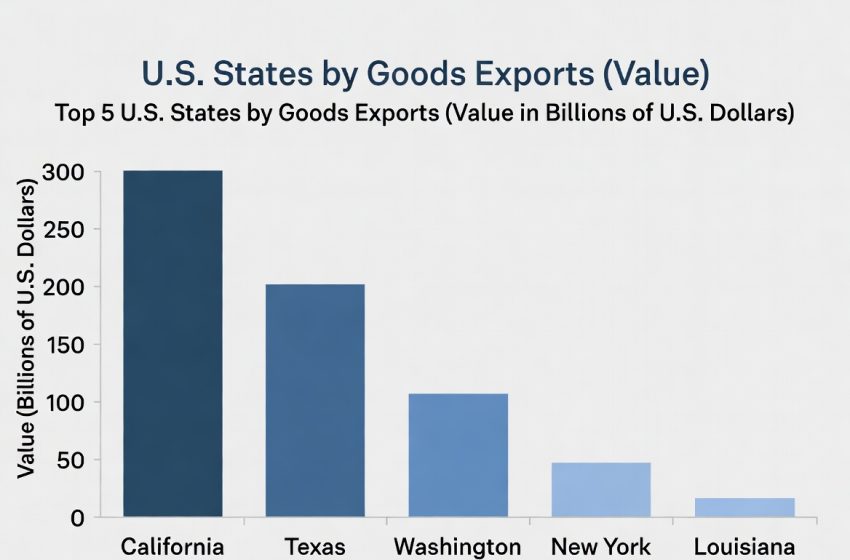
Top 20 states — goods exports value (2024)
The chart ranks states by total goods exports. Hover to see exact values, share of U.S., and YoY.
Methodology (what this ranking measures)
The ranking uses the U.S. Census Bureau’s state export exhibit based on origin of movement, reported on a Census basis and not seasonally adjusted. Values are annual totals for the calendar year shown, expressed in dollars. This method assigns exports to a state based on where the shipment begins its export movement (for example, where it is consolidated and entered into the export pipeline), which may differ from the state of production. That distinction matters most for complex supply chains and for non-manufactured goods—where the “origin” can align with the port of export rather than the producer’s location. Foreign Trade Zone (FTZ) shipments are included in the U.S. total and distributed among states in the exhibit.
“Latest year” here means the latest full-year state exhibit available at publication time. If the next annual release is delayed, the most recent completed year remains the correct snapshot for a clean, comparable Top 50 table.
Insights that help interpret the leaderboard
State export value is not just “how much the state produces.” It also reflects how goods move—through industrial clusters, distribution networks, and ports. That is why the ranking often shows three overlapping realities:
- Energy and bulk commodities shape the top: Gulf states can rank high when energy, refined products, and chemicals are strong, and when export gateways are busy.
- Manufacturing corridors create steady depth: The Midwest tends to show a broad middle-to-upper tier driven by autos, machinery, and industrial supply chains.
- High-value clusters punch above their weight: Tech, aerospace, and specialized manufacturing can lift a state’s export value even without the largest population.
- YoY swings can be structural or compositional: A large YoY jump can come from a genuine output surge, a commodity price move, or a shift in shipping patterns.
If you are using the ranking to understand “economic strength,” pair it with complementary indicators such as manufacturing output, port throughput, and sector composition. Export value is a powerful signal, but it is only one angle.
What this means for readers
For business readers, the Top 50 table is a quick way to see where the U.S. export ecosystem is most concentrated and where logistics advantages are likely to be strongest. For job seekers and students, export-heavy states often correlate with deeper networks in manufacturing, logistics, engineering, trade compliance, and supply-chain management. For local decision-makers, the ranking helps benchmark whether export growth is broad-based or driven by a narrow set of commodities and shipping channels.
The most practical use is comparative: look at your state’s rank, its share of the U.S., and its YoY change together. A state can remain high-ranked yet show a negative YoY if a major sector cools; another state can jump ranks quickly if a fast-growing industry scales or if export routing shifts.
FAQ: understanding state goods export rankings
Does this measure goods exports or services exports?
What does “origin of movement” mean in plain English?
Why can port states look especially strong for some commodities?
Why does Texas lead by so much?
Are the numbers “real” dollars or inflation-adjusted?
Can a state’s rank change a lot from one year to the next?
How should I use this ranking responsibly?
Full Top 50 table (all states) — interactive view
Use search and filters to narrow the table. “Exports” toggles between USD billions and share of U.S. total. “YoY” compares 2024 vs 2023. All 50 rows are present in the HTML source; tools only hide, sort, and compute derived fields.
| Rank | State | Exports | YoY |
|---|---|---|---|
| 1 | Texas | $455.0B 22.03% | +2.3% |
| 2 | California | $183.3B8.88% | +2.6% |
| 3 | New York | $91.2B4.42% | −6.7% |
| 4 | Louisiana | $87.0B4.21% | −13.2% |
| 5 | Illinois | $80.8B3.91% | +2.7% |
| 6 | Florida | $72.2B3.49% | +4.7% |
| 7 | Michigan | $61.6B2.98% | −5.1% |
| 8 | Indiana | $59.9B2.90% | +6.8% |
| 9 | Washington | $57.8B2.80% | −5.6% |
| 10 | Ohio | $56.6B2.74% | +1.5% |
| 11 | Pennsylvania | $53.2B2.57% | +0.6% |
| 12 | Georgia | $53.1B2.57% | +6.8% |
| 13 | Kentucky | $47.8B2.31% | +18.8% |
| 14 | New Jersey | $42.9B2.08% | −0.9% |
| 15 | North Carolina | $42.8B2.07% | +1.4% |
| 16 | Tennessee | $38.9B1.89% | +2.2% |
| 17 | South Carolina | $38.0B1.84% | +2.0% |
| 18 | Massachusetts | $34.9B1.69% | −1.0% |
| 19 | Oregon | $34.1B1.65% | +22.9% |
| 20 | Arizona | $32.2B1.56% | +11.9% |
| 21 | Wisconsin | $27.5B1.33% | −1.8% |
| 22 | Alabama | $26.8B1.30% | −2.2% |
| 23 | Minnesota | $26.6B1.29% | +6.6% |
| 24 | Virginia | $21.8B1.05% | −2.7% |
| 25 | Missouri | $19.4B0.94% | +8.6% |
| 26 | Utah | $18.2B0.88% | +4.7% |
| 27 | Maryland | $17.9B0.86% | −2.7% |
| 28 | Connecticut | $17.4B0.84% | +9.8% |
| 29 | Iowa | $17.0B0.82% | −7.9% |
| 30 | Mississippi | $13.7B0.66% | −4.3% |
| 31 | Kansas | $14.4B0.70% | +1.5% |
| 32 | New Mexico | $12.0B0.58% | +142.9% |
| 33 | Colorado | $10.5B0.51% | +1.2% |
| 34 | Nevada | $10.4B0.50% | +8.7% |
| 35 | Nebraska | $8.2B0.40% | +2.2% |
| 36 | Oklahoma | $7.7B0.38% | +19.0% |
| 37 | New Hampshire | $7.1B0.34% | −6.8% |
| 38 | Arkansas | $6.9B0.33% | +6.9% |
| 39 | Alaska | $5.9B0.29% | +13.1% |
| 40 | North Dakota | $5.5B0.27% | −26.4% |
| 41 | West Virginia | $4.9B0.24% | −14.1% |
| 42 | Delaware | $4.7B0.23% | −4.4% |
| 43 | Idaho | $4.2B0.21% | +5.9% |
| 44 | Rhode Island | $3.1B0.15% | +2.0% |
| 45 | Maine | $3.1B0.15% | +3.8% |
| 46 | Montana | $2.4B0.11% | +6.3% |
| 47 | South Dakota | $2.1B0.10% | −12.0% |
| 48 | Wyoming | $2.1B0.10% | −3.5% |
| 49 | Vermont | $1.9B0.09% | −6.3% |
| 50 | Hawaii | $0.5B0.02% | −19.2% |
Source year: 2024 annual totals (latest full-year exhibit in this snapshot). YoY uses 2023 annual totals. Units are shown in USD billions; shares are computed against the U.S. total.
Scatter: exports level vs YoY change
Each point is a state. Rightward means higher export value; upward means faster year-over-year growth. This helps separate “big exporters” from “fast risers.”
Interpretation: what “export-heavy” states usually have in common
A Top 50 state export ranking is easiest to interpret when you separate what is produced from how it is shipped. In an origin-of-movement series, both forces matter—and they often reinforce each other.
1) Scale matters, but composition matters more. Large states have more firms, more output, and more logistics capacity, so they often place high. But export value is highly sensitive to what a state specializes in: energy and chemicals, transportation equipment, advanced machinery, and high-value electronics can raise exports per worker and per shipment.
2) The ranking is partly a map of gateways. When exports are recorded by origin of movement, the state where goods enter the export pipeline can dominate the attribution. That is why some port and distribution states can look stronger than production-only narratives would suggest, especially for non-manufactured goods. Interpreting the table responsibly means reading it as both a trade activity measure and a shipment geography measure.
3) YoY helps distinguish “steady giants” from “volatile movers.” A state can sit in the Top 10 for years with small YoY changes, which indicates a broad and diversified base. Another state may jump sharply due to a sector cycle, a large one-off delivery, or a change in export routing. YoY is a signal to ask “what changed?” rather than to assume a permanent shift.
4) Mid-table ranks are closer than they look. In the middle of the Top 50, a few billion dollars can separate several states. A modest rise in a single export-heavy industry can move a state multiple positions without a dramatic macro story.
Policy takeaways (practical, non-partisan)
Export performance is often treated as a headline metric, but it is usually the downstream outcome of many smaller choices—workforce, infrastructure, reliability, and the day-to-day friction of moving goods across borders. Policy takeaways that follow directly from the mechanics of exports include:
- Trade infrastructure reliability is a growth strategy. When gateways, rail, and highways are reliable, exporters can commit to tighter delivery windows and larger contracts.
- Workforce pipelines compound over time. Exporting industries depend on technical skills, compliance knowledge, and supply-chain competence; small training improvements can yield persistent gains.
- Permitting and industrial services affect competitiveness. For energy, chemicals, and advanced manufacturing, predictable timelines reduce cost and support long-run capacity planning.
- Diversification reduces volatility. States with multiple export pillars tend to be less sensitive to one market cycle, showing steadier YoY paths.
- Measurement matters for decision-making. Use origin-of-movement to understand shipping and trade activity; pair with production and industry data when the question is “where is it made?”
How readers can use this table
If you are evaluating a state’s economic profile, start with three checks: (a) is the state’s share of U.S. exports rising or falling (YoY)? (b) is the state’s export value large because of a few mega-sectors or because of broad industrial depth? (c) is the state acting as a gateway for shipments that originate elsewhere?
For businesses, the practical next step is to look for fit: a state with high exports and strong YoY may offer expanding supplier networks, experienced freight forwarders, and deeper compliance support. For workforce planning, export-heavy states often imply more demand for operations, manufacturing, quality, logistics, and trade-related roles. For local governments and planners, the table is a benchmark: if a peer state is pulling away, the driver is usually not one “magic” policy but the accumulation of many reliability improvements across the export pipeline.